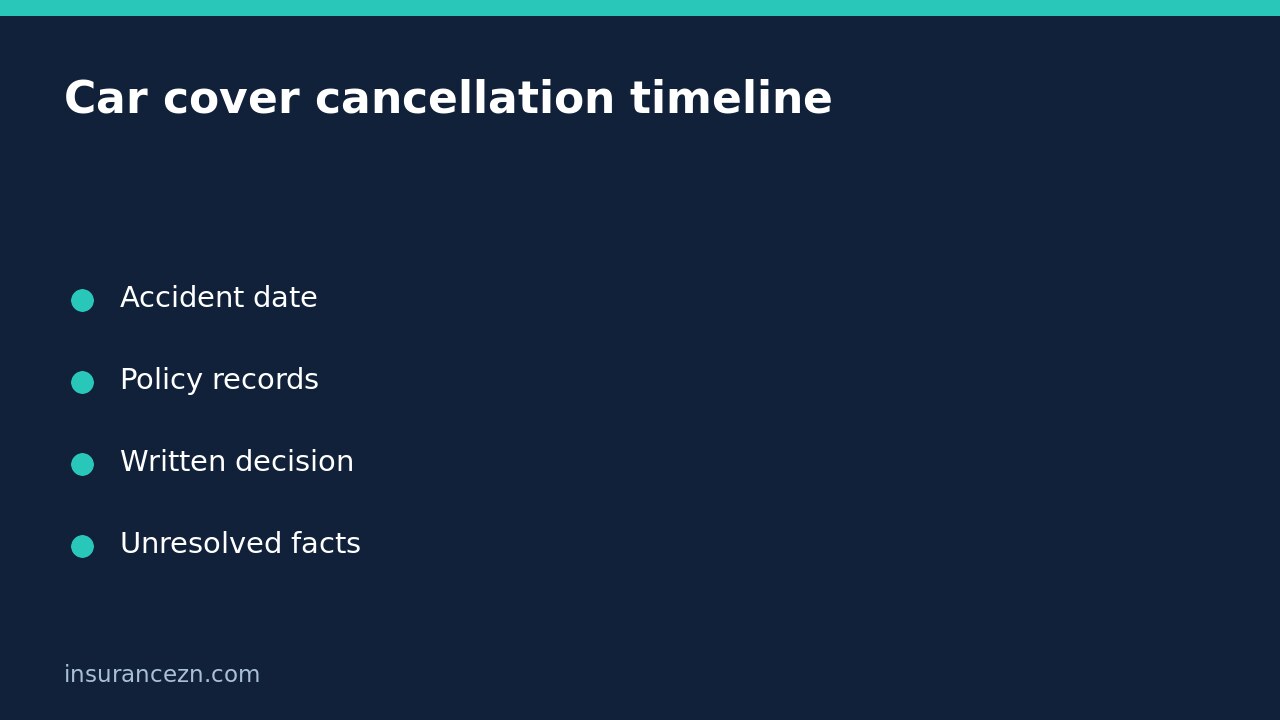

If your car insurer says your policy was cancelled before an accident, start by matching the accident time to the policy records and the cancellation relied on in the refusal. A renewal invitation, an old insurance certificate or a bank payment alone does not resolve whether the relevant cover was operating at the time of the loss. Ask for a written decision and the records supporting it before drawing conclusions.
This is general information for Australian readers, not personal financial advice or legal advice. Cover depends on the applicable policy, Product Disclosure Statement (PDS), schedule, facts and relevant law. This record-checking workflow cannot determine whether a cancellation was legally effective.
Separate cancellation from other explanations
Legal Aid NSW identifies cancellation before an accident as one possible reason an insurer might refuse a claim. Its guidance also lists other reasons, including a loss outside the policy cover. Those are different issues. Ask whether the insurer is saying there was no policy in force, that the accident falls outside an active policy, or that it still needs information before deciding.
Do not treat a call-centre comment as the complete explanation. Request the decision in writing, including the policy number, relevant cover period, stated cancellation date and the reason relied on. If the decision mentions several grounds, record each separately; resolving a date error may not resolve the remaining grounds.
Build one chronology from original records
Create a simple table with columns for event, date and time, document, and unresolved question. Preserve original emails and attachments rather than relying only on cropped screenshots. Include:
- The policy schedule showing the insured car and period of insurance.
- Any renewal invitation and evidence of whether renewal was accepted.
- The accident date, approximate time and location, identifying any uncertainty.
- Payment requests, bank transactions, refunds and failed-payment messages.
- Cancellation correspondence and any later reinstatement or replacement documents.
- The claim acknowledgement and written refusal.
Use the dates exactly as recorded. If the accident occurred near a cover boundary, ask which time zone and time of day the insurer used. Do not convert an uncertain recollection into a precise timestamp. Keep two similar cars or successive policy numbers in separate rows so a document for another vehicle cannot silently enter the comparison.
Reconcile payments without assuming what they prove
A bank transaction is useful evidence, but its purpose still needs matching to the policy ledger. Ask the insurer to identify the policy, instalment period and allocation for each disputed transaction. A payment might relate to an earlier period, another policy or an amount later refunded. Conversely, a record that appears missing may need investigation rather than an assumption that nothing was paid.
For example, imagine a driver sees a debit near the accident date while the refusal refers to an earlier cancellation. The useful question is not simply whether money left the account. It is what cover, if any, the insurer says that payment purchased, how it was allocated, and whether any later adjustment occurred. This is an illustrative records problem, not a statement that payment automatically creates or restores insurance.
Ask focused questions about the cancellation record
Send a concise request identifying the contradiction. Ask for the cancellation notice relied on, the effective date, the communication method and destination recorded, and any account notes relevant to the disputed sequence. Also ask whether a later reinstatement applied and, if so, its exact effective period. Do not assume every requested document must be provided; seek advice if access becomes an issue.
A useful message is: Please explain how the attached payment and policy documents fit the cancellation date in your decision. Please identify any missing requirement and confirm whether your decision changes. This asks for an explanation without making an unsupported legal conclusion about the validity of the notice.
Keep claim review and other deadlines separate
If the explanation remains unsatisfactory, Legal Aid NSW recommends a written complaint to the insurer’s internal dispute resolution section. Keep the chronology, the disputed finding and the outcome requested together. Ask for current complaint instructions and seek independent advice about applicable time limits. An information request or complaint does not itself establish that another deadline has stopped.
If you also receive a demand from another driver, keep that correspondence moving separately. Our car accident demand-letter handover checklist explains what to assemble. Court papers need urgent attention; waiting for a coverage review is not proof that someone has filed a court response.
Quick questions before closing the file
Does a corrected date guarantee payment? No. Other policy conditions and disputed facts may remain. Does a new policy cover the earlier accident? Do not assume retrospective protection; ask about the specific period in writing. What confirms the review outcome? Obtain the insurer’s written decision, not merely an automated receipt confirming your documents arrived.
Source: Legal Aid NSW: Car accidents insurance. Its NSW legal procedures should not be assumed to apply throughout Australia.