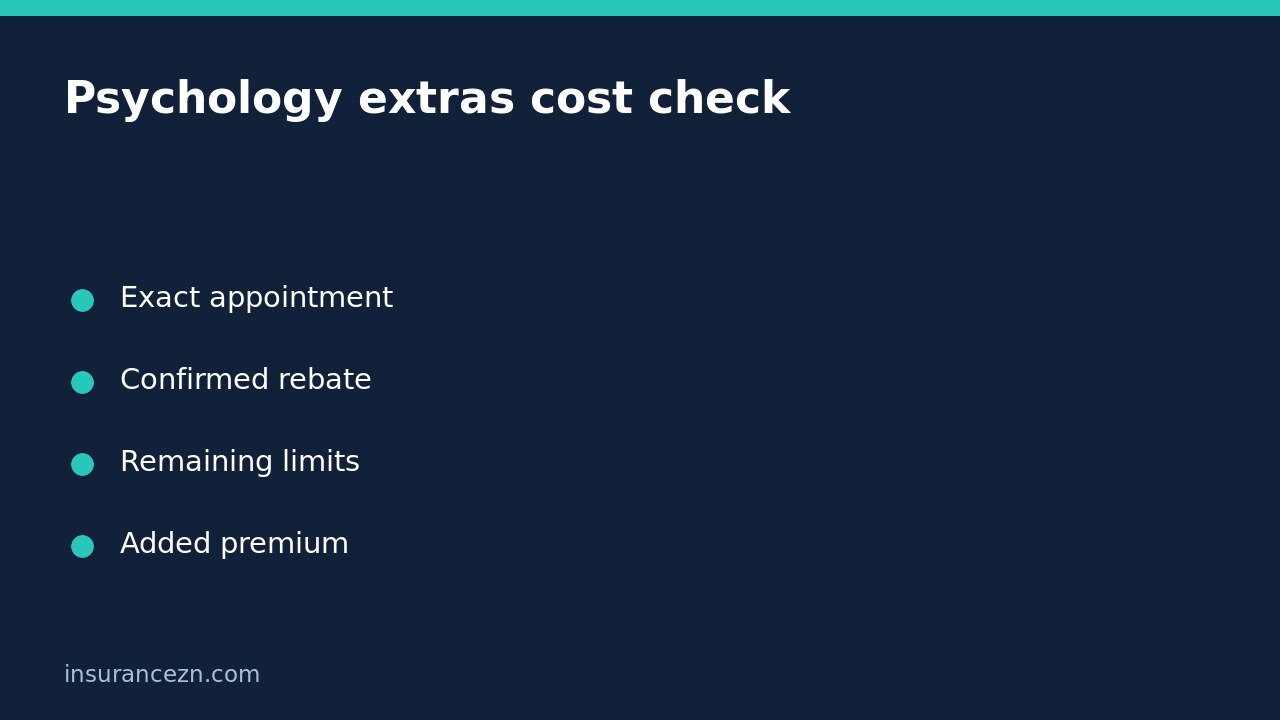

Before paying extra for a health insurance policy advertising psychology benefits, check whether it will pay for the actual appointment you plan to attend. Then compare the insurer-confirmed rebate with the additional premium over the same period. An annual limit is a ceiling under the policy, not cash automatically available to spend and not a promise that every session qualifies.
This is general information for Australian readers, not personal financial advice. Benefits depend on your policy, Product Disclosure Statement (PDS), membership rules, eligibility and the services actually provided. Clinical decisions and timely access to care should take priority over insurance budgeting.
Start with the appointment rather than the marketing label
The Australian Government’s PrivateHealth.gov.au general-treatment guide says some extras policies provide benefits for psychology and directs readers to health insurers for details. It does not establish that every policy includes psychology, every practitioner is recognised or every type of session attracts the same benefit.
Ask the practice for the practitioner’s name, professional details, appointment type, duration, delivery format and quoted fee. Identify whether the booking is an initial assessment, an individual follow-up or another service. A clinic describing its work as counselling or wellbeing does not, by itself, establish the benefit category the insurer will assess.
Send only the information needed through the fund’s approved channel. You should not need to broadcast a detailed clinical history simply to ask how a listed service is classified. If further health information is requested, clarify why it is needed and how to provide it securely.
Get a session-specific benefit estimate
Give the insurer the exact appointment information and your current product name. Ask it to confirm whether the practitioner and service are eligible, the estimated benefit, and any conditions that still need to be satisfied. Repeat the enquiry for the proposed replacement product rather than assuming its higher advertised limit means a higher payment for this appointment.
- Is this practitioner recognised for this service and delivery format?
- Does an initial session have a different benefit from a follow-up?
- Is there a waiting period, and when would it finish for this membership?
- Is the benefit capped by session, person, family or a shared allowance?
- How much of the relevant allowance remains after earlier claims?
- Which service date or other allocation rule determines the benefit year?
These are product-specific questions, not a list of universal restrictions. Keep the estimate and its assumptions. An estimate may change if the billed service or membership circumstances differ, so request a reference and ask what could affect the final assessment.
Keep funding routes separate
If the practice discusses Medicare, a referral arrangement or another funding source, ask it to explain the billing route for your particular booking. Ask the insurer how that route interacts with any proposed extras claim. Do not add two advertised rebates together or assume that two descriptions of assistance can both be used for the same service.
This worksheet does not determine Medicare eligibility or referral requirements. Confirm those questions with the treating practice and the relevant official service. Likewise, hospital psychiatric cover and an outpatient psychology extras benefit are not interchangeable labels; ask which policy component actually addresses the intended appointment.
Compare additional costs over a realistic period
Choose a comparison period that includes the premiums you would actually pay and the appointments you reasonably expect, based on clinical advice. Record the current premium, proposed premium, any separately charged extras component, and the benefit estimates under each option. If switching bundled products, note other cover changes instead of attributing the whole price difference to psychology.
A practical worksheet has one line per planned eligible session: quoted fee, estimated rebate under the current option, estimated rebate under the proposed option, and resulting patient payment. Apply the confirmed remaining limits and waiting-period dates before adding the lines. Do not multiply an advertised maximum by every appointment if that would exceed a shared or annual cap.
Compare the increase in expected rebates with the increase in premiums. Keep unconfirmed benefits outside the total or clearly label them as unresolved. A session that cannot receive a benefit during a waiting period should not appear as a guaranteed saving. Avoid assuming extra appointments merely to make the policy look economical; care frequency is a clinical matter.
Recheck when the booking changes
If the clinic substitutes a practitioner, changes appointment format or recommends another service, confirm eligibility again. Approval for one psychologist’s individual session is not confirmation for every service at the same clinic. Never ask a provider to relabel an appointment to obtain a benefit that does not match what was delivered.
For a reusable itemised comparison method, see our dental extras premium worksheet. Its budgeting approach can help organise costs, but dental eligibility and benefits do not establish psychology cover.
Brief decision checklist
Does the annual limit show what I will save? No; use eligible, expected session benefits after applicable limits. Does a clinic saying it accepts health funds confirm my rebate? No; obtain membership-specific confirmation. Should I delay needed care until a benefit starts? Do not let this financial worksheet replace clinical advice. Discuss timing and affordable care options with the treating team.
Source: PrivateHealth.gov.au: General Treatments, including its psychology entry. The official overview supports checking with your fund; it is not an individual benefit approval.