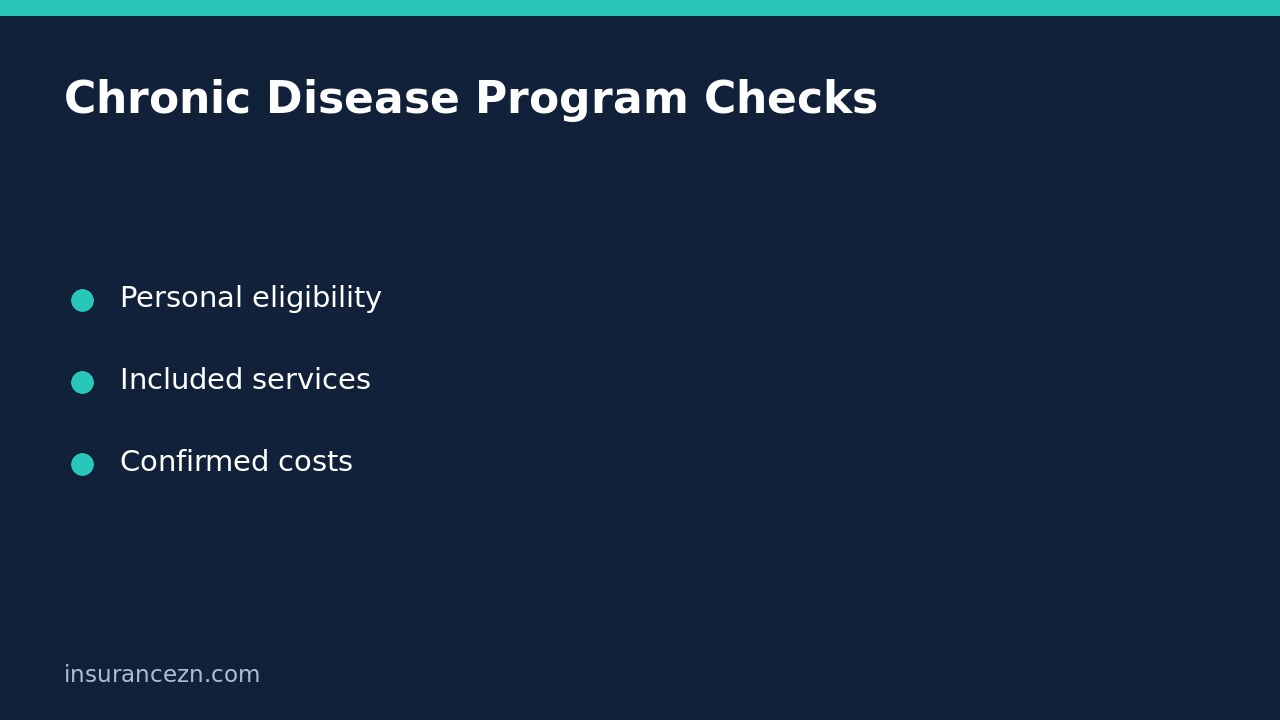

When comparing Australian health insurance, do not count a chronic disease management program as a saving until the fund confirms that you can join and explains what it will actually provide. A program advertised on a website is not necessarily available under every policy, in every location or for every clinical situation.
This is general information for Australian readers, not personal financial advice. Cover depends on the policy, Product Disclosure Statement (PDS) where applicable, fund rules and your circumstances. Clinical decisions belong with your treating team; do not postpone necessary care while comparing insurance.
Understand what the government overview establishes
PrivateHealth.gov.au’s explanation of private health cover says insurers can offer programs to manage or prevent chronic disease under broader health cover. It gives cardiovascular health, risk factors for chronic disease, and diabetes management or education as examples. It also says insurers are not required to offer these services and participation may depend on cover level and eligibility criteria.
That supports asking about programs, not assuming a particular fund owes you coaching, equipment or appointments. It also distinguishes chronic disease programs from hospital-substitute treatment. An offer of health coaching is not, by itself, approval for home nursing or a replacement for hospital treatment.
Ask for an eligibility decision about your situation
Start with your clinician’s description of the support being considered, without sending unnecessary medical information to multiple sales teams. Ask each shortlisted fund which information it needs, how it should be supplied securely and whether your proposed policy permits access to the relevant program.
- Is this exact program available to someone joining the quoted product?
- Are there clinical, location, age or membership requirements?
- Does a clinician need to refer you, and does the fund need to assess that referral?
- Are there waiting periods, capacity constraints or a separate enrolment process?
- What remains unconfirmed before participation can begin?
Record the response date and reference number. A referral sent to a program administrator is evidence of a request, not proof that enrolment has been accepted. If a decision is conditional, keep the condition visible in your comparison rather than recording the program as immediately available.
Compare the actual service, not its promotional name
Ask for a written description of the support offered. Clarify whether it consists of telephone coaching, video sessions, in-person appointments, educational material or another service. Ask about duration, appointment frequency, provider qualifications and arrangements if the service ends or your clinical needs change.
Do not assume that access includes a blood pressure monitor, glucose monitoring supplies, gym fees or every appointment recommended by your clinician. List each proposed item separately and ask whether it is included, assessed under another benefit, or paid entirely by you. A program enrolment does not establish a device benefit.
Similarly, ask whether appointments consume an extras allowance, involve a patient contribution, or are funded through a separate arrangement. If dietitian appointments are part of the proposed support, compare their actual billing and eligibility rather than counting both a program benefit and a full extras rebate for the same service. Our dietitian extras comparison checklist explains the appointment-level questions.
Build a comparison without inventing a cash value
Use three columns: current policy, alternative policy and unresolved questions. Record the premium over the same comparison period, confirmed patient charges, accepted services and any transition costs. Keep hospital and extras benefits you still need in the comparison; a useful program is not a substitute for suitable underlying cover.
For example, imagine one fund offers an apparently convenient coaching service, while another has no comparable program. Do not assign a fictional retail price to the coaching and subtract it from the premium. First establish whether you qualify, would use it, and would otherwise purchase equivalent support. Convenience can matter without being a measurable cash saving.
Where actual costs are confirmed, compare the premiums plus the amounts you would personally pay for the same realistic care plan. Mark uncertain benefits as uncertain rather than treating them as zero-cost care. Ask how switching or cancelling affects an existing program before changing memberships.
Final questions before switching
Does a website invitation guarantee access? No. Seek the product-specific eligibility requirements and a personal enrolment outcome.
Does joining guarantee an improvement in health? No particular clinical outcome should be assumed. Discuss whether the support fits your needs with your treating clinician.
What should I keep? Retain the policy quote, applicable rules, eligibility response, enrolment confirmation, service description and patient-cost estimate. Recheck them if the policy, provider or planned services change. Compare confirmed access and real expenses, not an attractive program label.