
When buying travel insurance for an overseas trip from Australia, do not copy only your hotel check-in and check-out dates into the quote. Overnight flights and time-zone changes can leave travel on calendar dates outside that hotel stay. Build a whole-journey date record, then ask the insurer which dates and time boundaries the proposed policy must show.
This is general information for Australian readers, not personal financial advice. Cover depends on the policy, Product Disclosure Statement (PDS), schedule, definitions, exclusions and any accepted amendments. Correct dates are necessary administration, not a guarantee that every event during the trip is covered.
Start with travel dates, not accommodation dates
Smartraveller’s travel insurance guidance says insurers usually quote according to how many days you will be away. It also explains that single-trip cover is for a set number of days and that annual multi-trip and credit-card policies can restrict each trip’s length. That makes the full itinerary a useful starting point before comparing prices.
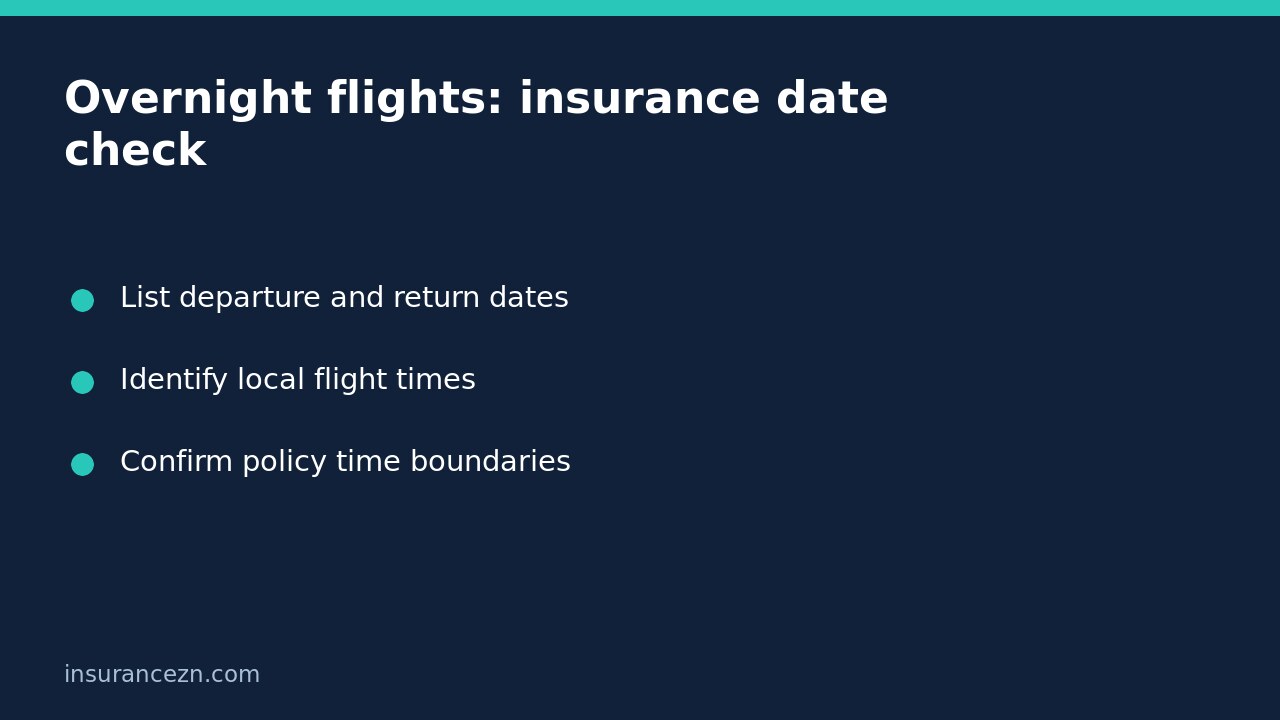
List when you expect to leave home, depart Australia, arrive overseas, leave the final overseas destination, arrive back in Australia and return home. Keep those events separate. Whether a contract starts or finishes at any particular event depends on its wording; there is no universal time boundary you can safely infer from a booking receipt.
Include domestic connections and an overnight airport hotel where relevant. This does not establish that those components are covered. It identifies the parts of the journey the insurer needs to consider.
Preserve local dates and time zones on the itinerary
Flight bookings generally show local airport times. Keep the local date attached to each arrival and departure rather than treating the itinerary as one continuous clock. If a booking displays a next-day marker, expand it into the actual arrival date in your record. If you are unsure what a marker means, check the airline’s booking explanation or ask the airline.
For a hypothetical example, a traveller might check out of the final hotel on a Monday, board an overnight flight that evening and arrive in Australia on Tuesday. A quote ending on Monday deserves review because the planned journey continues into Tuesday. This example does not say an insurer will automatically cover the arrival day or prescribe which time zone its policy uses.
- Record the date and local time printed for each flight segment.
- Flag overnight flights, date-change markers and long connections.
- Keep the airline itinerary as evidence rather than relying on a handwritten summary alone.
- Resolve unclear airport dates before requesting a final quote.
Ask the insurer to explain the contract’s boundaries
Send the complete itinerary through an ordinary sales or policy-enquiry channel. Ask what start and end dates to enter for that route and where the PDS defines the start and finish of the journey. Ask which time zone governs any specified deadline or end time. Do not assume an end date means midnight in your destination, midnight in Australia or the moment your flight lands.
Also distinguish pre-departure cancellation benefits from benefits during travel. Ask when each relevant benefit begins under the proposed contract; entering the departure date does not by itself explain when cancellation protection starts. Buying a policy does not create retroactive protection for an event that has already happened.
If using annual or card-linked cover, check trip-length conditions and activation separately. A correct flight-date record cannot resolve a maximum-trip-duration restriction or an unmet activation requirement.
Compare the final schedule with the accepted quote
Before relying on the purchase, compare the issued documents with your itinerary record. Check insured travellers, destinations, start and end dates, and any written explanation about the overnight return. If something is wrong, request a correction promptly and obtain the processed schedule or other contractual confirmation. A sent enquiry is not proof that a correction has taken effect.
Geographical scope is a separate question from time boundaries. Use the transit-country insurance checklist to review every connection without assuming that correctly entered dates make all countries eligible.
Quick questions before you buy
Should I automatically add a spare day? Do not substitute a guess for the insurer’s date-entry instructions. Ask how the actual itinerary fits the wording, then consider any optional longer period using a clear quote.
Does an airline change update my insurance? Not automatically. Compare the revised itinerary with your documents and ask whether an accepted amendment is required. Do not assume delays or extensions have universal protection.
What should I save? Keep the itinerary version used for the quote, issued schedule, PDS and written date clarification. The practical goal is a documented match between the journey you disclosed and the period the insurer actually accepted.