
If you are travelling overseas to run a marathon, compare insurance using the exact organised event rather than a general reference to running. An insurer may distinguish activities by their definitions and conditions. Race registration, permission to participate and an insurance quote are not confirmation that your participation and related losses are covered.
This is general information for Australian readers, not personal financial advice. Cover depends on the policy, PDS, exclusions, limits, excesses and any accepted conditions. Ask the insurer to assess your actual plans before relying on a benefit; this article does not establish that any particular race is insurable.
Describe the event in a way an insurer can assess
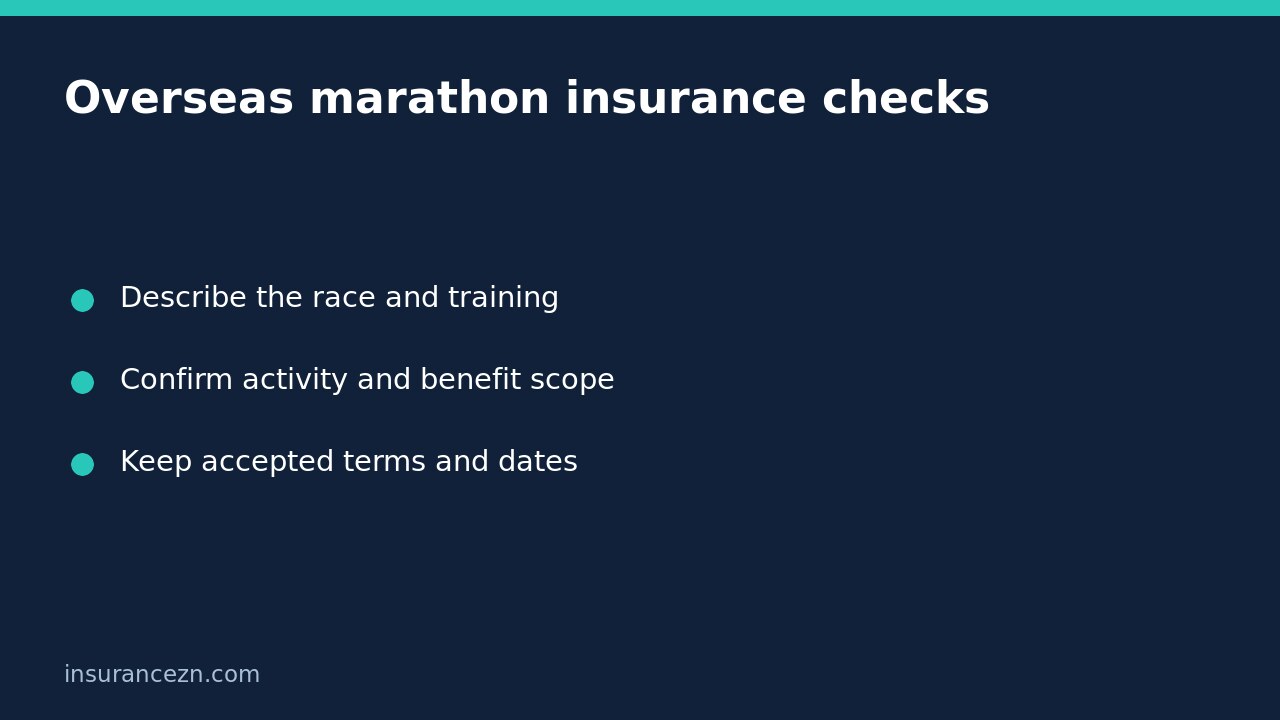
Prepare a short factual description: the event name, destination, date, distance, road or trail setting, whether it is timed or competitive, and your role. Mention planned training runs and other activities during the trip. Tell the insurer if the event includes unusual terrain, altitude or stages, rather than assuming the word marathon communicates everything relevant.
If you are unsure whether a policy definition treats your participation as organised competition, ask directly. Do not describe a registered race as a casual jog to fit a list of included activities. Equally, do not assume that being an amateur automatically excludes you or automatically makes you eligible. The applicable wording and accepted facts matter.
Smartraveller’s sports and adventure guidance tells travellers to check activity definitions, disclose planned activities and understand conditions. It specifically warns against assuming that cover for one activity extends to a similar activity. That is the checking principle here, not evidence of a universal marathon exclusion.
Separate medical cover from entry fees and trip costs
Ask the insurer to explain the consequences of its activity decision for different benefits. A statement about emergency medical expenses is not necessarily an answer about race-entry refunds, cancellation or damaged equipment. Similarly, a policy with cancellation cover does not promise reimbursement whenever a runner decides not to start.
- Medical treatment: Ask about eligible treatment after an incident during the race or training, relevant exclusions and assistance requirements.
- Evacuation or rescue: Check the actual location and circumstances, particularly for remote events, instead of equating ordinary ambulance services with every rescue expense.
- Cancellation: Identify which insured events could affect prepaid travel and whether the race-entry fee is an eligible cost.
- Equipment: Check any relevant belongings limits and exclusions separately from medical benefits.
Read the organiser’s entry-transfer and refund terms as a separate contract. An organiser refusing a refund does not establish an insured loss. Keep evidence of amounts that remain unrecoverable after any supplier refunds or credits, without assuming the insurer will pay the balance.
Compare two quotes using the same race description
Imagine a hypothetical traveller planning a city road marathon, several training runs and a short holiday afterwards. They obtain one cheaper quote that mentions recreational running and another quote after sending the full race description. Those prices are not meaningfully comparable until the first insurer confirms whether the same participation is accepted.
Use the same destination, journey dates, participant details, medical disclosures and requested benefits for both enquiries. Ask whether any additional option is required and what it actually changes. An add-on name alone does not prove acceptance of every event or remove unrelated exclusions.
Smartraveller’s travel insurance guidance recommends reading the PDS for inclusions, exclusions, definitions, claims processes and emergency support. It also advises matching cover to destinations, activities and health rather than choosing on price alone.
Keep a usable confirmation before departure
Request a written response that identifies your description, policy and relevant clauses. If an amendment is necessary, confirm that it was accepted, its effective date and any changed terms. Sending an enquiry or paying an extra amount is not, by itself, evidence that every requested change took effect.
Keep the policy documents, accepted event details, assistance contacts and booking records accessible while travelling. If the organiser changes the course or you enter a different event, ask whether that changes the insurance answer. For a mountain race, also read our guide to checking activity altitude against the highest point; it does not establish that hiking cover includes competitive running.
Quick questions before committing money
Does the organiser’s acceptance confirm insurance? No. Sporting eligibility and insurance acceptance are separate decisions.
Does finishing without an injury validate the policy? No. A safe race does not test a claim or prove what an insurer would have paid.
Should I wait for insurance approval before seeking urgent care? Never delay urgent medical help. Use local emergency services when needed and contact the insurer’s assistance service as soon as reasonably possible.