
Switching to a new health insurance plan often feels like a gamble until you realize that the real risk isn’t the premium cost, but the surprise bills waiting in your inbox. The most critical step before signing any new policy is verifying network coverage. Understanding how to find doctors who accept your specific plan ensures you receive care without financial shock. This guide provides a practical framework for navigating provider networks, distinguishing between different types of coverage, and avoiding common pitfalls that lead to out-of-network charges.
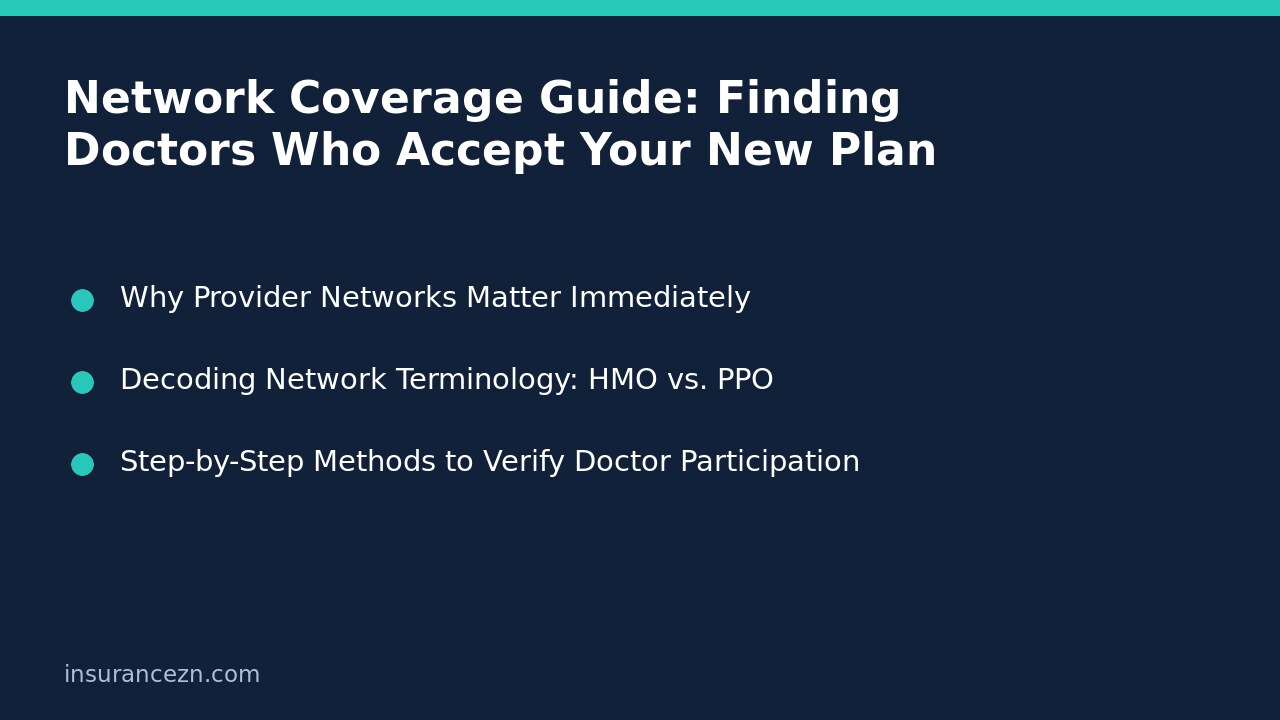
Why Provider Networks Matter Immediately
Health insurance plans operate on the principle of contracted rates with specific providers. When you see a doctor within your network, you pay a negotiated rate, and the insurer covers their portion according to your deductible and coinsurance terms. However, seeing an out-of-network provider triggers a different set of rules that can drastically increase your costs.
The immediate impact of network status is evident in the billing structure. In-network providers agree to cap their charges at a specific amount. Out-of-network providers may charge whatever fee they deem appropriate, submitting the excess as a balance you must pay, even if your policy has “out-of-network” coverage that only pays a percentage of that higher fee. This discrepancy is the primary driver of medical debt for many Americans. Therefore, your first action upon receiving a new plan document should be identifying which local specialists and primary care physicians fall within the approved list.
Decoding Network Terminology: HMO vs. PPO
Before searching for names, you must understand the network architecture of your specific plan type, as this dictates how you find doctors.
Health Maintenance Organizations (HMOs) typically require you to select a Primary Care Physician (PCP) who acts as a gatekeeper. You can generally only see specialists within the HMO’s network without facing massive penalties. If an HMO plan requires referrals for specialist visits, your new PCP must be in-network to facilitate that referral. Finding a doctor outside this closed system usually means paying 100% of the bill unless it is a true emergency.
Preferred Provider Organizations (PPOs) offer more flexibility. They maintain a “preferred” network but allow you to see out-of-network doctors, though at a significantly higher cost-sharing rate. With a PPO, finding a new doctor involves checking two lists: the preferred list for maximum coverage and the non-preferred or out-of-network list if your current doctor refuses to join the preferred panel.
Step-by-Step Methods to Verify Doctor Participation
Relying on memory or old patient portals is risky; networks change annually. Here are the most reliable methods to verify a doctor’s status with your new plan.
1. Utilize the Insurer’s Official Provider Search Tool
Every major insurance carrier maintains an online provider directory. While these tools can be clunky, they are the most direct source of truth. Navigate to the “Find a Doctor” section of your insurer’s website. Enter the doctor’s name and location. Look specifically for status indicators labeled as “Active,” “In-Network,” or “Participating.” Be wary of listings that say “Out-of-Network” or “Non-Participating.” Note that some directories may list doctors who have left the network but haven’t been updated yet; always cross-reference with a secondary source.
2. Contact the Doctor’s Office Directly
The most effective way to confirm coverage is to call the billing department of the doctor’s office, not just their clinical staff. Ask specifically: “Does your practice accept [Plan Name] as a fully participating in-network provider for the upcoming year?” Avoid asking, “Do you take my insurance?” This phrasing can lead to confusion about whether they are an out-of-network participant who happens to accept the insurer’s assignment of benefits.
3. Request Written Confirmation
If a doctor agrees to be in your network, ask for a letter or email confirmation stating their participation status. Some states mandate that insurers provide this documentation upon request. Keep this record in your medical file. If a dispute arises later regarding whether a specific visit was in-network, this written proof is invaluable.
Common Scenarios and Hidden Traps
Even with due diligence, misunderstandings occur. One frequent scenario involves “closed panels.” During peak enrollment seasons or due to budget cuts, insurance companies may temporarily close their network to new providers. In these cases, a doctor who was in-network last year might not be accepting new patients under that plan. Always confirm current availability when switching plans.
Another hidden trap is the distinction between “participating” and “non-participating.” A “non-participating” provider agrees to accept your insurance but does not have to honor the insurer’s negotiated rates. They can charge their standard fees, and you are responsible for the difference between their charge and what the insurer pays. This is often worse than being completely out-of-network in terms of financial liability.
Real-World Example: The Specialist Switch
Consider a patient named Sarah who recently switched from an HMO to a PPO plan to gain access to specialists without referrals. Her previous cardiologist, Dr. Smith, was in her old HMO network but is not participating in her new PPO’s preferred network.
Sarah discovers that while Dr. Smith will see her under her new policy, he is classified as “out-of-network.” She visits him for a routine check-up costing $200. Her PPO plan pays 40% of the allowed amount, which is lower than Dr. Smith’s actual charge because he isn’t bound by the network rate. Sarah receives a bill for the remaining balance plus her deductible portion. Had she used the insurer’s directory before the appointment, she would have seen that Dr. Smith was not “preferred” and might have sought a different in-network cardiologist to keep costs down.
Checklist for Verifying Your New Plan’s Network
To ensure you maintain control over your healthcare spending, use this checklist during your transition period:
- [ ] Log into the new insurer’s portal and download the current provider directory PDF.
- [ ] Search for your current Primary Care Physician (PCP) and top three specialists.
- [ ] Call each office to confirm they are currently accepting new patients on the specific plan name.
- [ ] Ask the billing office if they are “Participating” or “Non-Participating,” not just “In-Network.”
- [ ] Note the effective date of their participation in your new policy year.
- [ ] Save the contact information for the insurer’s provider relations department for future disputes.
Conclusion: Proactive Verification Saves Money
Finding doctors who accept your new health insurance plan is not a one-time task; it is an ongoing responsibility that evolves as networks change. By understanding the difference between HMO and PPO structures, utilizing official directory tools, and demanding clear verbal and written confirmation from medical offices, you can avoid surprise bills. The effort required to verify network status before scheduling an appointment pays dividends in the form of predictable costs and peace of mind. Always prioritize confirmed network status over convenience when selecting a new care provider.