
Filing an auto insurance claim when you are not responsible for an accident can be a stressful experience, but it does not necessarily mean you have to pay your deductible. In many jurisdictions and under specific policy conditions, the at-fault driver’s insurance company is legally obligated to cover your vehicle repairs, allowing you to file a claim against their liability coverage rather than your own collision coverage. This process preserves your no-claims bonus and keeps your premium from increasing due to a filing on your own record. However, navigating this process requires precise documentation and strict adherence to policy terms to ensure the at-fault party’s insurer accepts responsibility before you settle the bill yourself.
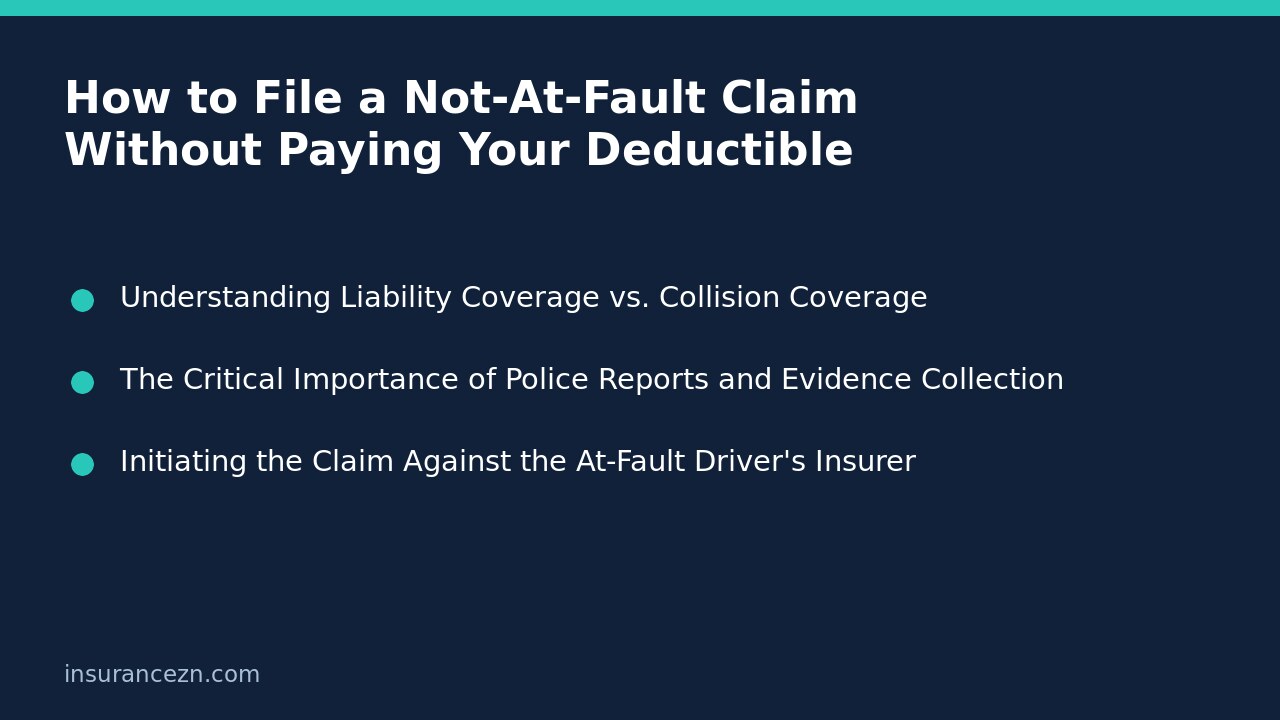
Understanding Liability Coverage vs. Collision Coverage
To successfully avoid paying a deductible in a not-at-fault scenario, it is essential to understand the distinction between the two primary types of coverage involved. Liability coverage is designed to pay for damages and injuries you cause to others when you are at fault. Conversely, collision coverage pays for damage to your own vehicle regardless of who caused the accident; however, this type of coverage almost always requires the policyholder to pay their deductible first.
When you are not at fault, the goal is to bypass your own collision policy entirely and instead make a claim against the at-fault driver’s liability insurance. If the other driver has sufficient liability limits, their insurer should cover the cost of repairs up to those limits without asking you to contribute. If the damages exceed the at-fault driver’s liability limit, your own insurance may step in as “excess” coverage after paying your deductible, but they will typically have the right to seek reimbursement (subrogation) from the at-fault party later.
The Critical Importance of Police Reports and Evidence Collection
The foundation of a successful not-at-fault claim lies in the immediate aftermath of the accident. Insurance adjusters rely heavily on objective data to determine liability, and a police report is often the single most important document in this equation. When law enforcement arrives at the scene, they will interview witnesses, inspect vehicle damage, and review traffic camera footage if available. Their final determination of fault carries significant weight with insurance companies.
If police do not attend the scene, you must gather your own evidence immediately while memories are fresh. Take comprehensive photographs of all vehicles involved, including license plates, specific points of damage, and any visible road hazards like skid marks or debris. Collect contact information from witnesses who saw the incident; their independent accounts can be crucial if the at-fault driver disputes liability later. Do not admit fault at the scene, even if you believe you might have made a minor error, as this statement could be used against you in a liability dispute.
Initiating the Claim Against the At-Fault Driver’s Insurer
Once you have gathered your evidence and obtained the name of the at-fault driver along with their insurance carrier and policy number, you should contact that specific insurance company to file a claim. Do not wait for them to reach out; be proactive. When filing the claim, explicitly state that you are seeking coverage under the at-fault driver’s liability policy and that you wish to avoid using your own collision coverage.
Provide the adjuster with the police report number, copies of your photographs, and witness statements. Be prepared to describe the accident chronologically and clearly. The at-fault insurer will assign an adjuster to review your case. During this phase, they may request a vehicle inspection or ask for repair estimates from shops they approve. It is vital to cooperate fully but remain firm that you are not requesting coverage under your own policy’s deductible clause.
Handling Disputes Over Fault and Liability Limits
Even with strong evidence, the at-fault driver’s insurance company might initially dispute liability or claim that damages exceed their policy limits. This is a common tactic used to reduce payout amounts or shift responsibility back to the insured vehicle owner. If the other driver contests the accident report or admits fault but claims they only have limited coverage, your situation becomes more complex.
In cases where the at-fault driver’s liability limits are insufficient to cover the full repair cost, your own insurer may initially pay the difference after you pay your deductible. However, most policies include a subrogation clause that allows them to recover those costs from the at-fault party once liability is confirmed. To avoid paying out of pocket during this interim, you must ensure your own policy includes “gap insurance” or understand the specific terms regarding subrogation rights in your jurisdiction. If the other driver refuses to cooperate or denies having insurance, you may need to utilize uninsured motorist coverage if you have purchased it, though this often involves a deductible.
The Role of State Laws and Jurisdictional Variations
It is crucial to recognize that auto insurance laws vary significantly by state and country. Some jurisdictions operate under “no-fault” insurance systems, where drivers must rely on their own Personal Injury Protection (PIP) or similar coverage for medical bills regardless of fault, though this rarely applies to vehicle property damage in the same way. In traditional “tort” states, you can sue an at-fault driver for damages exceeding their policy limits, but this is a legal process distinct from a standard insurance claim.
Always verify the specific regulations in your jurisdiction regarding third-party claims. For instance, some states require insurers to handle not-at-fault claims directly without forcing the victim into their own collision coverage first. Conversely, other areas may have strict time limits for reporting accidents or specific forms that must be filed with the Department of Motor Vehicles. Ignoring these local nuances can lead to claim denials or legal complications.
Practical Steps and Checklist for a Smooth Process
To streamline the process and minimize the risk of errors, follow this practical checklist when filing a not-at-fault claim:
1. Secure the Scene: Exchange information with all parties involved and call emergency services if there are injuries.
2. Document Everything: Take photos of damage, license plates, road conditions, and skid marks. Get witness names and phone numbers.
3. Obtain a Police Report: Ensure an officer is called; if not possible, file a report yourself at the local station within the required timeframe (often 24 to 72 hours).
4. Identify the At-Fault Party: Obtain the exact name of their insurance company and policy number from the other driver’s vehicle registration or insurance card.
5. File with the Other Insurer: Contact their claims department directly, provide your evidence package, and request a liability-only payment.
6. Monitor Communication: Keep records of all interactions, including dates, times, and names of representatives spoken to.
7. Review Settlement Offers: Do not accept an initial offer that suggests you pay a deductible unless the alternative is litigation or exceeding policy limits.
Conclusion and Final Considerations
Filing a not-at-fault claim without paying your deductible is entirely possible if the process is handled correctly and the at-fault driver possesses adequate liability coverage. The key lies in shifting the burden of proof to the other party’s insurance carrier immediately after the incident. By collecting robust evidence, securing an official police report, and communicating clearly with the at-fault insurer, you can protect your financial interests and maintain a clean claims history.
However, remember that insurance terms, availability, eligibility, laws, and prices depend heavily on the specific insurer, your policy details, and local jurisdiction rules. Do not assume that every situation will result in zero cost to you; if the at-fault driver is uninsured or underinsured, your own coverage may still be necessary as a safety net. Always read your policy documents carefully to understand your subrogation rights and deductible exceptions. With diligence and proper documentation, most drivers can successfully navigate this path without touching their own pocket money for repairs.