
If you are moving interstate, tell your health insurer and ask what changes for your exact membership before relying on an old quote or treatment estimate. Updating an address is not the same as confirming the cost and eligibility of care in your new location. Keep those tasks separate so an administrative change does not hide an unresolved treatment question.
This is general information for Australian readers, not personal financial advice. Benefits depend on your policy and applicable insurer rules, waiting periods, restrictions and exclusions. Read the policy documents and any relevant PDS; this checklist does not guarantee cover or replace clinical advice.
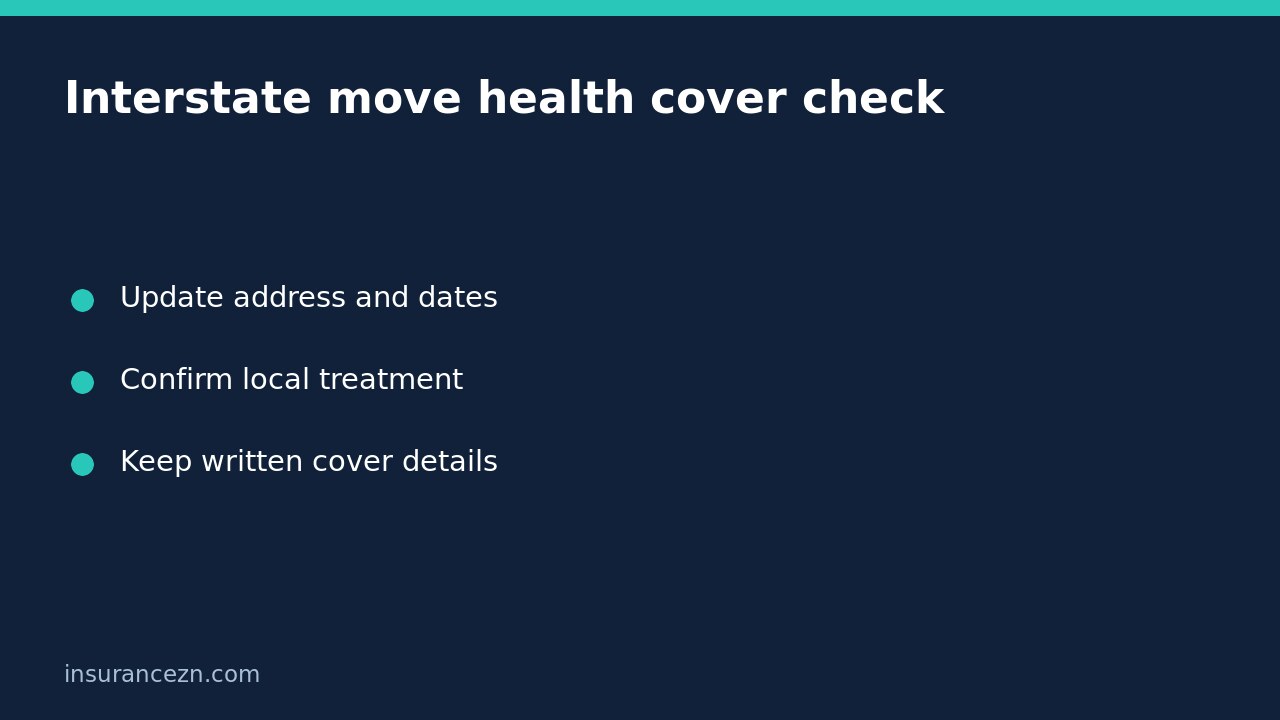
Notify the fund using your actual moving details
The Australian Government’s PrivateHealth.gov.au policy-management guidance says to keep your insurer informed of address and circumstance changes. It specifically notes that moving interstate may affect premiums or benefits. Do not assume either that everything changes or that nothing does.
Give the fund your membership number, new residential address, effective moving date and updated contact details. Distinguish a temporary correspondence address from where you will actually live. If household members are moving on different dates, explain that rather than entering one convenient date for everyone.
Ask which details the fund needs and when the change takes effect. Save its response and check that important notices will reach you while mail is being redirected. Use the insurer’s approved secure channel for membership and health information.
Request a before-and-after membership summary
Ask the insurer to identify any change to your premium, covered people, product name, benefit arrangements or payment schedule. Request the new effective date and written documents. A changed premium alone does not explain whether the treatment you need is included.
- Is the existing product continuing, or is another product being proposed?
- Does the move itself change any benefits under this membership?
- Does a quoted adjustment cover the same household and payment frequency?
- Will an advance payment or direct debit need reconciliation?
- Is any quoted product change optional, and what happens if you keep current cover?
Do not authorise a new product merely to obtain information. A useful instruction is: ‘Please provide a comparison only; I am not authorising a cover change.’ If you later choose a different product, separately confirm new or higher benefits and any waiting periods.
Recheck planned treatment at the new location
Consider a fictional member moving from Adelaide to Brisbane before a booked operation. Their membership may remain active, but a previous estimate for a different hospital and medical team does not establish the bill at the new facility. The practical task is to obtain fresh, matched information, not assume an interstate move automatically cancels protection.
Give the insurer the exact hospital, proposed admission date, treatment description and expected item numbers from the treating practice. Ask about treatment eligibility, relevant restrictions, outstanding waiting periods and applicable excesses or co-payments. Request estimates from the hospital and treating providers separately so medical fees are not confused with accommodation charges.
For the facility check, use the method in checking whether your booked hospital is an agreement hospital. Confirm the actual facility rather than relying on a hospital group’s familiar name. An agreement does not by itself promise that every doctor charges without a gap.
Check routine extras with your new providers
If you claim dental, physiotherapy or other extras, ask the fund about the new provider and the exact service before assuming an old rebate still applies. Obtain an itemised quote where possible. A provider accepting your membership card does not settle every question about benefit eligibility or remaining limits.
Ask whether provider arrangements affect the estimated benefit, what annual allowance remains and which date determines allocation of a claim. Treat these as product-specific questions, not uniform interstate rules. Moving house is not evidence that annual limits reset or earlier claims disappear.
Close the loop after the update
Compare the confirmation with your request. Check the address, dates, people covered, product and payment instructions. If the fund supplies conflicting information, ask it to reconcile the documents before relying on the more favourable answer. Record the enquiry reference and keep relevant written confirmations with treatment estimates.
Check the next bank statement too. A membership update is not proof that a direct debit was taken correctly. If payment fails, contact the fund promptly rather than assuming your move created a payment holiday.
Do I need to switch insurers when moving interstate?
Not automatically. First establish what the current insurer can provide at your new address and what local treatment may cost. If you decide to compare another fund, make transfer continuity and waiting-period credit a separate enquiry before cancelling. Necessary medical care should follow clinical advice; do not delay urgent treatment while completing an insurance checklist.