
Holding private hospital insurance does not establish that every charge from a private emergency department is covered. Separate the emergency visit, any doctors’ services and any later hospital admission. Ask which charges relate to each stage, then confirm what Medicare and your insurer may contribute to those particular charges.
Do not delay emergency treatment to investigate insurance. If the situation is urgent, get appropriate medical help first. Administrative questions can be handled when it is safe, including by a trusted support person where appropriate.
This is general information for Australian readers, not personal financial advice. Entitlements depend on Medicare eligibility, the actual services, your policy terms, relevant PDS or policy documents, exclusions and insurer rules. A billing estimate is not a clinical recommendation or a guarantee of payment.
Why the emergency department and admission are different
The Australian Government’s PrivateHealth.gov.au health-system overview states that Medicare does not cover emergency department administration or facility fees. It also distinguishes private-patient hospital costs from medical services outside hospital. That is a reason to identify the fee, not a reason to assume every charge on the account receives the same treatment.
Being physically inside a hospital building does not by itself explain how each service was billed. Ask the hospital to identify whether and when you became an admitted patient, and which services were provided before that point. A later admission should not be treated as proof that an earlier facility fee automatically becomes an insured inpatient charge.
Likewise, a hospital’s relationship with an insurer does not answer every emergency billing question. An agreement for eligible inpatient treatment may have a different scope from charges for an emergency visit.
Ask for the charges in separate groups
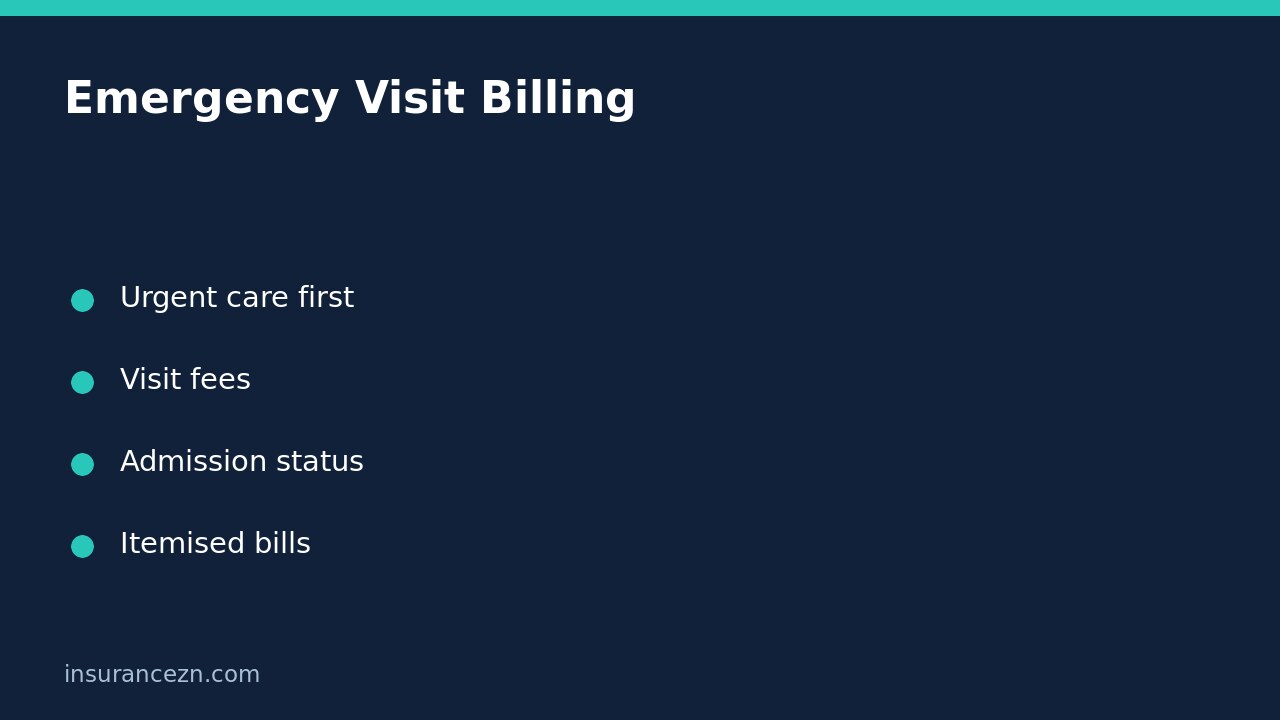
When circumstances allow, request an itemised account or estimate rather than only a single total. Ask the billing team to distinguish:
- The emergency department facility, attendance or administration charge, using the hospital’s exact fee description.
- Doctors’ consultations and any separate medical accounts.
- Tests, imaging, medicines or other services charged separately.
- Hospital accommodation and other charges if you are admitted.
- Any deposit, payment already made or amount still outstanding.
This list is a request for clarification, not a claim that every visit produces all those bills. Ask who will issue each account and whether further accounts are expected. Keep receipts and references so an initial payment is not mistaken for settlement of every associated charge.
Give the insurer a specific question
Instead of asking only whether the hospital is covered, provide the exact facility, visit date, charge description and any available item numbers. Ask whether your particular product offers a benefit for that emergency fee and, separately, what conditions apply to a subsequent admission. Request the relevant policy provision and the reason for any limit or exclusion.
For admitted treatment, ask about the applicable clinical category, waiting periods, restrictions, hospital agreement and excess or co-payment. Doctors’ gaps require separate checking. Our agreement-hospital checklist explains why the exact facility matters; it should not be read as confirmation that all emergency fees at that facility are included.
A staff member confirming that your membership is active has answered only one question. It does not confirm that a particular emergency charge, procedure or later medical account will be reimbursed.
A practical way to reconcile the account
Imagine an emergency visit followed by an admission. Do not combine all the paperwork into one assumed hospital benefit. Put the emergency account, admission paperwork and separate medical bills into distinct groups. Note each service date, provider, amount billed and any payment or benefit already recorded.
Ask the hospital to explain unfamiliar fee descriptions and the admission timeline. Then ask Medicare or your insurer about the relevant services using the itemised details. If a benefit is processed, compare the remittance with the original account and check the remaining balance with the provider before paying again.
If an explanation and a processed payment disagree, retain both and request a reconciliation. An enquiry reference or claim-submission receipt shows that something was received, not that the amount has been accepted or paid.
Short answers for common questions
Can I be a public patient if privately insured? The government overview says you can choose to be treated as a public patient even if privately insured. Discuss available care pathways with the treating service; do not assume public-patient arrangements apply to a private emergency visit.
Does no admission mean no bill? No. Identify the emergency and medical charges actually incurred rather than inferring the bill from whether you stayed overnight.
What should I prioritise? Necessary care comes first. Afterwards, gather itemised bills, clarify admission status, request product-specific benefit information and check what was actually processed.