
If an Australian health fund advertises a gym offer, first establish what the offer actually provides. A discounted membership price is not the same as an insurance benefit paid against an eligible expense. Neither the word ‘wellness’ nor holding extras establishes that your ordinary gym subscription is claimable.
Before changing cover or signing a gym contract, request the written offer terms and ask the fund to identify the payment pathway. This article is about checking a purchase, not prescribing an exercise programme or deciding which treatment you need.
Identify who pays whom
Start with a simple question: does the gym reduce its price, does the fund reimburse an eligible expense, or is this access to a separate programme? Ask which arrangement applies rather than assuming every health-related offer works through extras.
The Australian Government’s private health insurance glossary explains that information about other features can include healthy-lifestyle programmes, discounts, bonus schemes and additional services. These are different descriptions of possible product features, not a promise that any particular gym fee will attract a benefit.
The government’s overview of private health cover also explains that extras benefits depend on the selected policy and may be limited per service, per year or over a lifetime. A promotional saving should therefore be assessed on its own terms, separately from the insured services you may use.
Get the exact offer in writing before joining
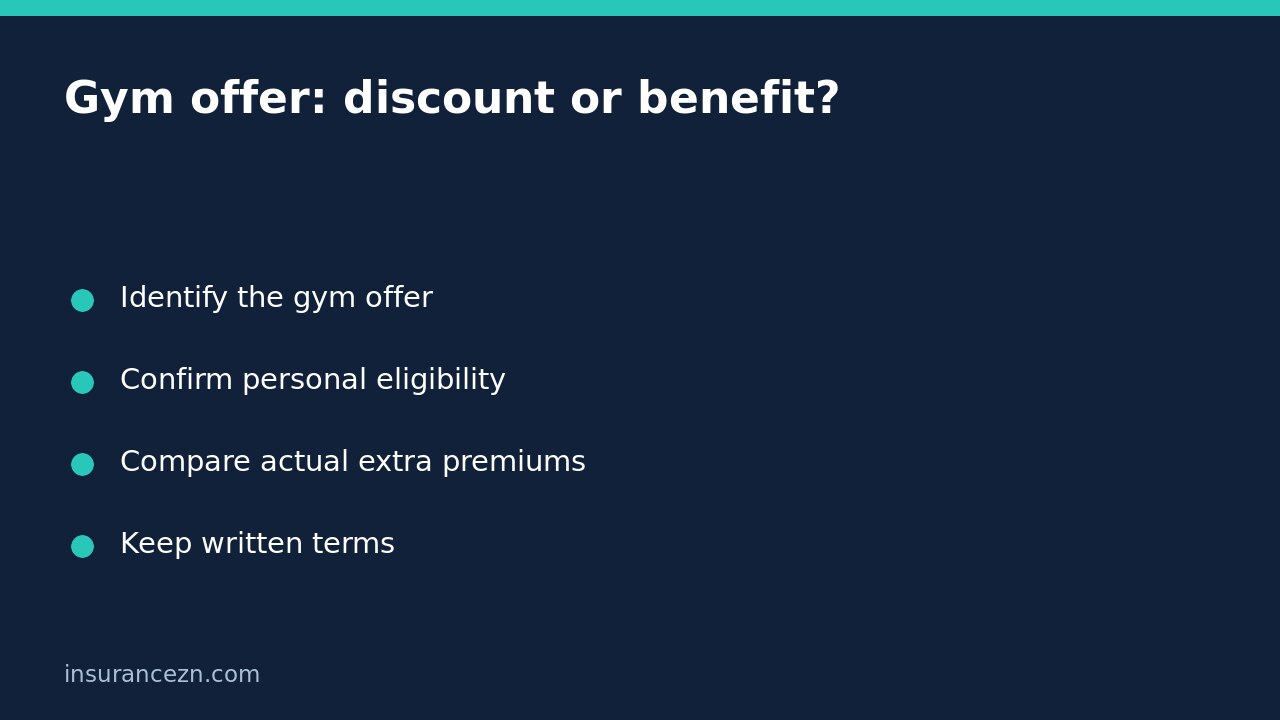
Send the fund the offer name, gym location, proposed membership type, joining date and price. Ask whether your exact current or proposed product qualifies. A gym chain appearing in an advertisement does not establish that every branch, membership or existing customer qualifies.
- Is the offer a lower gym price, a reimbursement, a voucher or programme access?
- Does it require a particular policy, membership status or enrolment channel?
- Are existing gym members eligible, and does the offer apply to their current contract?
- What joining fees, exclusions, expiry dates or minimum commitments apply?
- If reimbursement is available, what expense, supporting documents and service dates are eligible?
- Can the offer change, and what happens to the gym contract if health cover changes?
These are questions to resolve, not universal conditions imposed by every fund. If the fund refers you to the gym, obtain the gym’s terms too. Keep both answers: the insurer may explain product eligibility while the gym controls its own contract and billing.
Compare the additional premium with usable savings
Obtain matched quotes with and without the extras product you are considering. Keep the hospital component, household membership and comparison period consistent. Record any changed package discount so that the apparent extras price does not omit a rise elsewhere.
Then compare the additional insurance cost with the gym price you would actually pay under each arrangement over that same period. Include joining fees, unavoidable commitments and whether you would genuinely use the membership. Do not count a promoted maximum saving as money you will necessarily receive.
Keep other extras services on separate lines. Count only realistic estimated benefits for eligible planned appointments, rather than treating annual allowances as cash. A discount that lowers the gym’s price and an insurance claim for the same expense must not be counted twice without explicit confirmation that both can apply.
Keep gym access separate from clinical treatment
A gym may also host allied health practitioners or supervised sessions. That does not make the gym subscription itself a physiotherapy or exercise physiology appointment. Ask for separate service descriptions and charges, and have the fund assess each proposed expense under the correct rules.
Our guide to separating assessment and therapy quotes illustrates why an itemised plan is more useful than a single package headline. Its speech-pathology examples do not establish gym eligibility.
Questions before you commit
Does a referral make my membership claimable? Do not assume so. Ask the fund about the exact expense, required evidence and applicable product conditions; a clinical recommendation is not a payment approval.
Is an offer confirmation the same as a processed discount? No. Check the gym’s actual contract and first bill against the agreed terms. If reimbursement was confirmed instead, keep the invoice and compare the subsequent claim assessment with that confirmation.
Should I cancel existing arrangements immediately? First reconcile commencement dates, cancellation terms and the accepted offer. A requested change does not establish that either organisation has processed it.
This is general information for Australian readers, not personal financial advice. Eligibility and benefits depend on your policy, applicable PDS or membership documents, fund rules and offer terms; advertising and general government explanations do not guarantee reimbursement.