
Before buying travel insurance for separately booked flights, send the insurer your actual connection plan. Ask how the policy would respond if disruption to the first flight prevented you from using the second booking. A large travel-delay or cancellation limit does not establish that this particular self-transfer arrangement meets the benefit’s conditions.
The important comparison is not simply which policy advertises the biggest number. It is whether the event you are concerned about is covered, which resulting expenses can be considered, and what remains your responsibility.
Turn the itinerary into a clear question
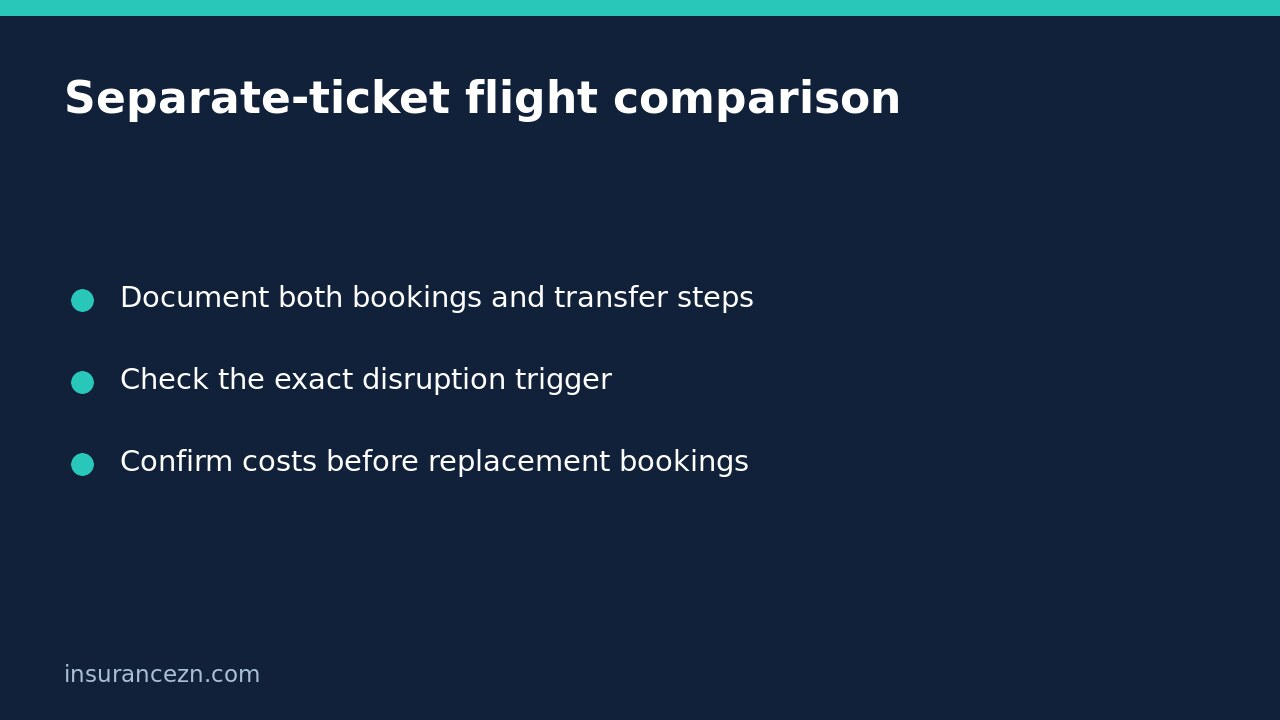
Prepare a short itinerary showing both booking references, travel dates, airports, scheduled arrival and departure times, and the steps between flights. Include any airport change, baggage collection and re-check, and border formalities relevant to your journey. Confirm operational requirements with the airlines and relevant authorities; do not ask an insurer to determine whether you can legally enter a country.
For example, imagine an Australian traveller booking one flight to a regional hub and a separate onward flight to an island. Their comparison question should identify those bookings and the proposed transfer, rather than saying only, ‘Does your policy cover missed connections?’ This is a hypothetical planning example, not an assertion that any particular product accepts the itinerary.
Compare the trigger before the dollar limit
Smartraveller’s travel-insurance guidance says policies differ and that the Product Disclosure Statement explains inclusions, exclusions, definitions, claims processes and emergency support. It also directs travellers to check cancellation and delay cover rather than assume changing plans are insured.
Apply that approach by asking each shortlisted insurer the same specific questions:
- Which benefit, if any, could apply if the first flight’s disruption prevents this separately booked onward departure?
- Does the wording distinguish separately ticketed travel, and what itinerary or connection conditions matter?
- Which causes of disruption qualify, and which exclusions or known-event conditions could prevent payment?
- Are replacement transport, accommodation and unused bookings considered under the same benefit or different sections?
- What excess, expense limits, evidence requirements and approval steps apply to each relevant section?
Do not invent a universal minimum connection time or assume an airline’s bookable itinerary establishes insurance acceptance. If the insurer cannot answer without the full schedule, provide it before relying on the quote.
Separate airline remedies from insurance assessment
Keep airline booking conditions and the insurer’s policy response in different columns. Ask the airlines what assistance, rebooking or refunds they would offer under the actual bookings and disruption circumstances. Do not assume that the second airline has accepted responsibility for a delay to an unrelated booking.
Then ask the insurer how any refunds, credits or airline assistance affect the amount you could claim. Record a cost only once in your planning worksheet. A carrier’s refusal does not itself prove an insured loss, and an insurer’s acknowledgement of your enquiry is not claim acceptance.
Where a response is unclear, mark that exposure as unresolved. Compare whether a different itinerary, more transfer time or different booking arrangement reduces the practical risk, without describing any of those choices as guaranteed insurance protection.
Check the whole journey and retain the comparison
Smartraveller recommends choosing cover for every country visited, including transit points, and checking the duration of the trip. Make sure the itinerary supplied for your separate-ticket question matches the countries and dates used for the quotation. If you later change the route, seek an updated answer rather than relying on an old email.
Save the PDS version, quote, itinerary and written explanation together. Compare otherwise equivalent cover and actual premiums. If considering annual cover, also check our guide to matching annual-policy trip limits to your longest journey; annual eligibility does not settle the separate-ticket question.
If disruption happens
Preserve airline notices, original schedules, booking conditions and records of assistance offered. Contact the insurer through the appropriate claims or assistance channel about proposed replacement costs when practical. A new booking receipt proves expenditure, not reimbursement approval. Keep necessary safety decisions separate from paperwork and do not delay urgent medical care for an insurance check.
Does a favourable pre-purchase explanation guarantee payment? No. A later claim still depends on what happened, the applicable wording and evidence. If the actual itinerary changes, disclose the change and reconcile any required amendment before relying on the earlier response.
This is general information for Australian readers, not personal financial advice. Cover depends on your policy/PDS, definitions, exclusions, limits and circumstances. Obtain product-specific written confirmation; no insurer or airline outcome is guaranteed.