
When comparing Australian travel insurance, do not read a cancellation limit as automatic protection against an airline, hotel or travel agent going out of business. Check whether the policy covers insolvency of the particular type of business holding your booking. Then compare that wording with the money you could lose, rather than choosing by the largest cancellation headline.
This is general information for Australian readers, not personal financial advice. Cover depends on the policy, PDS, exclusions, purchase timing and individual circumstances. Neither buying insurance nor submitting a recovery request guarantees reimbursement.
Identify which business owes you the service
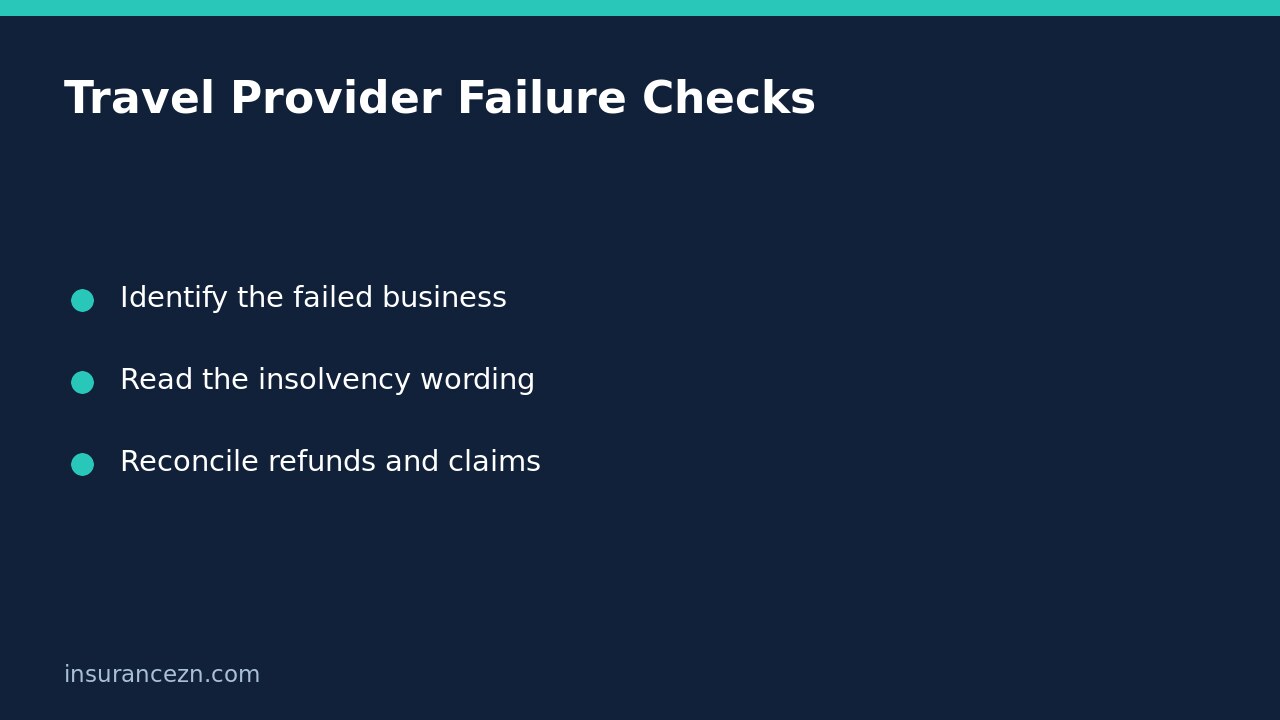
A booking can involve several organisations: the agent that took payment, a booking platform, a tour operator and the airline or accommodation provider. Make a simple booking record showing who charged you, who issued the confirmation and who must deliver each service. Save receipts and the terms provided at purchase.
This matters because an agent’s failure and an airline’s failure are different factual situations. Do not assume that a policy referring to one type of travel supplier includes every intermediary. If an agent stops trading, ask the actual service provider through its official channel whether your reservation remains confirmed before cancelling or paying again.
Keep insolvency separate from a routine timetable change, a supplier cancelling a service, your own decision not to travel or an unsuccessful booking enquiry. The same cancellation heading may contain different conditions for each event.
Read the exclusion as well as the benefits table
The Smartraveller-hosted CHOICE guide warns that only some insurers cover travel-provider insolvency and recommends checking the PDS or asking the insurer. It also distinguishes cancellation causes, including insolvency and changes attributable to transport providers. That guidance is a reason to check the contract, not proof that your selected product includes the benefit.
For each shortlisted quote, search the PDS for insolvency, bankruptcy, financial default, travel supplier and travel agent. Then read the surrounding paragraphs, definitions and general exclusions. If you cannot find a clear answer, send the insurer the exact booking arrangement and ask for the applicable clause.
- Which kinds of failed businesses are included or excluded?
- Is protection limited to particular unrecoverable prepaid costs?
- What limit and excess apply, and is the limit shared?
- Are replacement transport or extra accommodation addressed separately?
- What conditions depend on purchase dates or information already known?
These are comparison questions, not a claim that every policy offers those features. An unanswered question should remain an uncertainty in your comparison sheet.
Map the money without counting the same loss twice
Build a row for each booking with its total price, amount paid, unpaid balance, cancellation terms and possible recovery channel. Distinguish money already committed from money you might spend on replacement travel. Do not treat an entire holiday budget as an insured loss.
Consider a hypothetical itinerary with flights bought directly from an airline and accommodation booked separately through an agent. If the airline fails, the hotel booking is not automatically unusable or refundable. Record whether the trip can continue, what the suppliers confirm and which costs actually become unrecoverable. Do not assume insurance pays to replace every booking because one component fails.
Record refunds, credits and disputed amounts separately. A credit is not cash received; a requested refund is not a processed refund. Tell the insurer about recoveries and pending disputes so the same expense is not presented as an unrecovered loss after it has been repaid.
Compare other recovery routes without assuming success
The CHOICE guide suggests asking a travel agent whether it has insolvency insurance and notes that some banks may allow a credit-card chargeback when a paid-for service is not supplied. These are enquiries to make, not guaranteed substitutes for travel insurance. Ask what protection actually applies to your booking and what evidence is needed.
If a business fails, contact your card issuer through its genuine contact details about any available dispute process and applicable time limits. Keep payment evidence and supplier communications. Do not assume the bank must reverse the payment, that every payment method offers the same rights or that an insurance enquiry preserves another process’s deadline.
For a separate comparison of what a stripped-back policy leaves with you, see medical-only travel insurance and non-refundable booking exposure. Medical benefits and supplier-failure protection are separate questions.
Before buying: a short decision checklist
The CHOICE explanation of reading the fine print recommends checking the benefits table, policy cover, general exclusions, definitions and claims requirements. Use that sequence for each quote, keeping the traveller details, destination and dates equivalent.
Does comprehensive mean insolvency is included? Not necessarily; read the relevant wording.
Does an agent saying it is insured establish my reimbursement? No. Ask for the arrangement and whether your transaction qualifies.
What should I keep? Save the quoted product, PDS version, insurer’s written clarification, booking terms and payment record. If failure occurs, add dated supplier notices and each processed recovery. The objective is to understand the risk before buying and reconcile the actual loss if something later goes wrong.