
A travel insurance quote that excludes your pre-existing medical condition is not necessarily equivalent to another quote that accepts it. Before comparing premiums, establish what each insurer would exclude and which remaining benefits could still be useful. Do not treat a policy being available for purchase as confirmation that your medical circumstances are insured.
This is general information for Australian readers, not personal financial advice or medical advice. Cover depends on the policy, Product Disclosure Statement (PDS), assessment, exclusions and accepted terms. No comparison or pre-trip enquiry guarantees payment of a future claim.
Separate the health declaration from the buying decision
Smartraveller advises travellers to tell their insurer about pre-existing health conditions and ask if they are unsure whether a condition is covered. Its guidance identifies possible options including a specialised insurer or a policy covering situations unconnected to the condition. Those options are starting points for enquiries, not assurance that a particular product will suit you.
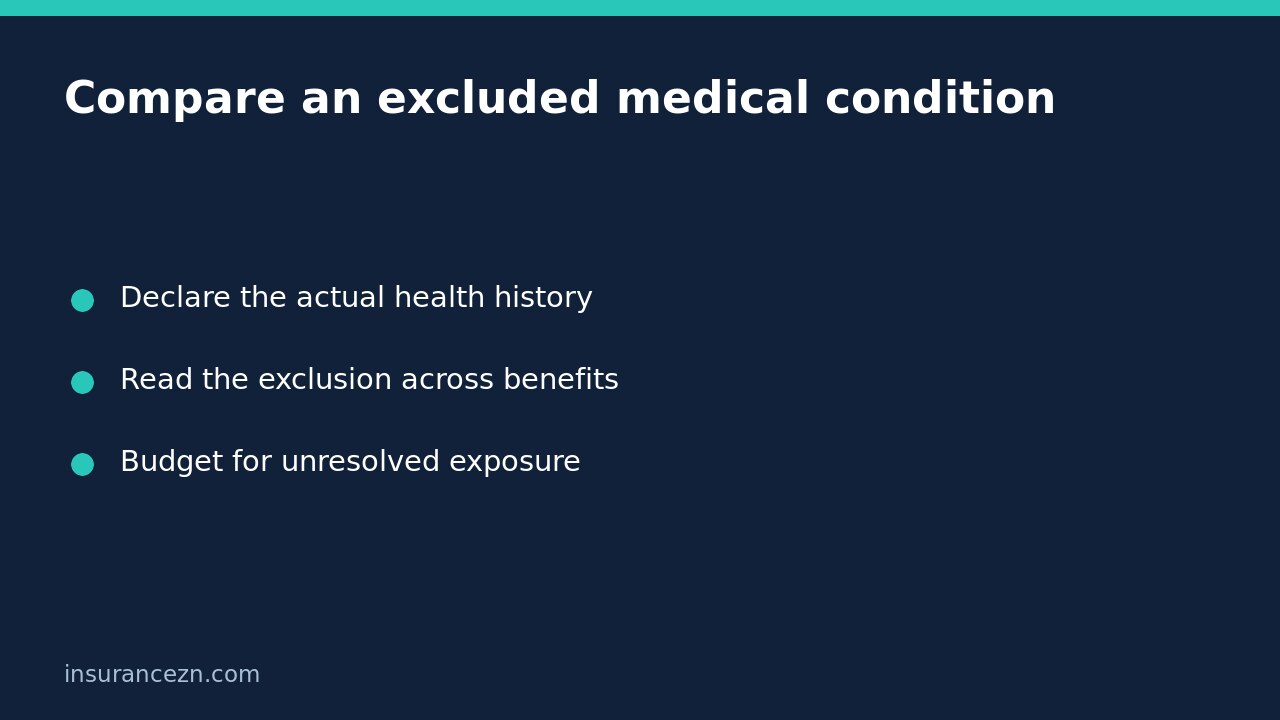
Answer the insurer’s actual questions accurately. Do not omit a condition because it is controlled, because an earlier insurer accepted it or because you believe it is unrelated to the trip. If a question is unclear, obtain clarification and any necessary clinical information. Ask your practitioner about fitness and treatment; ask the insurer about its contract. Medical clearance alone is not insurance acceptance.
Compare the wording, not just an exclusion label
Obtain the proposed exclusion in writing alongside the applicable PDS and quote. Ask what the wording means for the health circumstances you disclosed. If it refers to related conditions, complications or another defined term, request an explanation of how that definition operates. Do not assume that the exclusion is limited to the exact diagnosis name appearing on your form.
Create a separate row for each benefit that matters to you. Ask the insurer how the exclusion interacts with overseas medical expenses, emergency transport and cancellation or trip interruption, where those benefits are offered. This is a checking framework: it does not mean every product provides these benefits or applies medical exclusions in the same way.
An insurer saying that unrelated events may be covered does not decide in advance whether a later event is unrelated. A claim still requires assessment against the policy and evidence. Keep any explanation, its qualifications and the document references rather than paraphrasing the response as full cover.
Use a scenario comparison without inventing outcomes
Imagine a hypothetical traveller considering two quotes for the same itinerary. One quote contains a medical exclusion; the other requires additional assessment before offering terms. Rather than choosing the cheaper headline immediately, the traveller can ask both insurers the same focused questions:
- What decision has actually been made about my declared condition?
- Which document contains the applicable exclusion or acceptance terms?
- How would that wording affect the benefits I am comparing?
- What information, payment or acceptance step remains outstanding?
- Is there a specialised product or assessment pathway available?
This example contains no assumed claim outcomes. A request for more information is not acceptance, and an offered option is not purchased cover. Compare the final terms that can actually be issued, not a favourable possibility mentioned during an enquiry.
Keep the rest of the trip comparison intact
A medical exclusion should not distract you from checking destinations, activities, insured travellers and trip dates. Smartraveller explains that policies differ in inclusions, exclusions and definitions, and recommends reading the PDS before buying. An attractive medical answer does not establish acceptance of a planned activity, just as an activity option does not remove a medical exclusion.
Use equivalent itinerary details and record the payable premium, excesses and relevant limits. Identify losses you might have to fund yourself rather than counting an excluded benefit as part of the policy’s value. For a related comparison, see the costs you may need to fund with medical-only travel insurance. A product’s name alone is not a complete account of protection.
Resolve uncertainty before relying on the policy
If an insurer cannot explain a significant exclusion, mark that issue unresolved. Ask about available alternatives and applicable change or cancellation terms rather than assuming you can remove the uncertainty after departure. If your circumstances change, ask what notification or reassessment the contract requires; do not invent a universal deadline.
Does a lower premium compensate for an excluded condition? A saving does not replace missing protection. Consider the potential uninsured exposure and whether another suitable option is available, without assuming that any provider must accept the risk.
Should you wait for insurance approval before urgent care? No. Seek necessary medical care and follow emergency instructions. Insurance administration is separate from clinical decisions. Keep assistance details accessible, but do not treat access to an assistance service as approval of every expense.
Checked source
Smartraveller: Travel insurance explains pre-existing-condition disclosure, specialised-policy options, situations unconnected to a condition and the importance of reading the PDS. It does not determine the scope of any individual insurer’s exclusion.