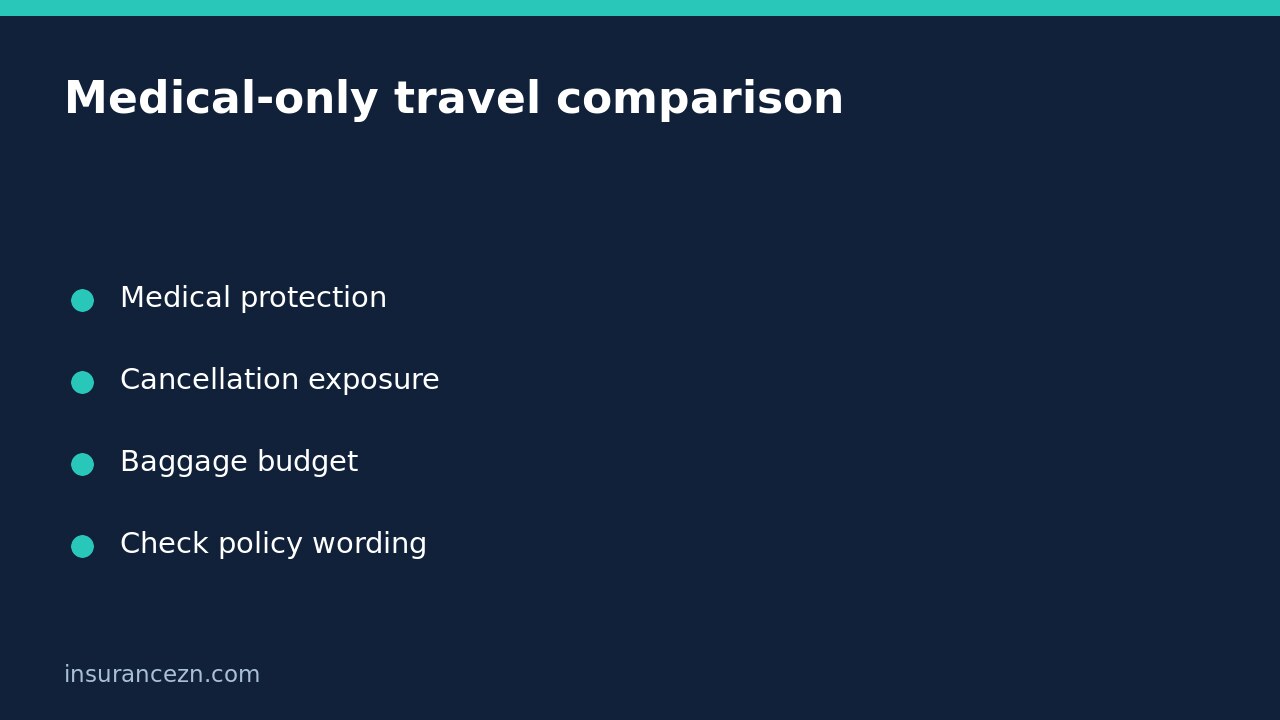

Medical-only travel insurance can leave you responsible for expenses that a broader policy might cover, even when the overseas medical benefit looks substantial. Before choosing it for an Australian departure, compare not just the premium but the cancellation, belongings and other trip costs you would need to pay yourself. A cheaper policy is not an equivalent substitute if it removes protection you expected to have.
This is general information for Australian readers, not personal financial advice. Cover depends on the actual policy, Product Disclosure Statement (PDS), exclusions, eligibility and accepted disclosures; no example guarantees payment.
Start with what medical-only actually includes
Smartraveller explains that basic medical-only policies generally focus on health and medical emergencies. They usually do not cover property or cancellation costs; where those benefits exist, conditions may be more restrictive and limits lower. It also notes that basic policies usually have a higher excess than comprehensive options. These are comparison starting points, not a description of every product.
Find the benefit table and the matching PDS clauses for each shortlisted quote. Record medical treatment, emergency assistance and any evacuation or repatriation provisions separately. Ask how approval and assistance arrangements work. Do not infer that a large headline medical limit automatically includes every related service or an unrestricted choice of transport home.
Build a cancellation exposure list before buying
List prepaid flights, accommodation, tours and transport bookings. Beside each entry, record the booking provider’s actual refund or credit conditions. A refundable hotel and a non-refundable tour create different financial exposures. A possible credit is also not the same as cash returned when you need it.
Now ask each insurer whether cancellation is included, which reasons qualify, the applicable limit and excess, and when the benefit starts. Do not assume any change of plans qualifies. Compare the same departure dates, travellers and destinations so a lower quote is not simply covering a different journey.
In a fictional planning example, a traveller has a refundable hotel but a non-refundable guided tour. A medical-only policy could leave the tour cost with the traveller if cancellation is outside its cover. The decision is whether that particular loss could be absorbed, not whether the hotel makes the whole trip refundable.
Price the belongings you could realistically replace
Make a short list of essential items rather than assigning a single optimistic baggage value. Consider the phone needed for bookings, prescription glasses, clothing and any work equipment. Check how you would obtain replacements while away, without assuming the insurer provides immediate cash.
If a broader quote includes baggage benefits, inspect individual item limits, exclusions, evidence requirements and the excess. A large overall baggage limit may still leave a particular item partly uninsured. Our one-expensive-item baggage comparison explains a useful way to test that limit. Do not add the advertised overall allowance to an item sublimit as if both were independently payable.
Keep medical eligibility separate from the missing extras
Choosing fewer non-medical benefits does not remove the need to check medical eligibility. Smartraveller advises declaring pre-existing conditions and asking the insurer if a condition is covered. Give accurate information and retain the insurer’s written acceptance or exclusion rather than relying on a quote screen alone.
Check every country, including transit points, and the activities you actually plan. Skiing, cruising or other activities may require additional protection or a different product. Medical-only is a benefit description, not permission to ignore activity exclusions. Compare the applicable excess and ask whether different benefit sections have different excess arrangements.
Use a two-column decision sheet
- Policy response: Write the verified benefit, limit, excess and relevant PDS section for each risk.
- Personal funding: Write what you would pay if the benefit is absent, excluded or insufficient.
- Unanswered questions: Mark unclear items as unresolved, not covered.
- Evidence: Save the quote, policy version, disclosures and written clarifications together.
Compare premiums only after completing this sheet. Do not treat a larger benefit as money you are certain to receive, or describe an uninsured expense as harmless simply because it is not medical. The practical question is whether the remaining exposure fits your circumstances.
Quick questions before checkout
Does travelling light make medical-only sufficient? It reduces one potential exposure but says nothing about cancellation costs or medical exclusions. Check the full trip.
Does comprehensive mean everything is covered? No. Smartraveller explicitly warns that comprehensive policies do not cover everything or everyone. Compare actual wording rather than product names.
What if the insurer cannot clarify a key benefit? Keep that uncertainty visible in your comparison and obtain an answer before relying on the policy. A low premium does not resolve an unanswered coverage question.