

An annual travel insurance policy does not necessarily cover a single trip lasting a whole year. Before comparing premiums, match the maximum length of each insured journey to your longest planned absence. An annual policy can be unsuitable even when its overall start and end dates surround your holiday.
For Australian travellers taking several short breaks and one extended visit overseas, this is a useful first comparison filter. It prevents a cheap annual quote from hiding a duration mismatch.
Separate the policy year from the individual trip limit
The policy period tells you when the insurance contract operates. A separate trip-duration condition can limit each journey within that period. Smartraveller explains that multi-trip and credit card policies can restrict the length of each trip, and that some let you pay for extra days. Neither an extension nor its availability should be assumed.
Read the Product Disclosure Statement (PDS), policy schedule and any endorsements together. Find the definitions of a trip, departure, return and usual residence. Ask whether travel must start and finish in Australia, and how a journey crossing the annual renewal date is treated. Record answers against the actual wording rather than relying on the phrase annual cover.
Build a journey-by-journey comparison sheet
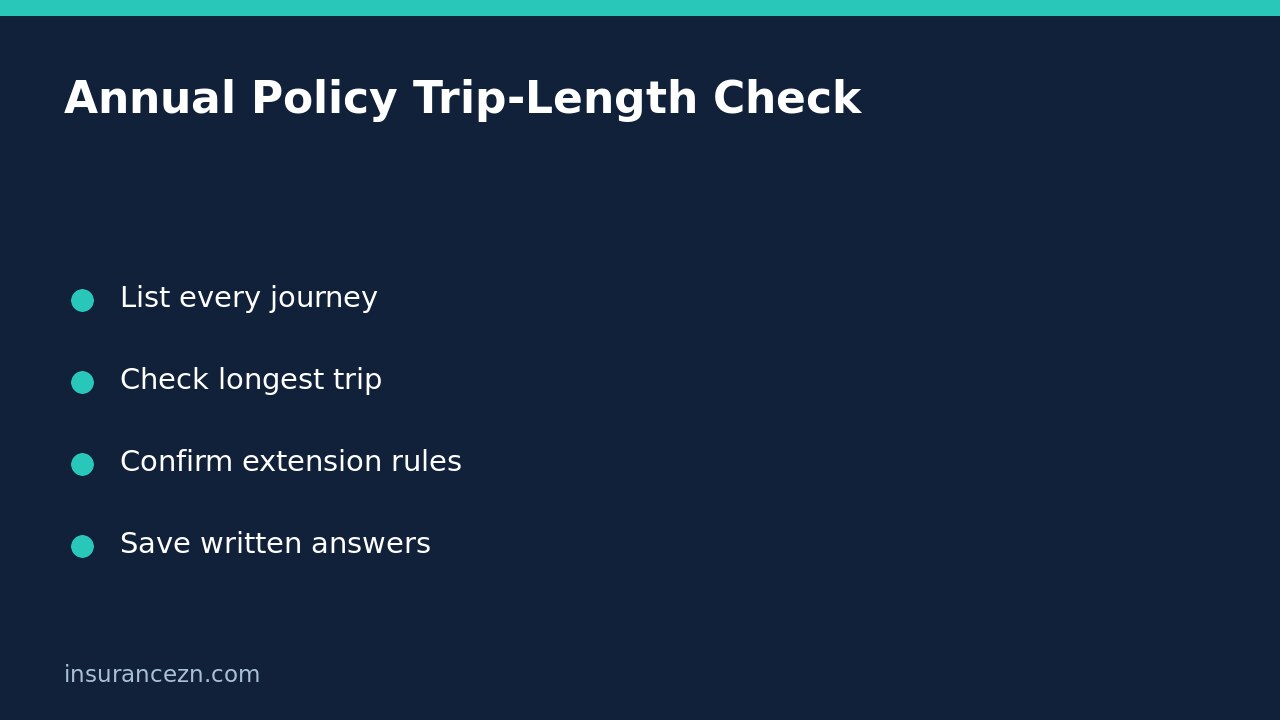
- List each planned departure and return, including transit stops and any optional extra nights.
- Count the entire absence using the counting method in the policy. Check how departure and arrival days are counted.
- Write the maximum permitted trip duration beside each quote.
- Flag any journey close to, or beyond, that maximum.
- Ask the insurer about that exact itinerary before paying.
Use columns for destination, travel dates, duration limit, extension availability and the page containing the relevant condition. Keep uncertain entries marked unconfirmed. Do not quietly round a borderline itinerary down to make it fit.
A worked comparison without assuming claim outcomes
Imagine an Australian traveller planning two brief holidays and a later six-week family visit. Hypothetical Quote A permits journeys of up to 30 days; hypothetical Quote B permits up to 60 days. These numbers illustrate the comparison method, not market offers or recommended limits.
Quote A fails the initial duration check for the family visit unless the insurer offers an appropriate extension and confirms its terms. Quote B passes that one check, but still needs assessment for medical conditions, countries, activities, excesses and cancellation cover. Passing a duration test does not establish that every loss will be insured.
Compare the total price of suitable options: an annual policy covering every trip, an annual policy with an approved extension, or separate single-trip policies. Include the cost and conditions of necessary options. Avoid buying overlapping policies on the assumption that benefits can simply be added together.
Ask what happens if your return is delayed
Planned extra holiday time and an unexpected interruption are different situations. Look for extension provisions, notification requirements and exclusions. Ask what happens if you cannot return on the intended date, whether approval is required, and whether any extension changes benefit limits or cover for newly arising conditions.
Also ask whether you can request extra days after departure. Do not assume that buying another policy while overseas repairs a gap or covers something that has already happened. Save the insurer response, reference number and revised schedule if an amendment is accepted.
Check the rest of the itinerary before choosing
Smartraveller advises choosing cover for every destination, including stopovers and transit points. Its guidance also highlights activity exclusions and the need to disclose pre-existing health conditions. Apply these checks to every journey, not just the longest one.
A later cruise, ski holiday or change of destination can alter what you need. Recheck the policy before adding travel rather than treating the original annual purchase as an unlimited pass. For broader preparation, use our travel insurance document preparation checklist alongside your itinerary worksheet.
Quick questions before you buy
Does annual mean unlimited days abroad? Not necessarily. Check the individual trip limit and all related definitions.
Can I pay for a longer journey? Some policies allow extra days; ask about eligibility, timing and the revised terms before relying on this.
What should I keep? Save the PDS version, schedule, itinerary and written answers about borderline dates. Repeat the check if your plans change.
Important: This is general information for Australian readers, not personal financial advice. Cover depends on the insurer, policy/PDS, exclusions, eligibility, limits and accepted amendments. No example guarantees a benefit or claim payment.


