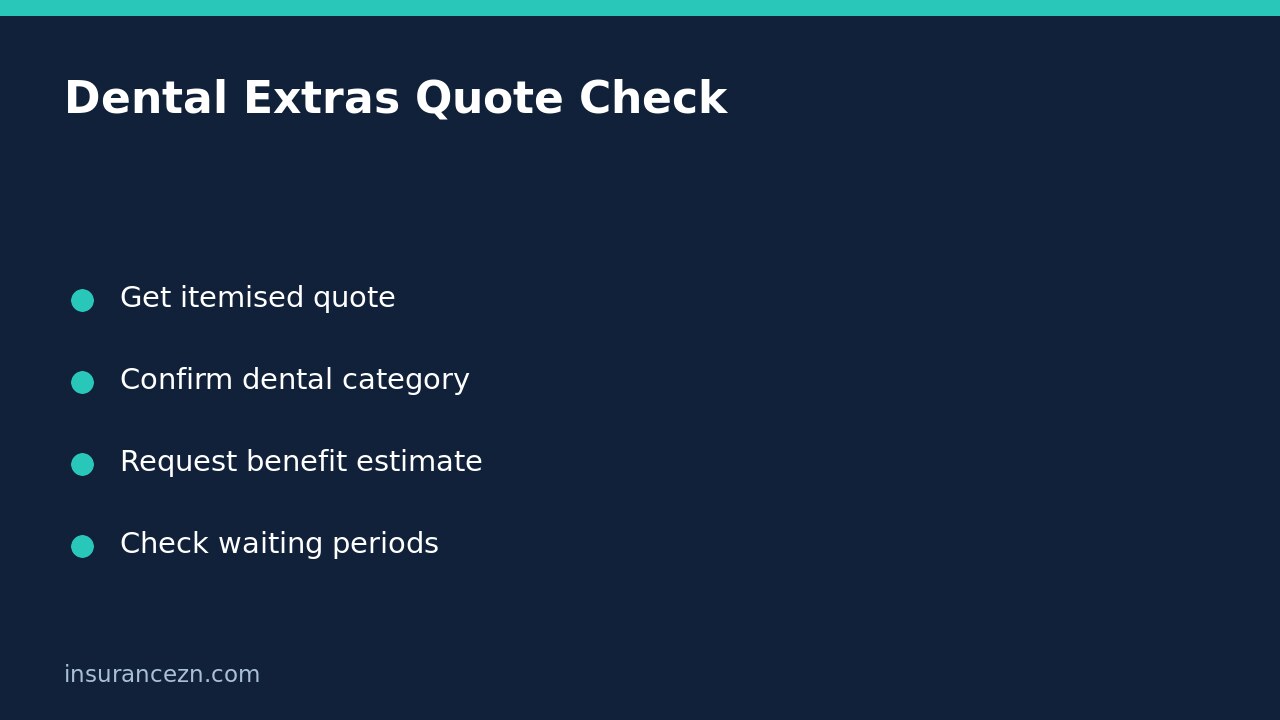

To compare Australian extras cover for dental work, start with your dentist’s itemised treatment quote rather than a policy’s headline dental limit. Ask each fund to assess the same proposed treatment, provider and timing. This helps reveal whether similar-looking policies would actually contribute towards the services you expect to use.
This is general information for Australian readers, not personal financial advice or medical advice. Benefits depend on the policy wording, fund rules, applicable Product Disclosure Statement (PDS), waiting periods and individual circumstances. A benefit estimate is not a guarantee of payment. Discuss treatment choices and urgency with your dental practitioner.
Get the treatment details before comparing benefits
Ask the practice for a written plan identifying each proposed service, its dental item number where available, the fee and the practitioner or practice details. If treatment involves several appointments, request the expected sequence. You do not need to share your full clinical history with a comparison service merely to begin comparing policies.
Separate planned work from uncertain possibilities. A check-up that might lead to further treatment is not the same as a confirmed treatment plan. Ask the dentist what remains provisional so you do not mistake an early estimate for a complete bill.
For staged work, ask which service is expected at each visit. This provides a clearer question for the fund than ‘How much dental cover do I get?’ Keep the quote date and ask when fees may need to be reconfirmed.
Check general dental versus major dental classification
The Australian Government comparison website’s General Treatments definitions describe general dental as typically including check-ups, cleans and simple fillings. It lists significant work such as complex fillings, extractions, crowns and bridges under major dental, but explicitly says the classification of specific items depends on each insurer’s rules.
That qualification matters. Do not decide that a service is covered merely because the treatment sounds ‘simple’, or assume that an extraction always falls into the same category across funds. Give each fund the same itemised quote and ask it to identify the relevant benefit category.
- Is the quoted service eligible under this exact product?
- Is it treated as general dental, major dental or another category?
- Is the proposed practitioner recognised for payment?
- Does using this practice affect the benefit or any advertised special offer?
Ask for an estimate that explains its limits
Record the expected benefit for each quoted item, not just the maximum advertised annual amount. Ask whether any per-service, annual, combined, lifetime or frequency limits apply to the proposed work. These are questions to investigate, not a statement that every policy has every kind of limit.
Also ask whether previous claims would reduce what remains available, and what period the relevant limits use. If a promotion mentions no-gap dental, request the eligible services, providers and conditions in writing. Do not extend a limited preventive-care offer to unrelated treatment.
Use a comparison sheet with columns for treatment item, quoted fee, estimated benefit, conditions and unanswered questions. Leave an uncertain benefit blank rather than assuming the maximum will be paid. Consider the premium as well, especially if you are comparing extras-only cover with a combined hospital-and-extras package.
Test timing before switching or upgrading
PrivateHealth.gov.au’s insurance basics explains that waiting periods can apply when first purchasing cover or upgrading, during which certain benefits may not be available or may be lower. Do not buy a new policy assuming it will immediately fund already-planned dental treatment.
For example, suppose a dentist proposes a crown after an assessment. Before switching for a higher advertised major-dental limit, ask the prospective fund about that quoted service, your proposed joining date, any waiting period and how existing cover would be assessed. Ask what evidence it needs from your current fund. This is a decision scenario, not a promise that waiting periods transfer or disappear.
Keep clinical decisions separate from insurance timing. Do not postpone necessary treatment solely to reach an insurance milestone without discussing the health implications with your dentist.
Quick questions before you choose
Does a large dental limit mean the whole bill is covered? No. Eligibility, item benefits and other conditions still matter. Request an estimate for your actual quote.
Can I compare using only the treatment name? Use it as a starting point, but item numbers and provider details make the enquiry more specific. Ask the practice and fund to resolve unclear descriptions.
Where do I start with policy documents? PrivateHealth.gov.au provides Private Health Information Statements to help compare available products. Read those summaries alongside the fund’s full rules and written answers. Our health insurance document preparation guide can help organise your records.
Before enrolling, save the treatment quote, exact product name, benefit estimate, waiting-period advice and unresolved conditions. Reconfirm benefits if treatment, provider or timing changes. A useful comparison replaces assumptions with specific answers; it does not guarantee that a future claim will be paid.