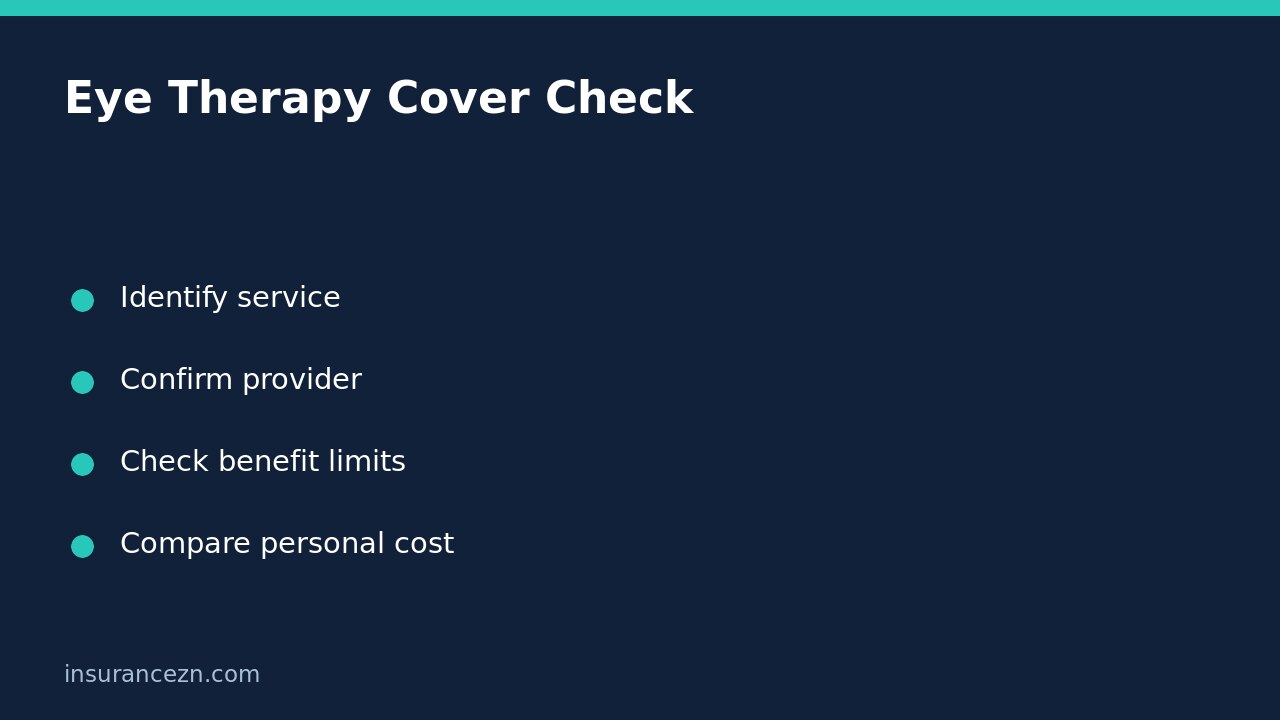

If you are comparing Australian extras policies for eye therapy, do not use the advertised glasses allowance as your answer. Ask each insurer about the exact proposed service and practitioner, then compare the estimated benefits and remaining costs. A policy mentioning optical cover does not, by itself, establish that a course of eye therapy is included.
PrivateHealth.gov.au’s overview of private health cover lists eye therapy among services that general treatment cover may include. It separately lists glasses and contact lenses. The overview also explains that not all policies cover all services and that extras benefits commonly have limits. That supports checking the treatment itself rather than transferring an optical marketing headline to a different expense.
Start with the clinician’s actual service description
Ask the treating practice for a written description of the assessment or therapy being proposed, who will provide it and the anticipated appointment pattern. If the practice uses service or billing codes, obtain those too. Do not invent a claim code or substitute the name of a different service to make a comparison tool return an answer.
Keep clinical recommendations separate from insurance classification. The clinician determines what care is appropriate; the insurer explains whether and how its particular policy provides benefits. This article does not establish which practitioner or treatment is appropriate for an individual eye condition.
Ask whether the written quote separates an initial assessment, subsequent therapy visits and any other charges. If there are reports, equipment or home-program materials, identify their prices separately and ask whether they attract a benefit. Their inclusion in a treatment plan is not evidence of insurance funding.
Match the service and practitioner to each policy
Send the same quote to every shortlisted insurer. Ask which benefit category, if any, applies to the named service, and whether the named practitioner at the relevant practice is recognised for that benefit. Ask what identifiers the insurer needs to check this accurately.
- Is this specific assessment eligible under the proposed extras product?
- Are the planned follow-up visits eligible, and on what basis?
- Is the benefit separate from, or shared with, another category?
- Are there waiting periods or other unmet requirements?
- Does the response apply to the person receiving treatment and the intended service dates?
These are questions to resolve, not a claim that every insurer uses the same categories or conditions. Ask for the relevant policy section and written clarification where a summary is unclear. A practice accepting electronic claims is not, on its own, confirmation that your chosen product will pay.
Compare the whole proposed appointment sequence
Create a worksheet with a row for each planned appointment. Record the provider’s fee, the insurer’s estimated benefit and your estimated contribution. Distinguish a per-visit benefit from a remaining annual allowance: a large annual headline does not tell you how much is payable at the next visit.
Include benefits already used and any other planned services sharing the limit. Ask the insurer which benefit period applies and how it treats the proposed dates. Do not assume an unused allowance carries forward or that changing funds restores an exhausted entitlement.
For a practical, non-numerical example, imagine an assessment followed by several therapy sessions. One quote may describe the whole program, while an insurer’s response addresses only the first assessment. Mark the later sessions as unresolved rather than extending that first answer across the course. Obtain clarification before treating the worksheet as a usable budget.
Include the cost of obtaining the cover
Compare premiums over the same period and for otherwise comparable household arrangements. If you would upgrade an existing policy, identify the additional premium and benefits you would lose or gain elsewhere. If you would buy extras solely for this treatment, compare the full relevant premium with the personal benefits reasonably estimated for the planned services.
Do not cancel existing cover merely because a new brochure lists eye therapy. First confirm the proposed cover, commencement date, waiting-period treatment and outstanding requirements. An insurer’s benefit estimate remains subject to the actual eligible services and claim assessment; it is not a promise to fund every appointment.
For another example of matching a benefit to a specific service rather than a broad category, see our comparison checklist for a specific non-PBS prescription. The medication rules are different, but the discipline of comparing the exact proposed expense is useful.
Final questions before choosing
Does optical cover automatically include eye therapy? Do not assume so. Obtain the product-specific answer for the service and practitioner. Does a referral guarantee payment? A clinical referral does not establish a private insurance benefit. What should I keep? Retain the quote, policy details, insurer’s written explanation and any later assessment so differences can be reconciled.
This is general information for Australian readers, not personal financial advice. Benefits depend on the policy wording, applicable PDS or member guide, limits, waiting periods, provider recognition and insurer assessment. Seek clinical advice about care; do not delay necessary treatment while comparing insurance.