
If your expected income changes, updating your private health insurance rebate tier can change the premium you pay upfront. But sending the health fund a request is not the same as having the new tier recorded, and a changed debit is not the final tax-time assessment. Check all three stages before deciding the matter is finished.
This is general information for Australian readers, not personal financial advice. Eligibility depends on applicable government rules and your circumstances; policy benefits remain subject to the policy terms and Product Disclosure Statement where applicable. Ask the ATO or a registered tax adviser about your personal tax position.
Separate the rebate from the underlying insurance price
The Australian Government private health insurance rebate is income tested and also varies by age group. PrivateHealth.gov.au explains that eligible people can claim it as a premium reduction through their health insurer or as a tax offset through their annual return. These are different ways to receive the rebate, not two entitlements to claim for the same premium.
A lower amount leaving your bank account does not necessarily mean the insurer reduced its underlying price. The contribution being applied may have changed. Conversely, a higher net premium after a tier update does not by itself prove the insurer increased its base premium or removed benefits.
Before contacting the fund, save the current premium notice and identify the membership, payment frequency, nominated rebate tier and any separately identified loading or discount. Use the government’s current table for the relevant period rather than an old comparison screenshot; this article deliberately does not reproduce changing thresholds.
Review the estimate without guessing the tax definition
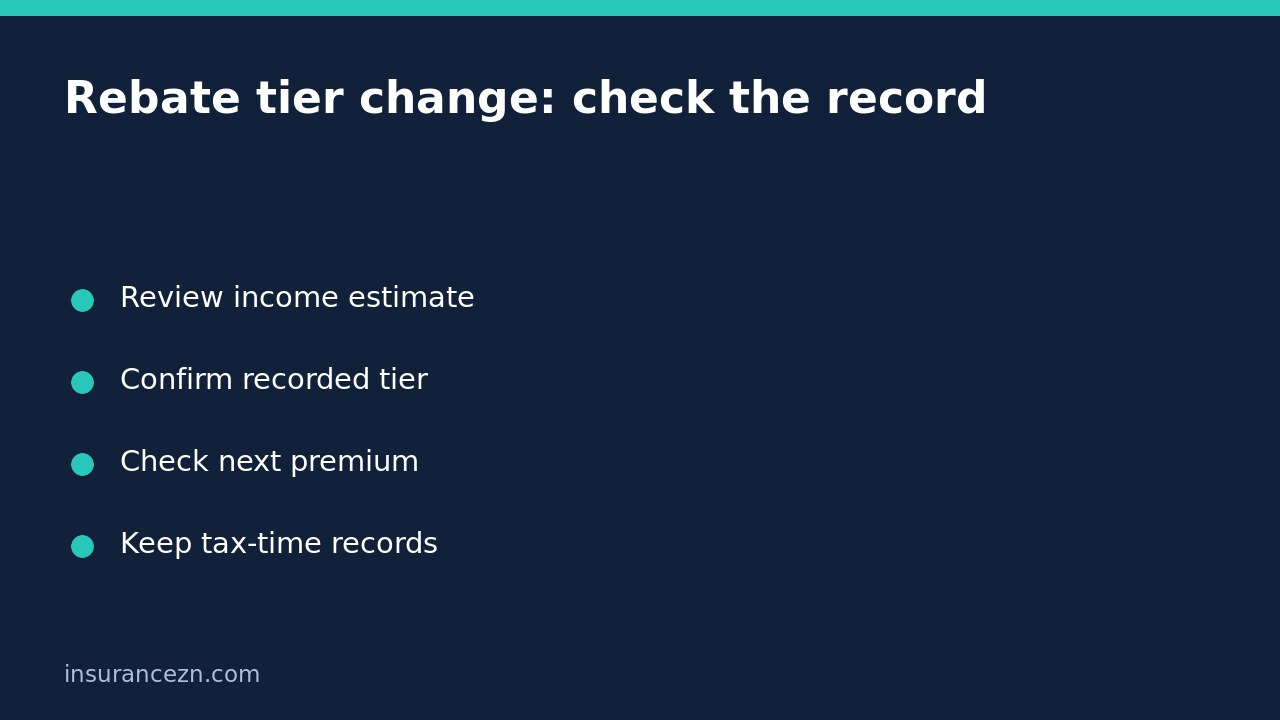
When receiving the rebate through your insurer, you nominate the income tier you expect to fall into. A salary change, additional income or changed household circumstances is a reason to review that estimate, not a reason to assume the correct tier from take-home pay alone.
- Identify which financial year and household circumstances your estimate concerns.
- Check the ATO guidance or calculator linked from the government rebate page for the applicable income test.
- Compare your revised estimate with the thresholds for the correct period and family situation.
- If uncertain, obtain tax guidance before sending a new nomination.
Keep the estimate and its assumptions with your records. You do not need to send detailed tax documents through an ordinary email just to ask the fund how its nomination process works; use its approved secure channel when personal information is required.
Ask for a processed change, not just an acknowledgement
A practical request is: please confirm the rebate tier currently recorded for my membership, the tier you have processed following my request, when that change applies, and the amount and date of my next premium payment. Also ask whether the next notice contains an adjustment for an earlier period and request an explanation if it does.
An automated message saying your enquiry was received does not answer those questions. Save the request reference, then obtain a written processed outcome. Do not assume that updating a rebate nomination changed your hospital product, excess, waiting periods or treatment eligibility; reconcile any unexpected product change separately.
For example, a member revises an income estimate shortly before a debit. The fund acknowledges the request but the next debit still matches the previous notice. That alone does not establish an error: check the processing date and the fund’s explanation before requesting a refund or making a second payment. Avoid inventing a universal processing deadline.
Reconcile the notice, bank debit and tax return separately
Compare the processed confirmation with the next premium notice and actual bank transaction. If they disagree, provide the dates and amounts and ask the fund to reconcile the account. Request the actual adjustment record rather than treating a promise to investigate as money already credited.
PrivateHealth.gov.au explains that nominating a tier associated with a rebate higher than your entitlement can result in a tax liability. Receiving less than your entitlement can instead lead to a tax offset through the return. The page states there are no additional penalties for incorrectly estimating income, but that does not remove the need to account for an overclaimed rebate.
A processed fund update therefore does not settle the final annual entitlement. Retain your insurer information for tax time and check it against your return. The government page also explains that the rebate does not apply to the Lifetime Health Cover loading component; do not assume it reduces every dollar of a loaded hospital premium.
Quick questions before closing the task
- Is an acknowledgement enough? No: obtain the recorded tier, effective timing and next payable premium.
- Does a tier correction improve treatment cover? It concerns the premium contribution, not automatic benefit approval.
- Should I raise my excess to offset the change? Compare that decision separately using our hospital excess and admission-cash checklist.
Source: Australian Government Private Health Insurance Rebate, including nomination, incorrect-tier and loading guidance.