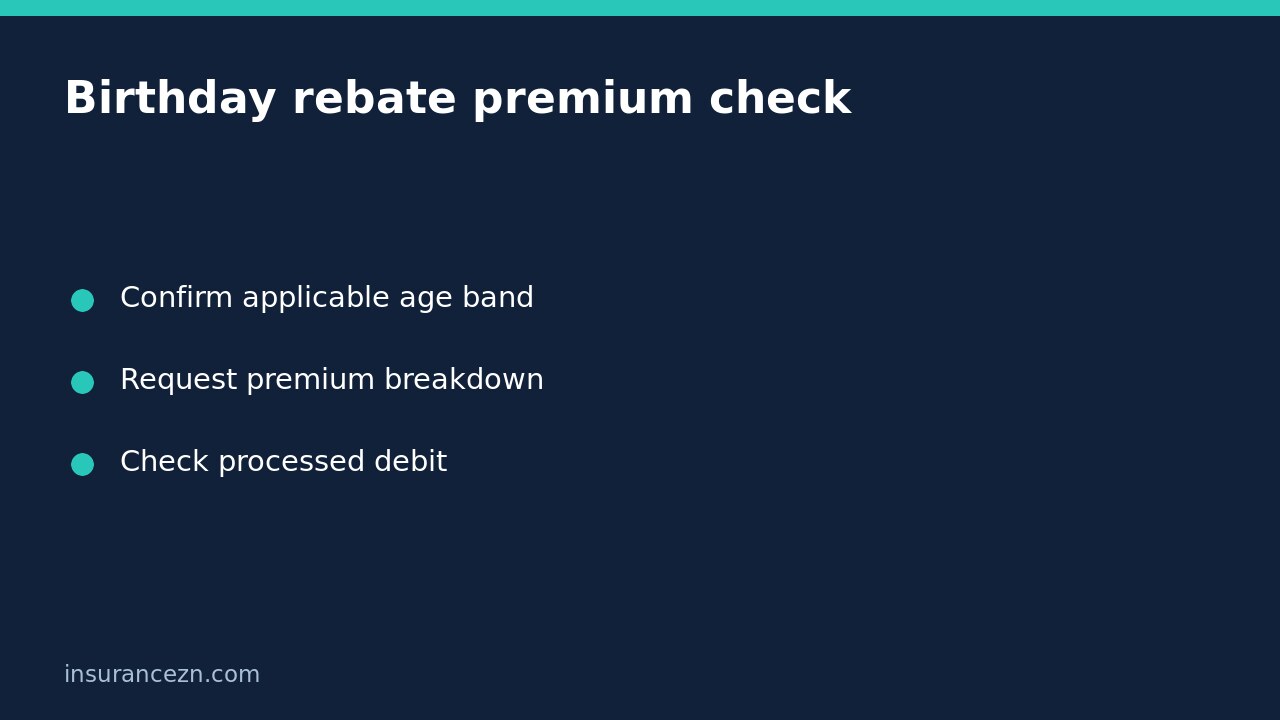

If you are turning 65 or 70, ask your health insurer whether your Australian Government private health insurance rebate age band changes and how that affects your next premium. Do not assume a birthday guarantees a particular bank debit: the applicable income tier, rebate-claiming method and other premium components also matter. Obtain the effective date and a processed premium breakdown before changing your budget.
This is general information for Australian readers, not personal financial advice. Eligibility and benefits depend on applicable rules and your circumstances. Read your policy documents, PDS where applicable and insurer terms; seek qualified tax advice for your tax position.
Start with the rebate, not an assumed birthday discount
The Australian Government’s private health insurance rebate overview shows different rebate bands for people under 65, aged 65–69 and aged 70 or over. The rebate is also income tested. An age-band change and an income-tier change are different inputs, so an older age alone does not establish the amount you will receive.
The overview describes rebates on eligible hospital, general treatment and ambulance policies from registered Australian health insurers. It does not extend the rebate to overseas visitors health cover. First confirm the kind of policy you actually hold rather than applying a birthday rule to every product with health insurance in its name.
Gather the records needed for a useful answer
Have your membership number, date of birth, current premium notice and rebate nomination available. If several people are insured, give the insurer the membership composition and ask which person’s age determines the applicable rebate treatment. Do not simply apply your own birthday to the entire membership without confirmation.
- Identify whether you currently receive the rebate through reduced premiums or claim it at tax time.
- Record the income tier presently nominated with the insurer.
- Keep the notice showing the premium before your birthday.
- Ask for the age band, effective date and billing period used after the change.
- Check whether another premium adjustment occurs at the same time.
You do not need to send identity documents through an unsolicited email. Use the fund’s verified member portal or an independently checked contact channel and ask what evidence it actually requires.
Request a like-for-like premium breakdown
Ask the insurer to show the premium before rebate, the rebate applied and the amount payable for the same policy and payment period. Where relevant, request separate entries for Lifetime Health Cover loading and any other discount. The government overview explains that the rebate does not apply to the LHC loading component, even though it can apply to the standard premium component.
Here is a hypothetical administrative example, not a premium quote: a member turns 65 shortly before a scheduled debit. The fund confirms a changed age band, but a separate policy-price change also affects that billing period. The member compares both notices and asks which adjustment accounts for each difference. A smaller-than-expected saving is not automatically an incorrect rebate, and an unchanged debit is not proof the birthday was ignored.
For another independent premium component, see checking LHC loading removal and the next premium. A rebate age-band review does not itself establish that a loading has ended.
Separate a requested update from the processed result
Keep the response confirming what the insurer will do, then check the revised notice or member account. Record the effective date, next debit amount and whether any adjustment affects a previously paid period. Ask the insurer to explain its treatment; do not assume universal backdating, a cash refund or an immediate mid-cycle debit change.
If you claim the rebate as a tax offset rather than through premium reductions, an unchanged insurer debit may be consistent with that choice. The government overview distinguishes these two claiming methods. Ask the insurer and, where needed, a qualified tax adviser how the relevant information will appear in your records rather than claiming the same entitlement twice.
Questions before closing the check
Will turning 65 automatically make my premium cheaper? Not necessarily. Confirm rebate eligibility and the applicable tier, then examine the whole premium rather than one component.
Can I rely on a table saved last year? Use the government overview for the period being reviewed. Rebate tables identify their applicable dates; an old percentage is not a current personalised estimate.
What if the next notice still looks wrong? Send the insurer the old and new notices, its written age-band response and the disputed billing period. Ask it to confirm the processed record, any correction and the remaining amount due. Keep ordinary payment obligations under review rather than cancelling a debit on an unverified assumption.