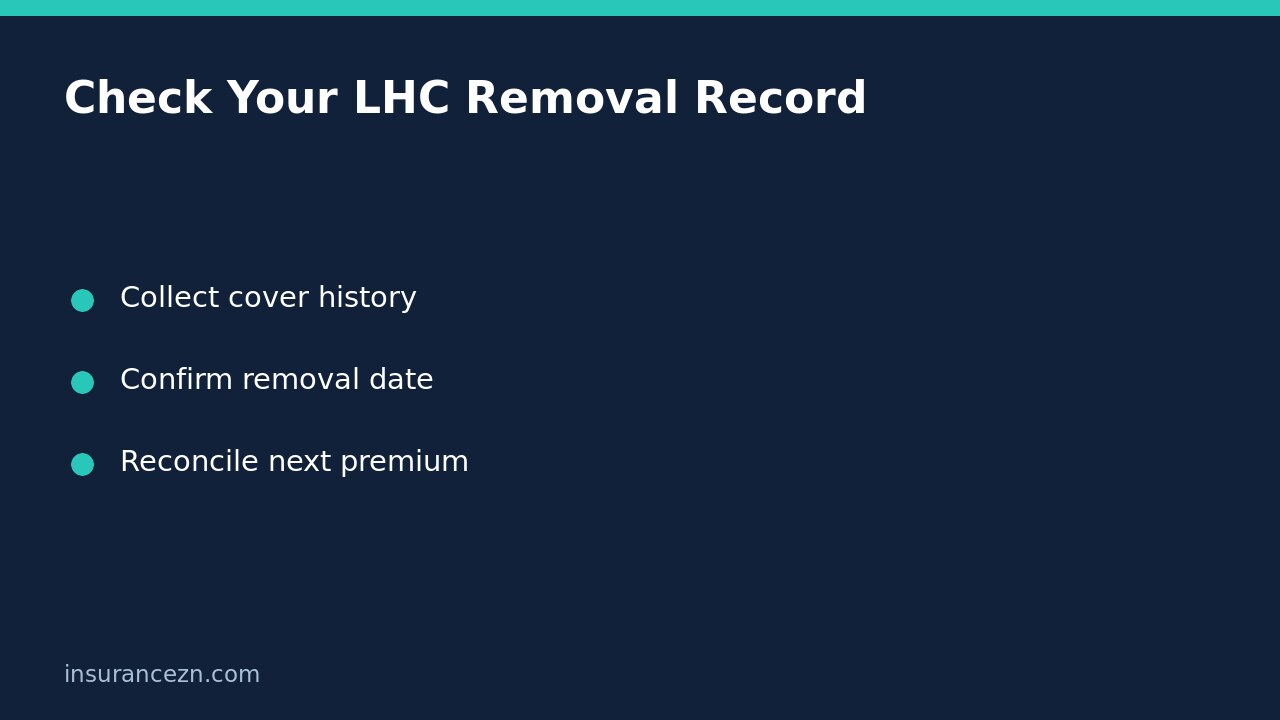

If you have paid Lifetime Health Cover loading for about ten years, ask your health insurer to confirm the recorded removal date and the premium payable after it changes. Do not simply subtract the loading from your next debit because a calendar anniversary has arrived. Qualifying cover history, permitted breaks and other premium components need to be reconciled first.
This is general information for Australian readers, not personal financial advice. Your policy, fund rules and any applicable PDS or other policy documents govern benefits and charges. Obtain a written assessment of your own cover history rather than treating this checklist as a personal loading calculation.
What the ten-year rule refers to
The Australian Government’s Lifetime Health Cover explanation says LHC loading is removed after ten continuous years of hospital cover with the loading. It also explains that permitted breaks can interrupt the calendar timeline without counting towards those ten years. Consequently, ten years since first joining a fund is not necessarily the same as ten years accumulated towards loading removal.
LHC applies to hospital cover, not extras. The official guide also distinguishes complying Australian hospital cover from products such as overseas visitors cover, overseas student cover and international insurance. Do not count every insurance policy you have held as qualifying hospital cover just because it paid some medical expenses.
Make a timeline before asking for a premium correction
Collect the records you already have and list the periods in date order. Useful material includes membership start and end confirmations, previous premium notices showing a loading, transfer documentation, and any approved suspension correspondence. Mark uncertain dates instead of filling them with guesses.
For each period, note the insurer, hospital product, start date, end date and any break. Keep extras-only periods separate. If you have changed insurers, the official guidance identifies a clearance certificate from the previous insurer as a document used to establish earlier loading and other cover information. Ask the current insurer what is missing from its record before requesting duplicate paperwork indiscriminately.
Ask how breaks affect the removal date
PrivateHealth.gov.au explains that permitted days without hospital cover do not count towards the ten-year period. A permitted break therefore does not necessarily increase the loading, but it can still move the date when loading is removed. These are different effects and should be checked separately.
The guide also explains that exhausting permitted days can break continuity and lead to a new loading and a restarted ten-year period on rejoining. Do not assume any break is permitted solely because it was short or involved overseas travel. Ask the insurer to identify how each gap or suspension has been classified and which supporting evidence it used.
A loading assessment also says nothing by itself about treatment waiting periods. The official source explicitly warns that permitted absences for LHC purposes do not establish that waiting periods will be preserved. If treatment is planned, request that assessment separately.
Use a precise written request
A useful enquiry is more specific than asking whether you have paid enough years. For example:
Please confirm my current LHC loading, the qualifying hospital-cover history recorded towards its removal, and the expected removal date. Please identify any excluded periods or missing transfer records. Once assessed, please confirm the hospital premium and total membership payment from the effective date, including the next debit amount.
This is an administrative request, not evidence that a correction has already been processed. Keep the reference number and ask when to expect an assessed response. If the fund needs further records, obtain the exact document description and relevant dates before sending sensitive information.
Check the processed premium, not just the acknowledgement
Consider someone whose own records show a decade since joining but who also had an approved suspension. Their first task is to reconcile the qualifying timeline, not to assume the insurer has overcharged. Once the fund confirms the removal date, the next task is to inspect the updated premium notice and payment record.
Even when loading is removed, the total debit may include extras and may be affected by other changes. Ask for an itemised before-and-after explanation for the same cover and payment period. A different total does not automatically mean the loading remains, and an acknowledgement of the enquiry does not prove it has been removed.
For another hospital-cost distinction, read why the hospital excess is not your total bill. Reducing a premium component does not change treatment inclusion, excesses or medical gaps by itself.
Final checks before changing your budget
- Has the insurer confirmed the assessed removal date in writing?
- Do the recorded hospital periods and breaks match your evidence?
- Does the revised notice show the processed loading position?
- Is the next payment amount confirmed for the correct period?
Can loading return later? The official guide says cancellation followed by later rejoining can make a person liable again. Removal now should not be interpreted as an unconditional lifetime exemption regardless of future cover history.