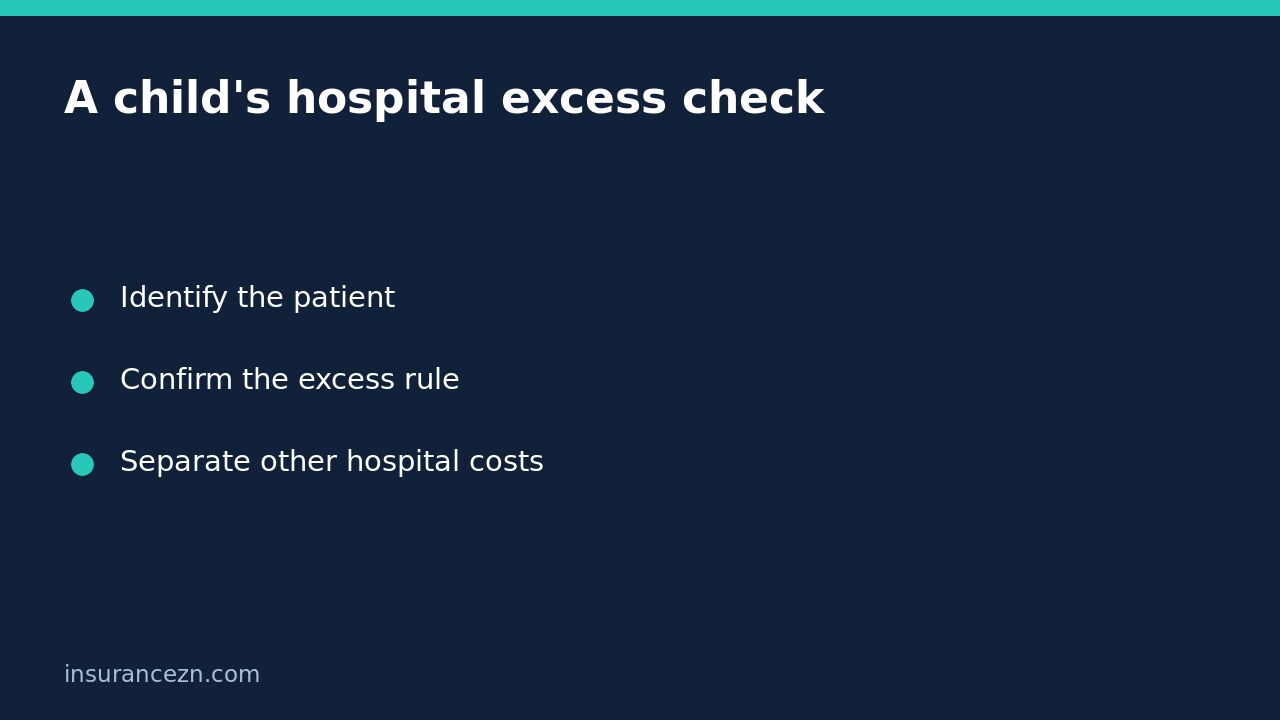

Before choosing a family hospital policy on price, ask how its excess would apply to the particular child needing treatment. Do not assume the adult excess automatically applies to every family member, or that describing someone as a dependant guarantees an exemption. Obtain the actual policy rule and a patient-specific estimate.
This is general information for Australian readers, not personal financial advice. Benefits depend on the policy, applicable rules, Product Disclosure Statement (PDS) where supplied, waiting periods, exclusions and individual circumstances. Do not delay necessary medical care for an insurance comparison.
Start with the child’s admission, not the headline premium
A family quote can show one excess figure without answering every question about who pays it. The government comparison website’s out-of-pocket costs guidance explains that people listed on a hospital policy may need to pay an excess for hospital treatment, and that its frequency depends on the policy. It also distinguishes an excess from a daily co-payment.
That guidance does not establish a universal child exemption. Ask the fund whether the quoted excess applies to your child under the particular product. If the fund describes an exemption or reduced amount, request the exact eligibility wording, relevant age definition, admission conditions and effective date. A marketing summary is not a substitute for matching that wording to your membership.
Give the insurer enough information to answer precisely
Use the child’s correct membership details and the proposed treatment information. Ask the treating team for relevant MBS item numbers where available, the hospital name and the anticipated admission date. A telephone question about an unspecified family admission may produce an answer too general for budgeting.
- Is this child correctly listed on the membership for the proposed date?
- What excess, if any, applies to this patient’s admission?
- Does any exemption depend on age, admission type or another condition?
- Are co-payments separate, and what limits apply?
- Does an earlier admission affect the remaining excess obligation?
- Is the treatment included, with relevant waiting periods satisfied?
These are separate questions. Correct membership does not establish treatment eligibility, and treatment eligibility does not establish that every account will be paid.
Compare premiums using two clearly labelled scenarios
Build a small worksheet for each otherwise comparable policy. Record the premium for the same period, the child’s confirmed excess rule, any co-payment and other estimated patient costs. Keep a no-admission scenario separate from a scenario involving the planned admission. Do not turn a possible expense into a certain annual charge.
For example, one quote might advertise a lower family premium while another appears to have a more favourable child excess rule. First confirm that both include the relevant treatment and that the apparent rule actually applies to your child. Then compare the written admission estimates. This is a comparison method, not a claim that either product will be cheaper or suitable.
If changing policies, ask about the treatment date, accepted commencement and any new or increased benefits before cancelling existing cover. A submitted application is not confirmation that the new membership and benefits are operating.
A waived excess is not a zero-cost admission
The government guidance separates medical fees from hospital fees. Doctors may charge above the amount used to calculate benefits, and gap arrangements need checking for the actual episode. A hospital agreement also does not erase an applicable excess or co-payment.
Obtain the hospital estimate and separate estimates from the surgeon, anaesthetist and other relevant clinicians. Ask whether each estimate includes any excess already collected, so that the same charge is not counted twice. Keep each provider’s account and any deposit receipt together.
Our explanation of why the hospital excess is not your total bill provides a broader framework for reconciling these separate amounts.
Final checks before relying on the comparison
Does a dependant label settle the excess? No. Match the insurer’s patient and excess definitions to the particular child and admission.
What evidence should I keep? Save the dated quote, policy wording, written patient-specific response and hospital estimate. If answers conflict, ask the fund to reconcile them rather than selecting the answer you prefer.
What if the estimate changes? Ask what changed in the patient details, treatment, hospital or applicable rules. Obtain an updated breakdown. Neither an earlier estimate nor an excess exemption is an unconditional promise about the final claim assessment.