
Two insurance quotes can display the same life, total and permanent disability (TPD), and critical-illness amounts yet leave very different protection after a claim. The important question is not just how much each line promises initially, but whether payment under one benefit reduces or ends another.
This is general information for Australian readers, not personal financial advice. Read the applicable Product Disclosure Statement (PDS), policy schedule, definitions, exclusions and accepted terms. The examples below use TAL’s published explanations to show what to investigate; they are not universal rules for Australian policies or recommendations of a provider.
Separate the product label from the benefit relationship
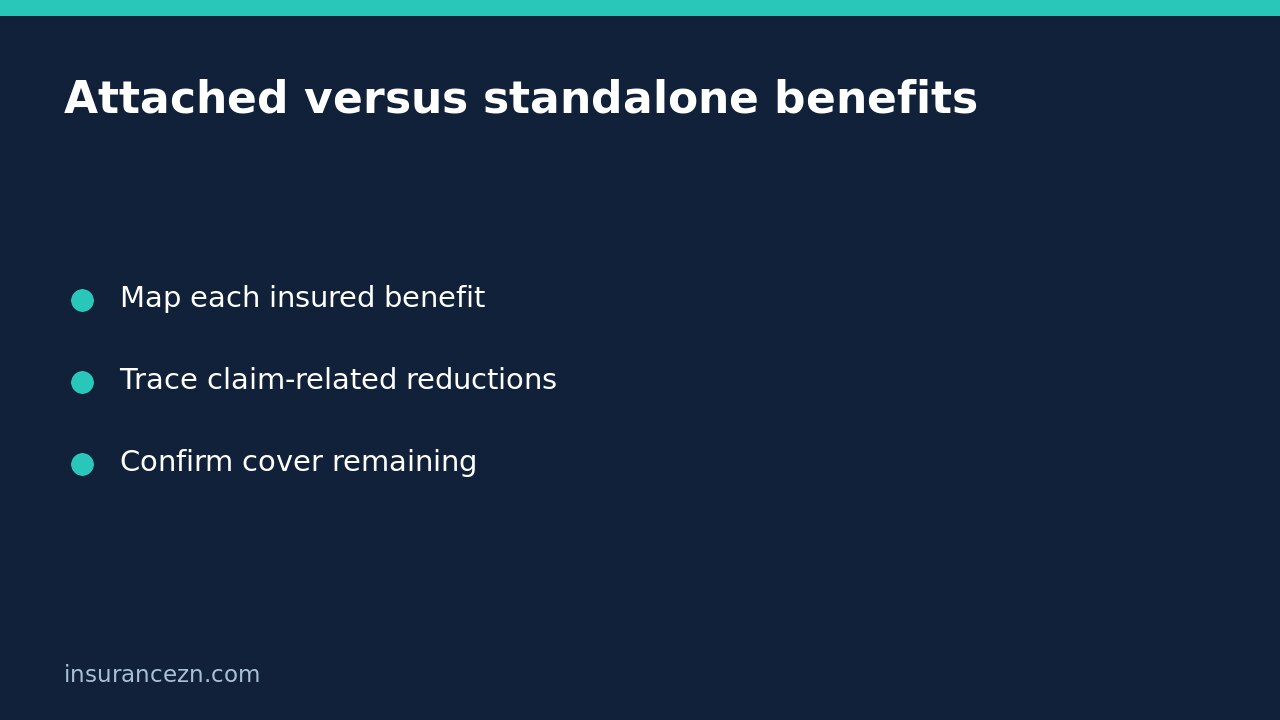
In its explanation of policy structures, TAL distinguishes standalone plans from attached plans. It says a claim under a standalone plan does not reduce the benefit amount of another standalone plan. For attached plans, it says payment under one plan reduces benefit amounts on the other plans to which it is attached. Its explanation also identifies common ownership and issue under one policy for attached plans.
That distinction matters more than a marketing label such as ‘bundle’. A package name does not, by itself, tell you whether benefits are independent. Nor should you assume that every provider uses ‘attached’, ‘linked’ or ‘standalone’ in precisely the same way. Ask the insurer to point to the clauses governing your proposed structure.
Draw a before-and-after benefit map
Start with the schedule, not a total formed by adding every advertised benefit. Record each insured person, benefit type, amount, owner, relationship to other benefits and any relevant option. Then ask what happens after a claim under each component.
- If critical-illness cover pays, which life or TPD amounts change?
- Does a partial payment have a different effect from a full payment?
- Can one benefit end while others continue?
- Does the event affect premiums, automatic increases or optional benefits?
- Are any restoration or buy-back options available, and on what conditions?
The purpose is to discover the contract’s answer, not to assume a restoration option exists. If an option is available, request its timing, eligibility, cost and exclusions separately. A discussion with a consultant is not proof that an option has been selected and recorded.
Use one claim scenario to compare competing quotes
Imagine a household considering life and critical-illness cover. Rather than merely adding both quoted amounts and calling that the family’s protection, ask both insurers for the same scenario: a qualifying critical-illness claim has been paid, the insured survives, and the family wants to know what death cover remains.
For an attached structure, request the revised schedule or a written illustration of the reduction mechanism. For a standalone structure, confirm that the other standalone benefit is not reduced by that payment, while still checking its own expiry, exclusions and ongoing premium requirements. Neither illustration guarantees that a real claim meets the relevant medical definition.
Compare the premium alongside the remaining protection. A lower initial price is not an equivalent comparison if one arrangement leaves less cover after the event you are considering. Equally, do not assume a more expensive structure is automatically appropriate for your circumstances.
Check cancellation as well as dollar reductions
Some interactions concern the end of a plan rather than just subtracting a payment. On its life-insurance overview, TAL says that payment of its Terminal Illness Benefit results in cancellation of attached or linked plans. That is a provider-specific example of why asking only ‘What amount is deducted?’ may miss an important consequence.
Ask the insurer to explain both reductions and cancellation triggers for the exact policy version. Do not assume a terminal-illness provision works like a critical-illness provision, or that an older contract matches a current product webpage. The applicable contract and assessment remain essential.
Obtain the processed position after an actual payment
If a claim has already been paid, request confirmation of which benefit was assessed, the payment amount, which other plans were reduced or cancelled, the effective dates and the next premium. Compare this with the updated schedule and account record.
A payment receipt confirms money moved; it does not explain the status of every remaining benefit. Likewise, a request to restore cover is not acceptance of that restoration. Resolve discrepancies through the insurer before relying on an assumed balance.
For the separate question of whether voluntarily reduced cover can later be increased, see questions to ask before reducing life cover. Voluntary reductions and claim-triggered changes are different processes, even though both affect future protection.
Quick comparison checklist
Can I add every benefit amount together? Not safely without checking how the benefits interact.
Does standalone mean every claim is payable? No. Independence from another plan’s payment does not remove the standalone plan’s eligibility conditions.
What evidence should I retain? Keep the quote, schedule, relevant relationship clauses, written claim scenarios, accepted options and any post-claim amended schedule together. A clear before-and-after map makes a comparison more useful than a headline bundle discount alone.