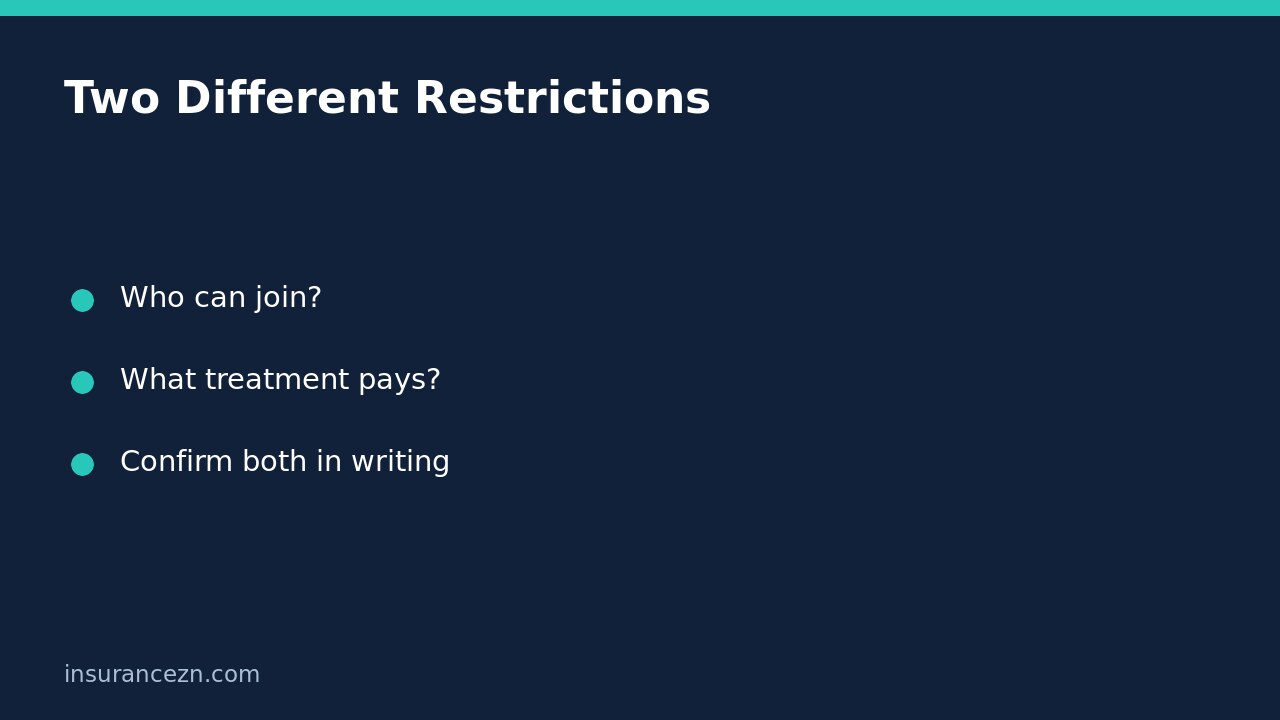

A restricted health insurer and a policy with restricted benefits are not the same thing. In Australia, the first term concerns who can join the insurer. The second concerns the level of benefits for particular treatment. Being eligible to join a fund does not establish that its policy will adequately cover your planned admission.
This is general information for Australian readers, not personal financial advice. Benefits depend on the specific policy, fund rules, applicable waiting periods and policy documents or PDS where applicable. Obtain individual confirmation before relying on cover.
Start with the membership question
PrivateHealth.gov.au’s restricted-insurer overview explains that restricted insurers cover members of a specific industry or group. Some also admit family members. The directory includes different eligibility descriptions, so do not assume that every fund uses the same definition of employee, former employee or family.
For example, someone whose parent worked in an eligible industry might investigate a family membership pathway. That connection is a reason to ask the fund about eligibility, not proof that an application will be accepted. Ask which relationship qualifies, whether current or previous employment counts, and what evidence is required. Avoid sending unnecessary identity documents until the insurer identifies its secure process.
Then ask the separate treatment question
According to PrivateHealth.gov.au’s policy-management explanation, restricted benefits mean limited cover for certain conditions or services. Significant out-of-pocket costs can remain when receiving that treatment as a private patient. An exclusion is different again: the policy does not cover the excluded treatment as a private patient in a public or private hospital.
A fund’s restricted membership does not tell you whether a particular clinical category is included, restricted or excluded on the product you are considering. Equally, an insurer open to the general public can sell a policy with restricted benefits. Read the actual product information rather than treating the insurer’s name or membership rules as a benefits summary.
Use a two-column enquiry before applying
Keep two headings in your notes: membership eligibility and treatment benefits. Under the first, record the qualifying relationship, requested evidence, people to be insured and the insurer’s response. Under the second, record the exact policy name, treatment category, relevant item numbers supplied by your clinician, hospital and proposed admission date.
Send questions such as: ‘Am I eligible to join through this family relationship?’ and separately, ‘On this product, is this treatment included, restricted or excluded, and what hospital benefits would apply at this facility?’ Ask the insurer to identify any waiting periods and other conditions. A membership application acknowledgement answers neither question conclusively.
A practical example: eligible family, uncertain admission
Imagine a reader can join a restricted fund through a family connection and is considering planned joint surgery. Membership acceptance would resolve access to the fund, but not the operation’s funding. The reader should obtain the clinician’s treatment description, check the correct category and request a benefits assessment for the specific policy and hospital.
If restricted benefits apply, ask for a written explanation of the likely benefit and obtain the hospital’s own estimate of the balance. Discuss medical fees separately with the doctors involved. Do not describe a hospital booking, insurer membership number or accepted application as a promise that the full bill will be paid. Necessary care should not be delayed solely to complete insurance administration.
What to check before switching
If a different product offers broader benefits, establish when those benefits become available. PrivateHealth.gov.au explains that transferring to new or higher benefits can involve waiting periods, while continuity rules matter when changing insurers. Do not cancel existing cover merely because a new application was submitted.
Also read our explanation of why an agreement hospital does not automatically mean no gap. Membership eligibility, treatment inclusion and the final bill remain separate checks even after the correct policy is selected.
Quick questions to keep together
- Does the insurer confirm my eligibility and the family members included?
- Is the exact treatment included, restricted or excluded?
- What waiting periods and effective dates apply to this person?
- What hospital and medical expenses may remain unpaid?
- Have I received a processed membership outcome and a separate written benefits explanation?
Does restricted membership mean poor cover? No such conclusion follows from the term alone. Compare the actual product and your needs. Does unrestricted membership guarantee full treatment benefits? No. Joining rules do not replace the policy’s treatment conditions or a personal cost estimate.