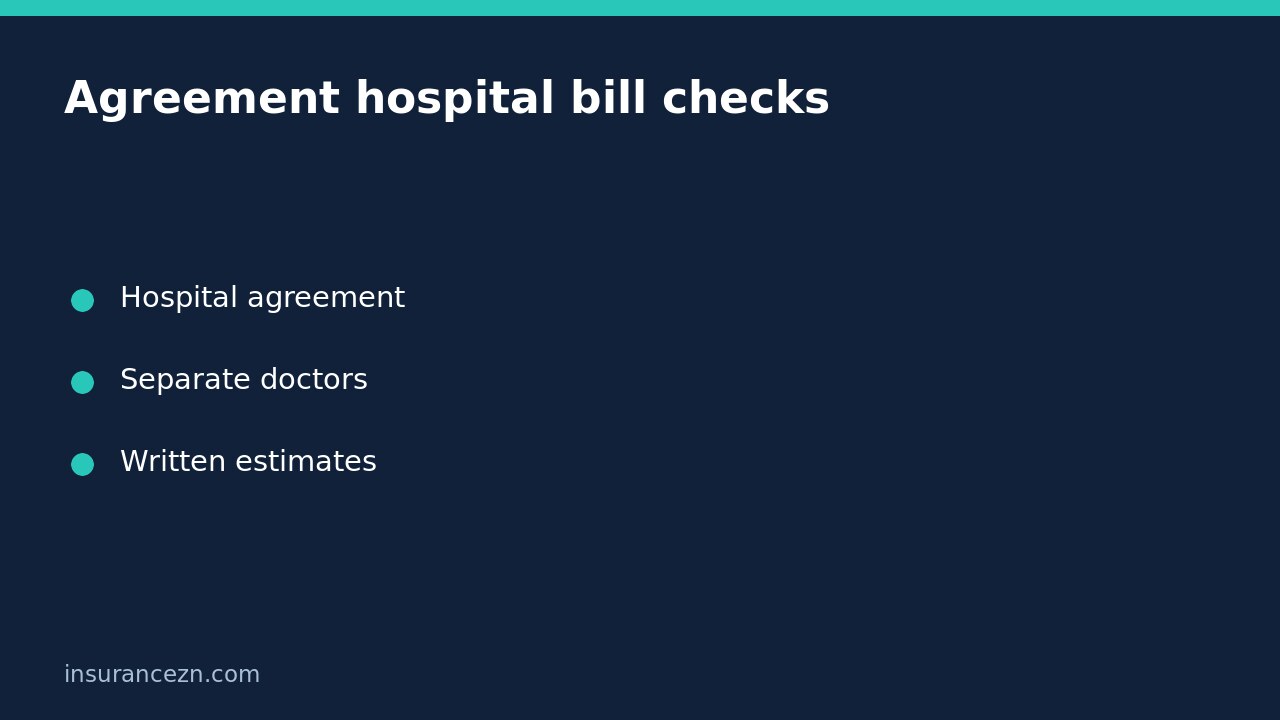

An agreement hospital has an arrangement with your health insurer, but that does not automatically make your entire private admission free. Your policy may still require an excess or co-payment, and the doctors treating you may bill separately. Before a planned admission, check the hospital account and each medical account as different questions.
This is general information for Australian readers, not personal financial advice. Benefits depend on your policy terms, applicable PDS or fund rules, exclusions, waiting periods and treatment eligibility. Written estimates help you plan but are not a guarantee of the final bill.
Separate the hospital agreement from the medical gap scheme
The Australian Government comparison website, PrivateHealth.gov.au, distinguishes hospital charges from medical fees. Hospital services can include accommodation and theatre use. Medical fees can come from the surgeon, assistant surgeon, anaesthetist and other treating providers.
An agreement between a hospital and insurer addresses hospital benefits under that arrangement. A medical gap scheme concerns participating doctors and the fees they charge. These are not interchangeable. A doctor may decide whether to use an insurer’s gap arrangement for a particular admission, so a general statement that the doctor participates is not enough.
Ask both the insurer and the doctor’s office whether the scheme will apply to your proposed services. Do not infer that the anaesthetist is included because the surgeon has confirmed a no-gap arrangement.
Build a three-part admission worksheet
Start with the exact hospital name, proposed admission date and expected procedure details. Obtain expected Medicare Benefits Schedule item numbers from the treating doctor, then use the same details in each enquiry. If the clinical plan changes, ask for updated estimates.
- Insurer confirmation: ask whether your policy covers the proposed treatment, whether relevant waiting periods have been served, and whether the named hospital has an applicable agreement. Ask about restrictions and exclusions, not just the policy tier.
- Hospital estimate: request your expected excess, co-payment and any other hospital charges in writing. Ask which services or items fall outside the estimate and when payment is required.
- Medical estimates: obtain a separate estimate from each known treating doctor. Ask what Medicare and insurer benefits are expected, what you must pay, and whether a gap arrangement will be used for this admission.
Keep the responses together with dates, reference numbers and the staff member’s role. If one party tells you to ask another, record the unanswered question instead of treating the referral as confirmation.
Example: the hospital says yes, but a doctor has not answered
Imagine a patient whose insurer confirms an agreement with the hospital. The hospital provides a written estimate, and the surgeon confirms their proposed fee arrangement. The anaesthetist has not yet provided a quote. This is an incomplete cost picture, not a no-gap admission.
The next practical step is to ask the surgeon’s office how to contact the anaesthetist and request a separate estimate. The patient can then check the expected benefit and any remaining amount with the insurer. No premium, benefit or final charge can safely be calculated from the hospital agreement alone.
For urgent care, obtaining every estimate in advance may not be practicable. Ask about costs as soon as circumstances permit; do not delay urgent medical assessment to finish a financial worksheet.
Resolve conflicting answers before relying on them
If the hospital says there is an agreement but the insurer cannot confirm it, first check the facility’s exact name and location. A brand may operate more than one facility. Then ask each party to review the proposed admission details and identify what their answer covers.
If a doctor’s estimate seems inconsistent with the insurer’s benefit advice, ask whether both used the same item numbers and fee arrangement. Do not assume the difference is an error or a promise that someone else will absorb it. Request a revised written explanation.
Quick questions before admission
- Is the hospital agreement confirmed for the proposed treatment?
- What hospital amounts remain payable despite that agreement?
- Have all known doctors supplied separate estimates?
- Does each stated gap arrangement apply to this admission?
- Who will update the estimate if treatment changes?
Does paying an excess settle every bill? No. It is one potential hospital contribution, not a substitute for checking separate medical fees. For the broader habit of testing precise policy wording, see our worked explanation of checking a defined policy term; that article concerns travel cover, not hospital benefits.