
An optical benefit does not mean every charge at an optometrist is payable by your health fund. Before ordering glasses or contact lenses, separate the consultation from the products, then ask the insurer what it would pay for the exact proposed purchase. An advertised annual optical limit is not a promise that your entire shopping basket will be reimbursed.
This is general information for Australian readers, not personal financial advice. Benefits depend on your policy, applicable PDS or fund rules, exclusions, waiting periods and available limits. Obtain confirmation for your own membership before relying on a rebate.
What does optical mean in extras cover?
The Australian Government’s General Treatments explanation describes optical as including prescription lenses, spectacle frames and contact lenses. It also explains that insurers do not pay benefits for optometrist consultations because those consultations are generally eligible for Medicare benefits.
That distinction is important: a consultation and a pair of spectacles may appear on the same practice’s paperwork, but they are not the same benefit. Do not assume Medicare will pay every consultation charge either. Ask the practice about the service, Medicare eligibility and any patient charge separately. The government description is a starting point, not a list of every product your particular fund accepts.
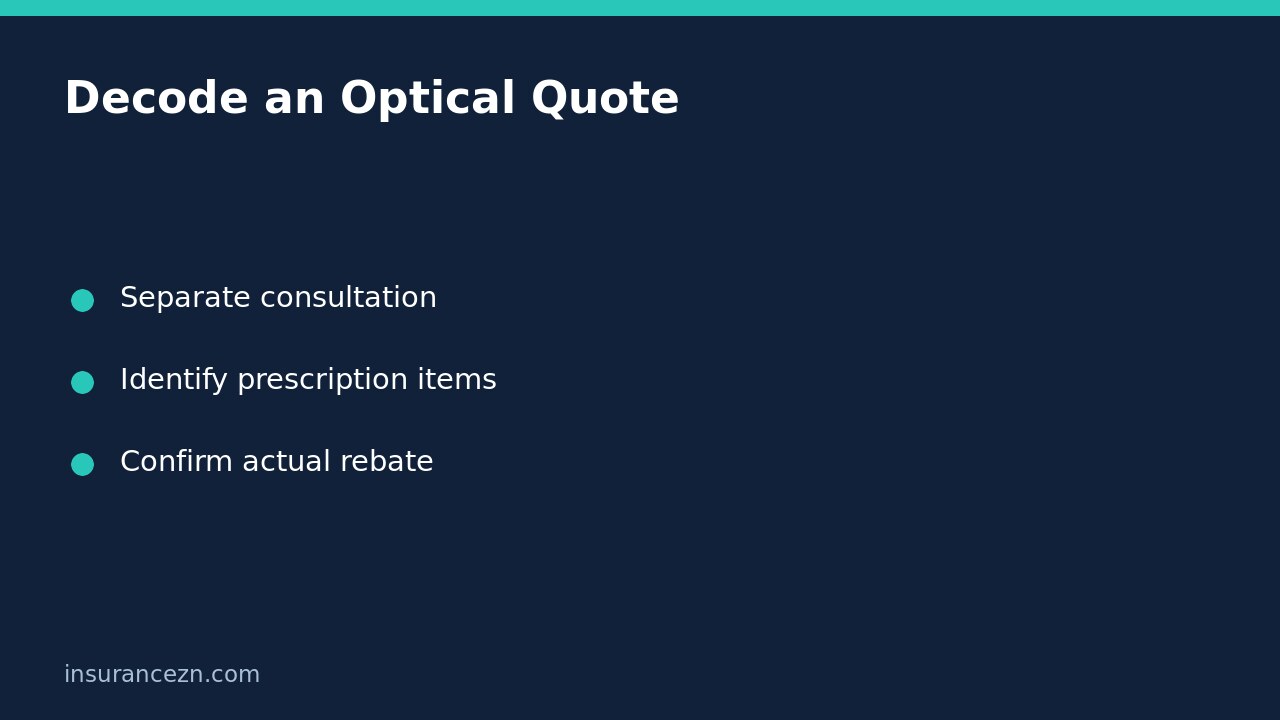
Ask for an itemised quote before ordering
Request a written quote that shows the consultation separately from frames, prescription lenses and contact lenses. Ask the practice to identify any optional lens treatments, additional pairs or other extras as their own lines. Do not decide that an optional feature is insured simply because it is sold with a prescription product.
- Record the name and location of the dispensing provider.
- Ask for product descriptions and any claiming codes the practice uses.
- Distinguish the price before insurance from the estimated rebate and patient balance.
- Ask whether the quote assumes a particular insurer arrangement or promotion.
There is no need to publish your prescription online to obtain general help. Send personal and clinical details only through the practice’s or insurer’s appropriate secure channel.
Turn the quote into a benefit enquiry
Send the actual items to the fund rather than asking only, ‘Am I covered for optical?’ Ask which lines are eligible, what benefit applies to each and whether any item-specific or combined limit changes the result. Check waiting periods, the remaining allowance, provider recognition and the date the fund uses to allocate a claim. These are policy-specific questions, not universal rules.
A useful enquiry is: ‘Please confirm the estimated benefit for the attached frames and prescription lenses under my current membership. Please identify any excluded components, limits already used, provider requirements and the relevant claim date. I have not authorised an order or policy change.’
Keep the reply with the dated quote. If the optometrist gives a different rebate estimate, ask both parties to reconcile the same products and membership details before treating either figure as settled.
A worked purchase check without assuming a payout
Imagine a fictional quote containing an eye examination, a frame, prescription lenses and an optional lens treatment. First ask the practice how the examination is billed. Then ask the insurer to assess the frame, lenses and optional treatment individually. Finally, compare the confirmed eligible benefit with the amount you actually expect to pay.
Do not deduct your full annual optical allowance from the whole invoice automatically. The allowance may be only a ceiling, while benefit rules determine the amount for the actual purchase. If you have already claimed contact lenses, ask whether those earlier benefits affect this glasses purchase. Do not assume separate products have separate untouched pools.
Questions to settle at collection
Check that the final invoice matches the quoted products and that any insurer payment or deposit is shown correctly. If a product changed after the estimate, request a fresh benefit check. Retain an itemised receipt and the rebate statement so a later query can identify exactly what was purchased and paid.
Does an optical limit cover an eye test? Not by itself. Clarify consultation billing separately from insured optical products.
Does unused optical cover make every upgrade free? No. Eligibility, item benefits and remaining limits still need confirmation.
For another example of why a benefit summary needs follow-up, read what to ask when a PHIS says ‘Other services’. A short summary is useful for comparison, but it cannot replace product-specific answers.