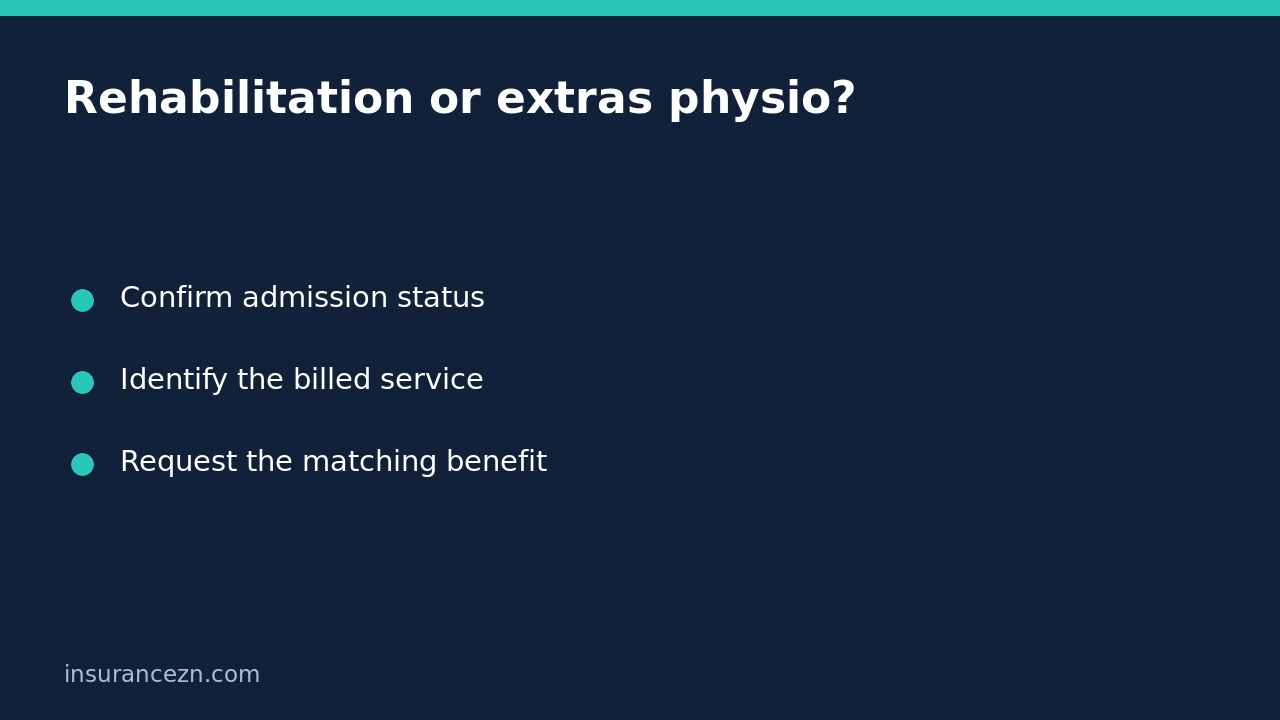

A session called rehabilitation is not automatically a hospital-insurance claim. Before relying on a benefit, establish whether you are receiving admitted hospital rehabilitation or a separately billed non-admitted physiotherapy appointment. The location, referral wording and therapist’s profession do not by themselves identify the benefit that applies.
This is general information for Australian readers, not personal financial advice. Benefits depend on your policy wording, fund rules, waiting periods, limits and exclusions. Read the policy documents and any applicable PDS, and obtain an estimate for your actual treatment.
What the hospital rehabilitation category means
The Australian Government’s clinical categories explanation describes Rehabilitation as hospital treatment for physical rehabilitation related to surgery or illness. Its examples include inpatient and admitted day-patient rehabilitation, stroke recovery and cardiac rehabilitation.
The word admitted matters. Attending a facility during the day does not establish that you are an admitted day patient. Equally, a rehabilitation appointment inside a hospital building should not automatically be treated as a hospital admission. Ask the facility to confirm the administrative status of the exact appointment, rather than inferring it from its address or programme name.
A doctor’s recommendation establishes a clinical reason for care, not the amount your insurer will pay. Even when the treatment fits a hospital category, your particular policy’s level of benefit and the proposed admission still need checking.
Where extras physiotherapy fits
The government’s general treatment definitions describe physiotherapy as treatment of injury, disease and disorders through physical methods, including manual therapies and exercise programmes. That explains the service; it does not promise that every physiotherapy appointment attracts an extras benefit.
For a separately billed appointment, give the insurer the practitioner, provider number, service description, appointment date and quoted charge. Ask whether that exact service is eligible under your extras product, what waiting period applies, and what personal or shared limit remains. A familiar therapist or a previous successful claim is not confirmation for a differently billed service.
Build two records when care crosses settings
Consider a hypothetical recovery plan involving an admitted rehabilitation programme followed by community physiotherapy. Do not combine everything under one label such as post-operative rehab. Create separate entries for the hospital episode and the later appointments.
- Hospital entry: record the facility, admission dates, proposed rehabilitation programme, patient status and written cost estimate.
- Appointment entry: record each non-admitted service, practitioner, fee and proposed extras claim details.
- Insurer response: attach the benefit estimate to the matching entry, including assumptions and outstanding approval requirements.
- Personal cost: reconcile provider charges against that entry’s estimated benefits, keeping hospital excesses, co-payments and other gaps identifiable.
This approach prevents an extras annual allowance being mistaken for funding for an entire hospital programme. It also avoids assuming that hospital rehabilitation inclusion pays for every outpatient follow-up after discharge. Ask about any specific alternative funding arrangement separately; do not assume it exists.
Ask a precise question before confirming the booking
A useful enquiry is: “The facility says this appointment is non-admitted physiotherapy after my rehabilitation admission. Which benefit, if any, applies to this provider and service, and what is my estimated contribution?” For an admitted programme, replace those details with the actual admission and request the applicable hospital benefit explanation.
If the facility and insurer describe the service differently, ask them to reconcile the discrepancy before relying on an estimate. Keep the original referral, quote and replies. A submitted enquiry or pre-admission form is not proof that funding has been approved, and an estimate remains different from a final claim assessment.
For the separate issue of a hospital’s agreement status, read why an agreement hospital does not mean every bill has no gap. That check complements, rather than replaces, identifying the right benefit pathway.
Quick questions before treatment
Does a referral guarantee payment? No. Ask the insurer about the actual billed service and any requirements still outstanding.
Can I use the same estimate after the programme changes? Request an updated estimate if admission status, provider, dates or services change; the original assumptions may no longer apply.
What should I retain afterwards? Keep itemised invoices, admission details, claim submissions and assessments together. Compare the assessment with the service actually provided and request an explanation for discrepancies. Do not delay necessary medical attention while resolving insurance administration.