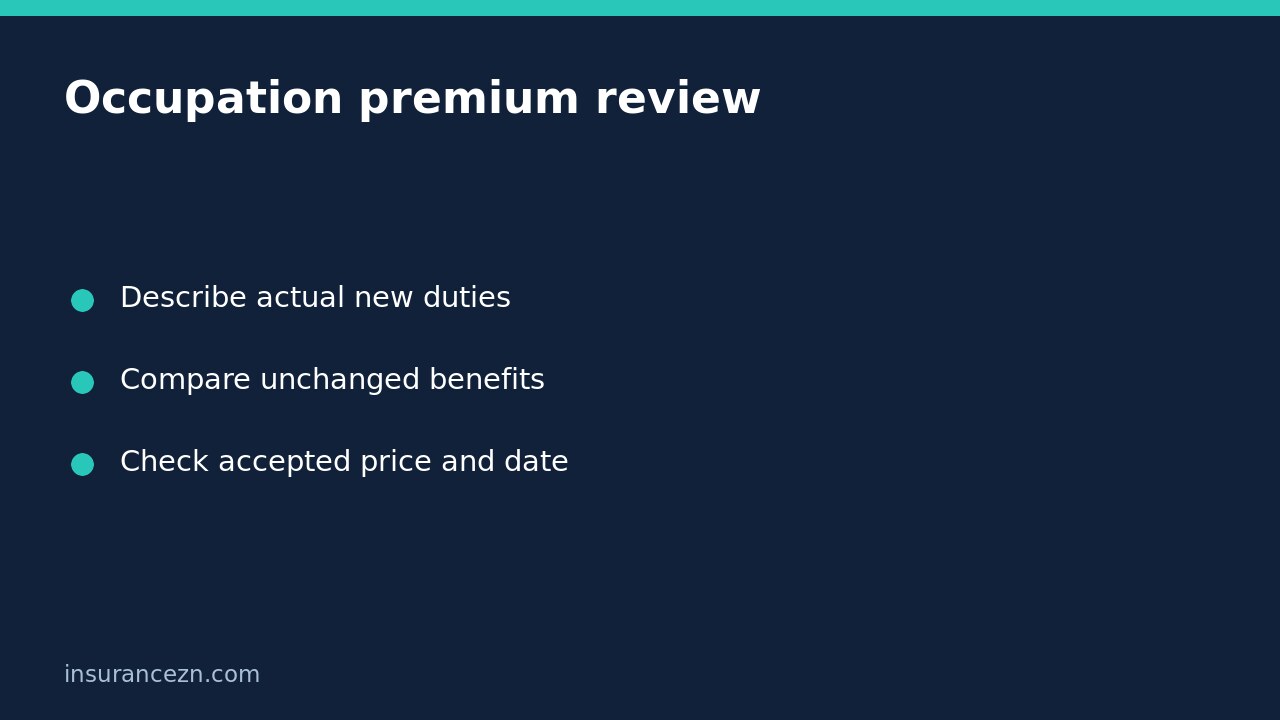

Moving from physical work into a desk-based role can be a reason to ask your life insurer whether your occupation classification and premium can be reviewed. It is not proof that a discount exists or that the insurer has already changed your price. Describe the actual duties, ask what your specific policy permits and obtain an accepted amendment before budgeting around a saving.
This is general information for Australian readers, not personal financial advice. Check your policy schedule, Product Disclosure Statement (PDS), endorsements and any relevant super fund rules. Occupation classifications, alteration requirements and benefits depend on the particular product. A premium review is not approval of a future insurance claim.
Start with the provider’s rule, not a universal assumption
TAL’s insurance FAQs say a change to a lower-risk occupation could support a request to alter a policy and potentially lower the premium. Its example involves a carpenter moving into an office-based construction role. The FAQ also says TAL assesses circumstances at application and does not require notification of subsequent health or occupation changes once accepted for the insurance.
Those are TAL’s explanations, not a rule for every Australian insurer or every product version. Ask your own provider to confirm the position for your existing policy. Distinguish a voluntary request for a potentially better price from any actual obligation to notify changes under your contract. For an application still underway or a request for new benefits, ask what information must be updated before acceptance.
Describe the work rather than selecting a convenient title
A title such as project manager does not tell an insurer whether you mostly prepare budgets or regularly work on roofs. Prepare a short, accurate duties summary. Include employment status, usual hours, work locations, site visits, manual tasks and any ongoing higher-risk activities. If the role is temporary, mixed or still changing, say so rather than presenting it as permanently office-only.
- Record the date the new duties actually started.
- Separate administrative work from physical tasks that continue.
- Explain supervision, travel and site exposure where relevant.
- Ask which evidence is required and how to send it securely.
Do not invent a percentage of desk work or omit occasional duties to fit a preferred classification. The insurer, not the job advertisement, decides how its categories apply. Keep a copy of the information you supplied so the eventual decision can be checked against it.
Compare the same benefits before calling it a saving
Request a comparison of the current arrangement and proposed occupation alteration with other settings held unchanged. List each insured benefit separately: life cover, total and permanent disability, critical illness and income protection where held. Ask which benefit premiums would change and which would not. A changed occupation classification need not affect every component in the same way.
Check insured amounts, definitions, waiting and benefit periods, exclusions, optional benefits, ownership and premium structure. Ask whether the proposal is an alteration of the existing policy or requires replacement or another application. Do not accept a lower total price as evidence of a favourable review if the quote also reduces benefits.
For example, a hypothetical construction worker moves into estimating but still visits active sites. The useful question is whether those actual duties qualify for a different classification while keeping the existing benefits, not whether the word estimator attracts a discount. If a quote changes both occupation and insured amounts, request a like-for-like version before comparing prices.
Verify acceptance, commencement and the first collection
Submitting a duties questionnaire or receiving a reference number does not mean the change is accepted. Obtain written confirmation of the classification accepted, affected benefits, new premium, effective date and any conditions. Do not assume a reduction will be backdated to the first day of the new job.
Then reconcile the confirmation with the updated schedule and first premium collection. If an adjustment or credit was promised, ask how it will appear and check the processed entry. A smaller debit on its own does not establish that all benefits were preserved; a written quote alone does not prove billing was updated.
When the review does not produce a lower price
Ask for the reason and whether the decision concerns your duties, the product’s classification rules or an alteration restriction. Do not reduce insured benefits automatically just to create the saving you expected. Our article on reducing life cover and possible restoration requirements explains why a benefit reduction is a separate decision.
Should I cancel first and reapply? Do not assume that is necessary. TAL’s FAQ warns that replacement can involve different terms, new health and lifestyle questions, restarted qualifying periods and lost accrued benefits. Get advice where appropriate and establish the accepted replacement arrangement before considering cancellation.
Does review acceptance guarantee a claim? No. An accepted pricing alteration and a later claim assessment are different outcomes. Keep the final confirmation with the policy records.