
An early payment from a life insurer can help a family meet immediate expenses after a death, but it does not necessarily mean the insurer has accepted the full death claim. Before committing that money to funeral arrangements, establish what the payment represents, what remains under assessment and whether repayment could be required.
This is general information for Australian readers, not personal financial advice. Benefits depend on the applicable policy, Product Disclosure Statement (PDS), schedule, exclusions and claim assessment. The TAL example below illustrates one provider’s published terms, not a rule for every life insurer.
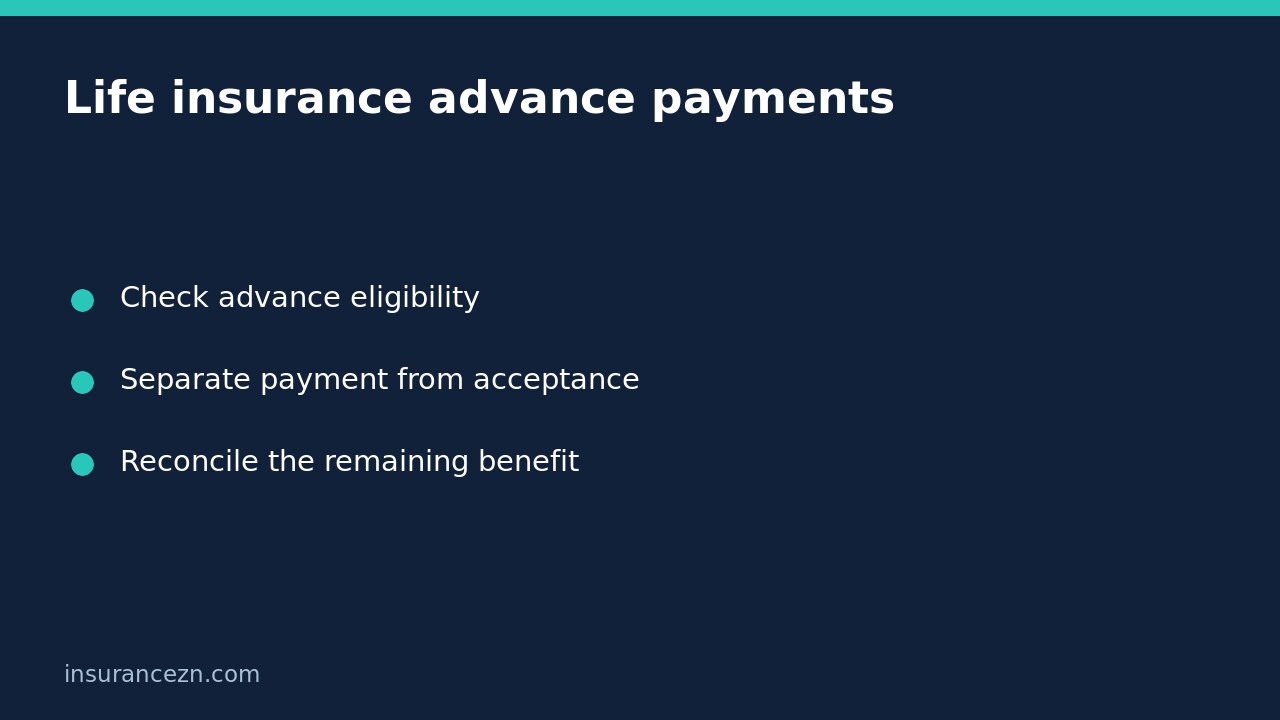
Read the advance clause separately from the death benefit
In its life-insurance product overview, TAL describes an Advanced Payment Benefit that pays part of the insured benefit after specified evidence of death is provided. Its explanation also says the payment does not constitute admission or acceptance of a claim or liability for current or future life-insurance payments.
Those are separate propositions: evidence can establish that a death occurred without resolving every contractual question about the claim. A family should therefore avoid treating a bank deposit, payment notification or acknowledgement of documents as a final assessment letter.
Ask the claims team to identify the exact benefit being paid and to confirm whether the main death claim is accepted, still being assessed or awaiting further information. Keep the response with the claim reference.
Check eligibility before promising payment to a funeral provider
TAL’s overview describes different cause-of-death conditions during the first three years of the plan and after that period. In the initial period, its advance is described as payable only for accidental death. Later, the overview describes broader causes subject to exclusions. These are TAL-specific conditions, not a universal waiting period for life insurance.
The useful comparison is the wording applying to the deceased person’s actual plan. Obtain the relevant start date, any applicable reinstatement provisions, required certificates and exclusions. Ask whether the policy is held directly or through another arrangement and who is authorised to receive information and payment. Do not infer payment timing or recipient rights from another family’s experience.
- Identify the insurer and policy number.
- Request the advance-payment clause for the applicable policy version.
- Confirm what evidence is required and whether it has been received.
- Obtain the insurer’s decision about advance eligibility and the actual amount.
- Keep funeral-provider payment terms separate from the insurer’s assessment timetable.
Reconcile the advance with the remaining benefit
TAL states that an advance reduces the benefit amount by the sum advanced. It is not automatically extra insurance on top of the main death benefit. Ask for a written reconciliation showing the starting benefit, advance paid, any other relevant adjustments and what remains subject to assessment.
For a hypothetical example, imagine a policy with a benefit recorded as 300,000 units and an advance of 10,000 units. If the contract deducts the advance, the starting reconciliation is 290,000 units remaining, before any other applicable adjustments. This is arithmetic illustrating a deduction, not a quote, entitlement or prediction of payment. The insurer must confirm the actual figures and assessment outcome.
When several relatives help with expenses, keep one payment ledger. Record the insurer’s payment separately from family contributions and funeral invoices so nobody accidentally counts the same money twice.
Ask about repayment before treating the money as unconditional
TAL’s published explanation says it will require repayment of the advance if its later assessment determines that the death benefit will not be paid because of a breach of the duty of disclosure or a misrepresentation. Do not extend that statement into an assertion that every insurer can reclaim every advance for any reason. Instead, ask the actual insurer which repayment provisions apply and request the relevant wording.
A practical enquiry is: ‘Please confirm whether this payment is an advance, what unresolved assessment matters remain, whether repayment could arise under this policy, and how the advance affects any final payment.’ If a decision is unclear or disputed, request the written reasons and complaint process rather than assuming an initial payment resolves the issue.
Quick questions for the family records
Does providing a death certificate finish the claim? Not necessarily. It may meet an evidence requirement for an advance without completing the full assessment.
Is funeral assistance always an additional benefit? No. Check whether it is deducted from the insured benefit, separately reimbursed or structured differently under the contract.
What should be kept together? Keep the policy wording, claim reference, certificates, advance decision, payment record and final assessment. For another useful identification step, see matching your life policy’s legal insurer name to APRA. Knowing the responsible insurer helps route questions, but does not establish claim entitlement.