
A life insurance premium freeze does not necessarily freeze your cover. A product may keep the premium steady by reducing the insured benefit at policy anniversaries. Before accepting that arrangement, ask for the benefit amounts you would retain and compare them with the financial need the policy is meant to address.
This is general information for Australian readers, not personal financial advice. Availability, eligibility and consequences depend on your policy, insurer and Product Disclosure Statement (PDS). A premium arrangement does not guarantee that a future claim will be accepted or paid.
Read the actual freeze mechanism
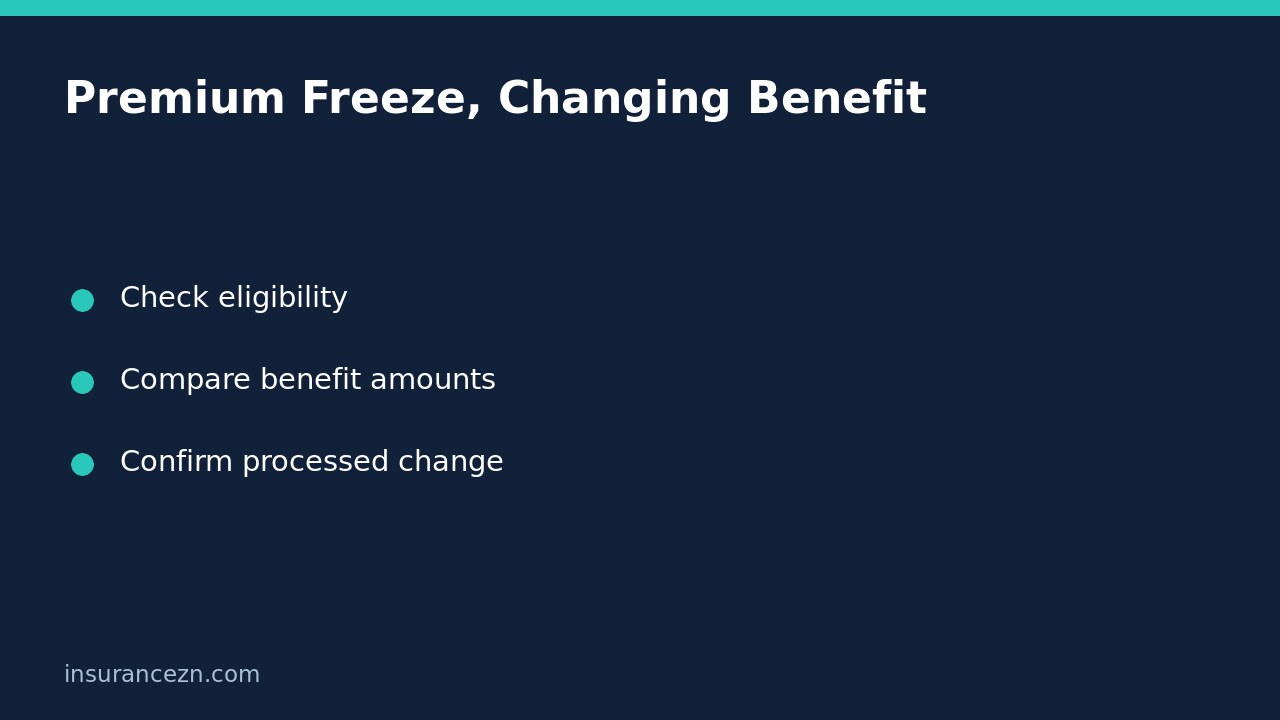
TAL’s life insurance page describes a Premium Freeze Benefit under which premiums stay the same while the Benefit Amount reduces at each policy anniversary. Its summary says this benefit can only be exercised where Variable Age-Stepped Premiums have been selected and the insured is at least 30. These are TAL’s stated product conditions, not rules applying to every Australian life policy.
The important distinction is between the price you pay and the amount insured. A steady debit can feel reassuring while the protection supporting your household changes. Check the PDS and schedule applicable to your own policy, rather than relying on a similarly named feature in a newer product.
Request an illustration with two separate columns
Ask your insurer for a written comparison of keeping the current arrangement and choosing the freeze. Request the premium and insured benefit separately at the next anniversary and at later points the insurer can illustrate. Ask which figures are guaranteed contractual amounts and which are projections or depend on future pricing assumptions.
- What benefit amount would apply immediately after the freeze starts?
- How is each later reduction calculated, and when is it applied?
- Which policies, insured people and benefit components would change?
- Are any fees or other amounts outside the stated frozen premium?
- How will the annual statement identify the new benefit?
Do not invent a future reduction rate from the feature’s name. The source summary establishes the direction of the trade-off, not a universal percentage or a guaranteed schedule for your membership. An insurer’s illustration should make its assumptions visible.
Check the household obligation the benefit supports
Use a simple needs worksheet before deciding whether the reduction is acceptable. Record the obligations you originally wanted the cover to support, such as an outstanding mortgage or continuing living expenses for dependants. Then consider what has genuinely changed. A lower debt balance and an unchanged need for ongoing household support are different situations.
For a practical worked review, put the current benefit in one row and the insurer’s illustrated post-freeze benefit in another. Beside each, list the same household obligations and available resources. This makes any new shortfall visible without assuming that cheaper ongoing payments mean equivalent protection. Avoid counting uncertain resources as guaranteed money available to your family.
Distinguish freezing premiums from declining indexation
Stopping an automatic benefit increase and accepting a benefit that reduces over time are not the same instruction. TAL’s page separately describes an Inflation Protection Benefit and a Premium Freeze Benefit. Ask how these features interact under your contract, rather than assuming that selecting one simply switches the other off without further consequences.
If the insurer presents several affordability options, request a separate written explanation for each. One option may change the benefit, another the premium structure, and another a particular component of cover. This article does not recommend one option over another. A licensed financial adviser can help assess trade-offs against your circumstances where you need personal advice.
Ask about ending the freeze before starting it
Find out what happens if you later want to resume the previous arrangement. Ending a premium freeze and restoring benefit amounts that have already been lost are separate questions. Request the rules for each, including whether additional health information, underwriting or other conditions would apply. Do not assume the original benefit can be recovered automatically.
Our related article on restoring life cover after a reduction explains why reversibility matters. Here, the immediate task is to understand an ongoing premium mechanism, not merely approve a one-off reduction.
Confirm the instruction was actually processed
Keep the illustration and the exact instruction you authorised. Request confirmation of the accepted start date, affected policy and revised benefit. Check the updated schedule and the next statement; a received request is not evidence that the intended arrangement has taken effect. Continue meeting the existing payment requirements unless the insurer confirms otherwise.
Does a freeze mean the cover amount stays unchanged? Not under the TAL feature described above: its summary explicitly says the Benefit Amount reduces at anniversaries.
Is the feature available on every policy? No such conclusion follows from one insurer’s product page. Ask your own insurer to identify the relevant clause and confirm your eligibility.
Does confirmation settle a future claim? No. Recording a premium change is separate from assessing a claim against the policy’s terms, exclusions and evidence requirements.