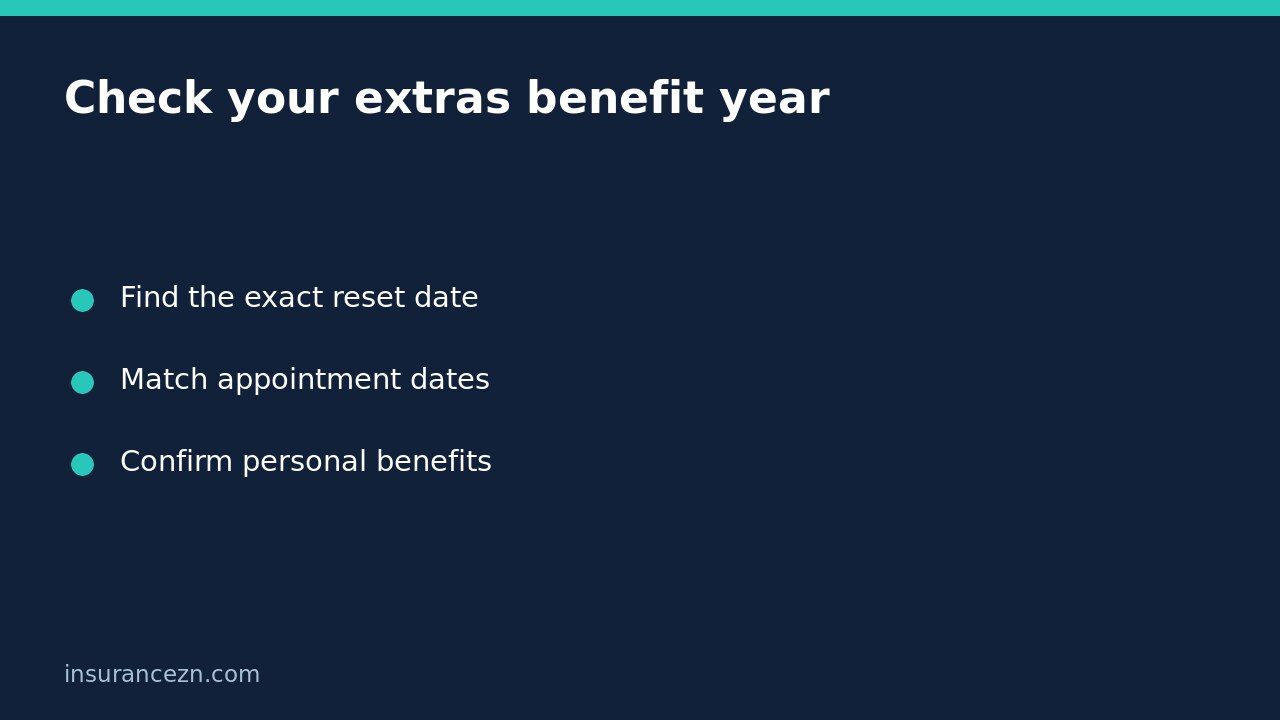

An extras annual limit does not necessarily reset on 1 January. Before budgeting for appointments around a year boundary, establish the exact period your policy uses and ask which date determines the year against which a service is assessed. A new calendar, a premium renewal and a fresh benefit allowance are not automatically the same event.
This is general information for Australian readers, not personal financial advice. Your policy rules, Product Disclosure Statement (PDS), fund documentation and individual benefit assessment determine what is payable. Do not postpone necessary treatment solely to chase an assumed insurance reset; discuss timing with your treating practitioner.
Annual can mean three different periods
The government PrivateHealth.gov.au glossary defines an annual limit as the maximum benefit payable for a particular service within a twelve-month period. It explains that the period can be based on a calendar year, a financial year, or the anniversary of taking out the policy. That definition is a starting point, not confirmation of your particular product’s dates.
Look for the annual-limit definition in your current extras rules and the benefit table for the specific service. Write down the start and end dates of the current period, then ask when the next period begins. If the portal only says ‘annual remaining’, request the actual date range rather than inferring it from when you last paid a premium.
Build a dated appointment list, not a reset assumption
Consider a hypothetical member planning a dental appointment in December and another in January. If the relevant allowance runs on a calendar year, the appointments may fall in separate periods. If it runs July to June, both appointments could fall within the same period. An anniversary-based allowance needs the member’s actual anniversary before either conclusion is safe.
This example explains timing only. It does not promise a benefit for either visit. The treatment must still be eligible, relevant waiting periods must be satisfied, and per-service benefits and other applicable limits still matter. A newly available annual maximum is a ceiling, not a cash payment or a guarantee that the full invoice will be covered.
- List each proposed appointment and the actual service or item code.
- Record the provider, estimated charge and proposed service date.
- Ask the insurer which benefit period would apply to each item.
- Obtain a personal benefit estimate using the current product and recorded claims.
- Compare the expected benefit with the charge before deciding what you can afford.
Ask which date counts for the claim
An appointment date, advance payment date, invoice date and claim-submission date can differ. Do not assume that lodging a claim in January moves a December treatment into a new allowance. Ask the fund which date its rules use for that exact service, including any course of treatment or prepaid arrangement.
Keep the answer with the provider’s itemised estimate. If a course crosses the boundary, request an explanation of how each component would be allocated rather than multiplying a sample single-visit benefit by the number of appointments. The general glossary does not establish your insurer’s processing rules, claim-submission deadlines or treatment-course conditions.
A reset does not remove every other limit
The same government glossary distinguishes annual limits, combined limits, sub-limits and lifetime limits. A combined limit covers several services from one pool; a sub-limit caps a particular service within a larger limit. The arrival of another annual period does not, by itself, establish that every other restriction disappears.
Ask whether the displayed balance is personal or shared, which other services draw from it and whether pending claims could affect the estimate. Check any separate lifetime allowance before assuming a new annual balance restores it. A policy change or transfer also needs a specific explanation of how previous benefits are treated, not an assumption that joining paperwork creates another full allowance.
Keep confirmation separate from a processed balance
Before the boundary, save the current benefit statement and the written explanation of dates. After it passes, check the recorded balance and period. If the display differs from the answer, ask the fund to reconcile the rule, service dates and assessed claims. Request the corrected record if an error is confirmed. A staff member agreeing to investigate is not evidence that a balance has already changed.
For help separating comparison examples from a personal estimate, read why PHIS example benefits are not your own extras rebate quote.
Quick FAQ before booking
Does renewing my premium reset extras? Not necessarily. Ask which period the benefit rule specifies.
Can I spend the whole displayed limit on one visit? Not necessarily. Service benefits, sub-limits and eligibility may produce a lower payment.
What is the most useful written question? Provide the member, product, provider, item code and proposed service date, then ask which allowance period applies and what estimated benefit remains after recorded claims. That is more actionable than asking only whether ‘the year has reset’.