
If an old health-insurance booklet mentions a ‘benefit limitation period’, do not assume it is a current waiting period you must simply wait out. PrivateHealth.gov.au’s glossary says benefit limitation periods are no longer in use in private health insurance. The practical task is to identify why the old document uses that term and obtain the current rules for your membership and proposed treatment.
This is general information for Australian readers, not personal financial advice. Your current policy, fund rules, Private Health Information Statement (PHIS), relevant Product Disclosure Statement (PDS) where applicable, and accepted amendments determine benefits. General definitions do not establish personal treatment eligibility or a guaranteed claim payment.
What the historical term meant
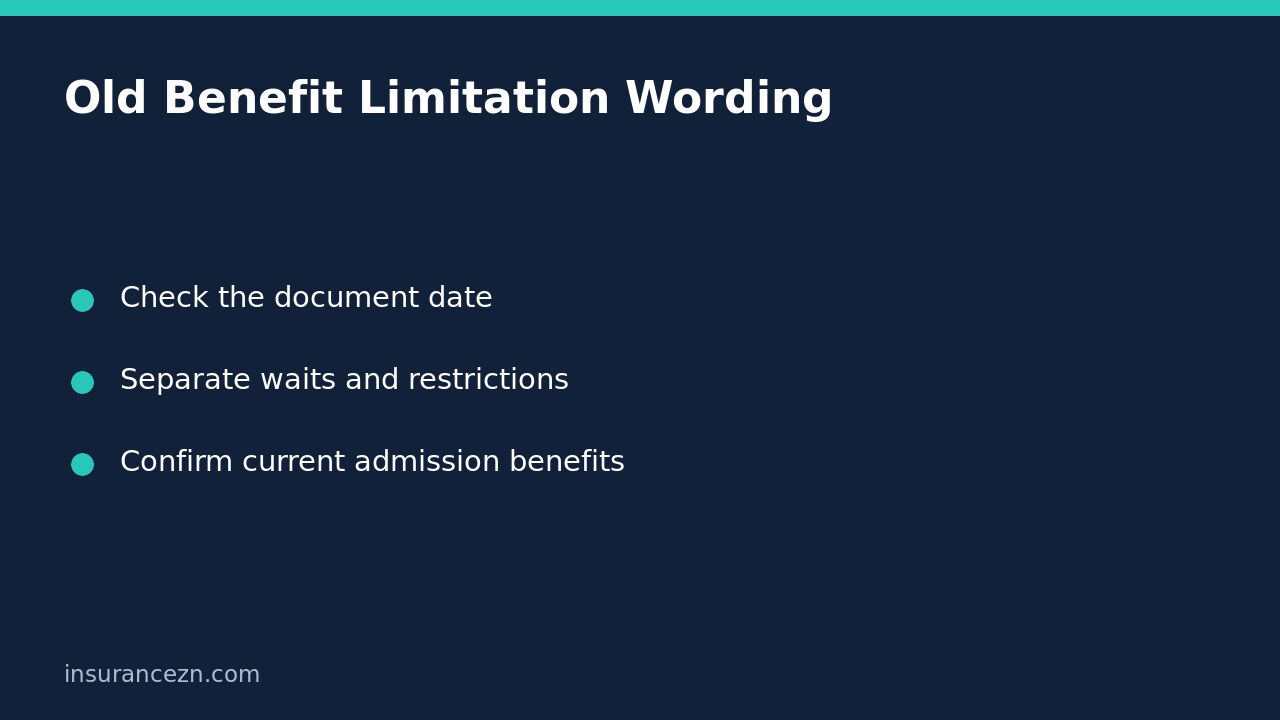
The government glossary explains that, before 1 July 2018, some insurers imposed benefit limitation periods of up to 24 months for certain hospital-treatment categories. During such a period, a member was entitled only to restricted benefits for the relevant condition or treatment. It explicitly states that these periods are no longer used.
Those dates and durations describe the historical arrangement, not a current rule that a new member should expect. If you encounter the wording in a saved brochure, comparison printout or archived email, retain it as evidence of what you were given, but check its issue date and the product it describes. Do not silently substitute its terms for your current policy.
Separate three concepts before asking about a bill
- Historical benefit limitation period: the discontinued arrangement described above. An old reference calls for document reconciliation, not an assumption that a fresh countdown applies today.
- Waiting period: the time a member must serve before eligibility for relevant benefits. The glossary distinguishes government-set hospital waiting maxima from insurer-set general-treatment waiting periods.
- Restriction: a current policy condition under which a treatment receives limited hospital benefits. A restriction is not automatically removed merely because you have held the policy for longer.
An exclusion is different again: it identifies services for which the policy does not pay benefits. Ask the insurer to name the precise current issue rather than accepting a vague statement that ‘a limit applies’. Time, treatment inclusion and the amount payable are separate questions.
Build a small document comparison
Collect the old page containing the disputed wording, your current product name and policy identifier, the latest PHIS, membership start and amendment dates, and any written advice about an upgrade or transfer. Keep each version intact. Highlight the exact sentence that prompted your question instead of sending an entire folder without explanation.
In a hypothetical example, someone finds an old booklet while preparing for an admission. They assume its benefit limitation period has long expired and therefore expect full private-hospital accommodation benefits. That conclusion skips the current cover check: the present policy might have a restriction or exclusion unrelated to the old historical term. Conversely, the old booklet alone is not evidence that a discontinued limitation still applies.
A useful comparison has three columns: wording in the old document, wording in the current document, and the insurer’s explanation of which provision applies now. Leave unanswered cells marked as questions rather than filling them with assumptions.
Ask for a treatment-specific written answer
Provide the planned admission date, hospital, procedure details and item numbers available from the treating team. Ask: ‘This older document refers to a benefit limitation period. Please confirm whether it has any relevance to my present membership. Identify the current inclusion, restriction, exclusion or waiting-period rule for this proposed admission and the document supporting your answer.’
Then ask about hospital accommodation, theatre charges, excess or co-payments and medical accounts separately. An answer resolving outdated wording does not mean every bill is covered. Our guide to why an agreement hospital does not mean no gap explains another reason not to treat a single label as an all-costs assurance.
Keep the outcome, not just the enquiry receipt
Save the insurer’s substantive reply with the documents it relied on, the admission details checked and the date of the answer. If a record or document needs correction, request confirmation of the processed change. An automated acknowledgement establishes receipt, not that a rule has been reviewed or a benefit approved.
Will waiting longer fix a restricted service? Do not assume so. Ask whether a policy change would be needed, what it would include and what waiting requirements would then apply. A request for an upgrade is not proof that changed protection has commenced.
Should treatment be postponed while sorting out wording? Do not delay urgent medical care for insurance administration. Discuss clinical timing with the treating team and use the insurer’s ordinary enquiry process to clarify financial arrangements.
Source: PrivateHealth.gov.au’s glossary, particularly the entries for benefit limitation period, waiting period, restrictions and exclusions. The glossary supplies definitions; your fund must confirm the rules and estimates for the actual admission.