
A cheaper hospital policy can shift risk in two very different ways: it can exclude a treatment, or retain treatment inclusion while requiring you to pay a higher excess. Those are not interchangeable savings. Before changing Australian hospital cover, compare the treatment entitlement first and the patient contribution second.
This is general information for Australian readers, not personal financial advice. Your policy documents, applicable rules and any relevant PDS determine cover; this comparison does not establish personal eligibility or a payable benefit.
Understand what each saving changes
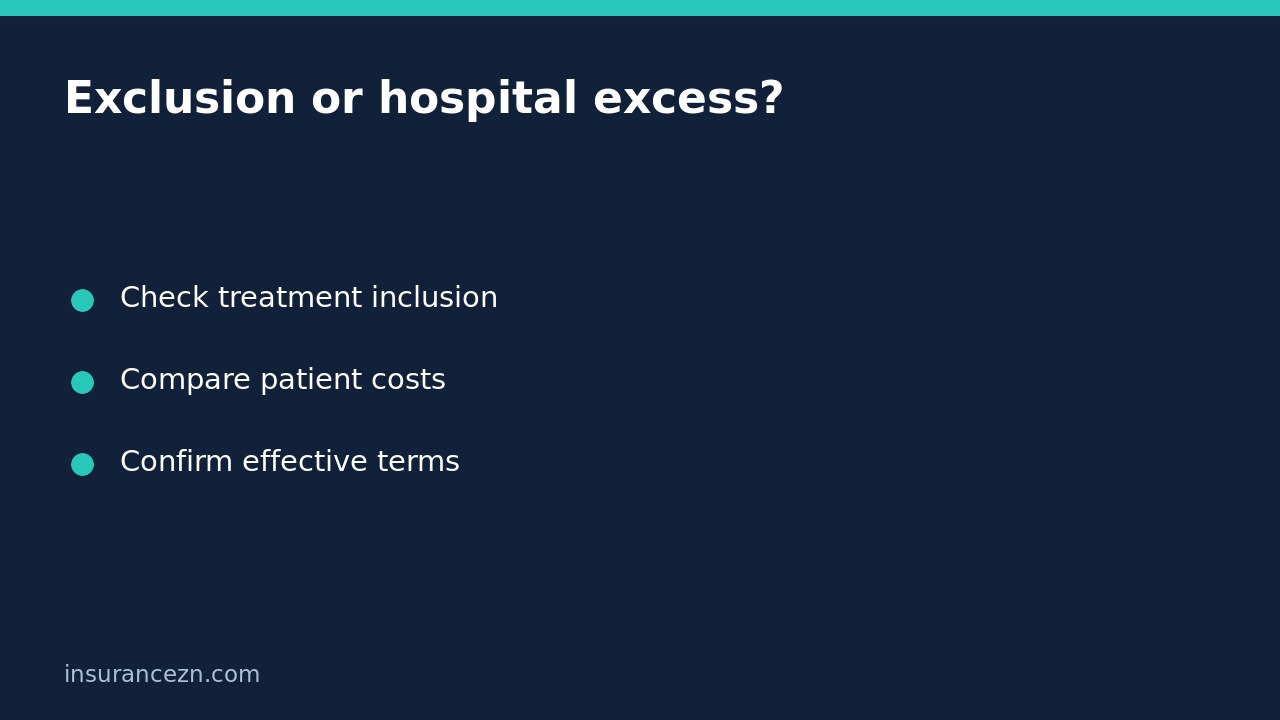
PrivateHealth.gov.au’s managing-your-policy guidance explains that premiums can be reduced through exclusions, restricted benefits, or an excess or co-payment. An exclusion means the policy does not cover the specified condition or service as private hospital treatment. An excess is an agreed contribution towards a hospital stay before insurer benefits are payable.
Restricted benefits form a third possibility: they provide limited cover, rather than either full inclusion or a complete exclusion. Do not mark a quote as equivalent simply because the treatment name appears somewhere in its documents. Record whether that category is included, restricted or excluded.
Build a comparison around one actual treatment
Choose a treatment category relevant to your review and ask each fund to identify its status in writing. Use the proposed procedure description and any item numbers supplied by your treating practitioner. A broad label used in conversation may not identify the policy category accurately.
- Keep a copy of your current product and its treatment-category list.
- Obtain the proposed product’s current information statement and full rules.
- Record the category status under each option.
- Ask how the quoted excess applies to this patient and admission.
- Check the hospital arrangement and seek separate medical-fee estimates.
Only after these checks should you compare premiums. A quote that removes a relevant category is a reduction in treatment protection, not merely a different way to pay for the same admission.
Use a scenario instead of comparing premiums alone
Consider a hypothetical choice between Option A, which includes a particular category with a higher excess, and Option B, which excludes it and advertises a lower premium. If private treatment in that category becomes necessary, Option A still requires assessment under the policy, including waiting periods and other conditions. Option B does not become cover for that category merely because you offer to pay an excess.
The worksheet should therefore contain two separate questions: is the treatment eligible for benefits, and what costs remain with the patient? Do not enter the excluded treatment’s cost as if it were a small fixed excess. Obtain an appropriate provider estimate if considering self-funding; the actual costs are not established by the insurance quote.
For included treatment, a higher excess is still not a ceiling on all expenses. Hospital gaps, doctors’ fees and other charges need their own checks. Read our three-estimate approach to hospital out-of-pocket costs before treating any one figure as the complete admission budget.
Check the route back before removing cover
If you later want an excluded category included again, ask about the available upgrade, its commencement and waiting periods. PrivateHealth.gov.au warns that upgrading to remove an exclusion can require serving a waiting period before private treatment. A plan to upgrade when treatment is booked is therefore not proof that benefits will be available by admission.
Request written answers about the exact old and new products, the categories changed, the accepted effective date and any new waiting periods. A submitted change form or a revised quote is not confirmation that the amendment has been processed. Keep the acceptance and updated policy schedule together.
Questions before accepting the cheaper quote
- Is the relevant category included, restricted or excluded?
- Does the excess apply per admission, per person or subject to a stated cap?
- Are co-payments additional to the excess?
- Which hospital and medical charges remain outside the quoted contribution?
- What would restoring the removed category require later?
- Has the insurer confirmed the processed product and effective date?
Does paying a bigger excess overcome an exclusion? No. An excess and treatment inclusion are separate policy features. Ask the insurer to clarify the category rather than assuming one replaces the other.
Should urgent care wait for an upgrade? No. Seek necessary clinical care promptly. Insurance comparisons and administrative changes must not delay urgent treatment.