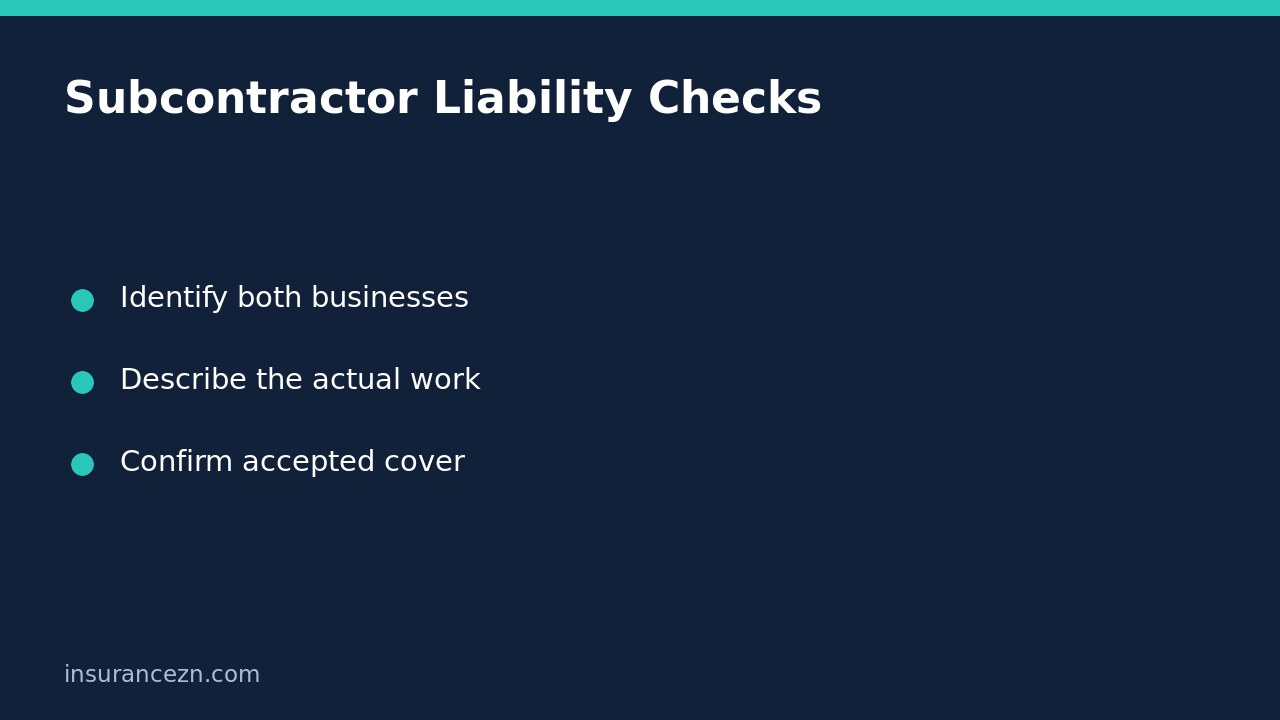

Before a subcontractor starts work, check two separate questions: whether your business has cover for its own potential liability, and whether the subcontractor has cover for theirs. A contractor’s certificate does not establish that your policy insures that business, or that every incident involving their work will be accepted.
This is general information for Australian readers, not personal financial advice. Cover depends on the applicable policy wording, Product Disclosure Statement (PDS), schedule, endorsements, exclusions and circumstances. Obtain advice about contracts and legal responsibilities from an appropriately qualified adviser.
Separate the businesses before discussing insurance
Write down the legal name of the business engaging the subcontractor, the subcontractor’s legal name and the customer or site operator. Include trading names where useful, but do not substitute a familiar business name for the actual insured entity.
Next describe who supplies equipment, who directs the work, the location and the tasks each business performs. An invoice labelled subcontracting is not an insurer’s determination about the relationship. Employment and workers compensation questions require their own checks; a public liability discussion does not settle them.
In its public liability explainer, AAMI says contractor and subcontractor situations can depend on the work, supervision and legal liability or negligence involved. It warns that subcontractors may not automatically be covered and may need specific addition. This is a provider explanation, not a promise that adding a name always resolves cover.
Send a work description, not just a request for a certificate
Give your insurer or broker enough detail to assess the arrangement before work begins. A useful request identifies the job, dates, location, subcontracted activities and any change from the work already declared on your policy. Attach the relevant contract requirements without assuming that insurance will meet every promise in the contract.
- Does our policy respond to our potential liability arising from this described arrangement?
- Is the subcontractor itself insured under our policy, or only our business?
- Must the subcontractor, activity or site be specifically declared or endorsed?
- Are there exclusions, supervision conditions or other requirements we must satisfy?
- If an amendment is needed, when does accepted cover begin and what premium applies?
Ask for the answer against the actual policy number and wording. A request received or a quote issued is not confirmation that an amendment has been accepted and commenced.
Review the subcontractor’s evidence separately
Ask the subcontractor for current insurance evidence relevant to the agreed activities. Check the insured name, period, described business and limit, then clarify material gaps with the subcontractor and the appropriate insurance contact. Do not assume their public liability policy includes professional advice, their own tools or every type of property in their custody.
AAMI’s public liability overview describes injury to someone other than an employee and damage to another person’s property arising from business activities or products. The page presents other business covers separately and directs readers to policy terms. That helps explain why a liability certificate is not an all-risks checklist.
Our guide to checking a business certificate of currency helps with document details. Here the additional task is deciding whose potential liability is insured under the specific subcontracting arrangement.
Use a job scenario to uncover an unanswered question
Consider a hypothetical maintenance business that hires another business to complete part of a customer’s job. The subcontractor damages a customer’s fitting, and the customer also alleges that the engaging business failed to supervise the work properly. These are allegations, not established fault findings.
The engaging business should not simply forward the subcontractor’s certificate and assume its own exposure has disappeared. Each business needs to understand its notification obligations and obtain instructions from its own insurer. AAMI’s explainer also notes that a subcontractor can remain a third party capable of making a claim against the engaging business. Having them on site does not merge the businesses into one insured entity.
Keep a clear pre-start record and incident pathway
Keep the work description, insurance questions, written replies, accepted endorsements and current certificates together. Tell the insurer if the planned activities materially change rather than treating an earlier answer as permission for different work. Confirm what remains unresolved before authorising the subcontractor to proceed.
Does the subcontractor’s policy replace mine? Not automatically. Each policy needs to be checked against its insured entity and potential liability. Does written confirmation guarantee a future claim? No. It documents the accepted arrangement; the insurer still assesses an incident under the applicable terms.
If an incident occurs, prioritise safety, preserve the facts and notify the relevant insurers through their ordinary claim channels. Do not promise a settlement, admit disputed responsibility or assume another business’s notification has also notified your insurer. Record claim references and agreed next actions separately.