
If damage interrupts your business, spending money to keep trading does not automatically make that spending an insured expense. Before booking temporary equipment or signing a short-term lease, ask which extra operating costs your purchased business interruption section can assess, what approval is required and what records will support the claim.
This is general information for Australian readers, not personal financial advice. Cover depends on the applicable policy wording, PDS where provided, schedule, endorsements, limits and exclusions. An expense ledger helps explain a claim; it does not establish entitlement or guarantee reimbursement.
Separate extra operating costs from other losses
In its business cover overview, AAMI describes its Back In Business cover as potentially covering a reduction in business revenue and increased costs of working arising from interruption or interference due to loss or damage from an insured event. That is a provider-specific summary, not a promise that every temporary operating expense is covered by every policy.
Keep distinct records for repairing damaged property, replacing stock, lost revenue and additional costs incurred to continue operations. A temporary machine hire invoice is not the same thing as an invoice to repair your own machine. An expense appearing in your accounts does not identify the insurance section responsible for it.
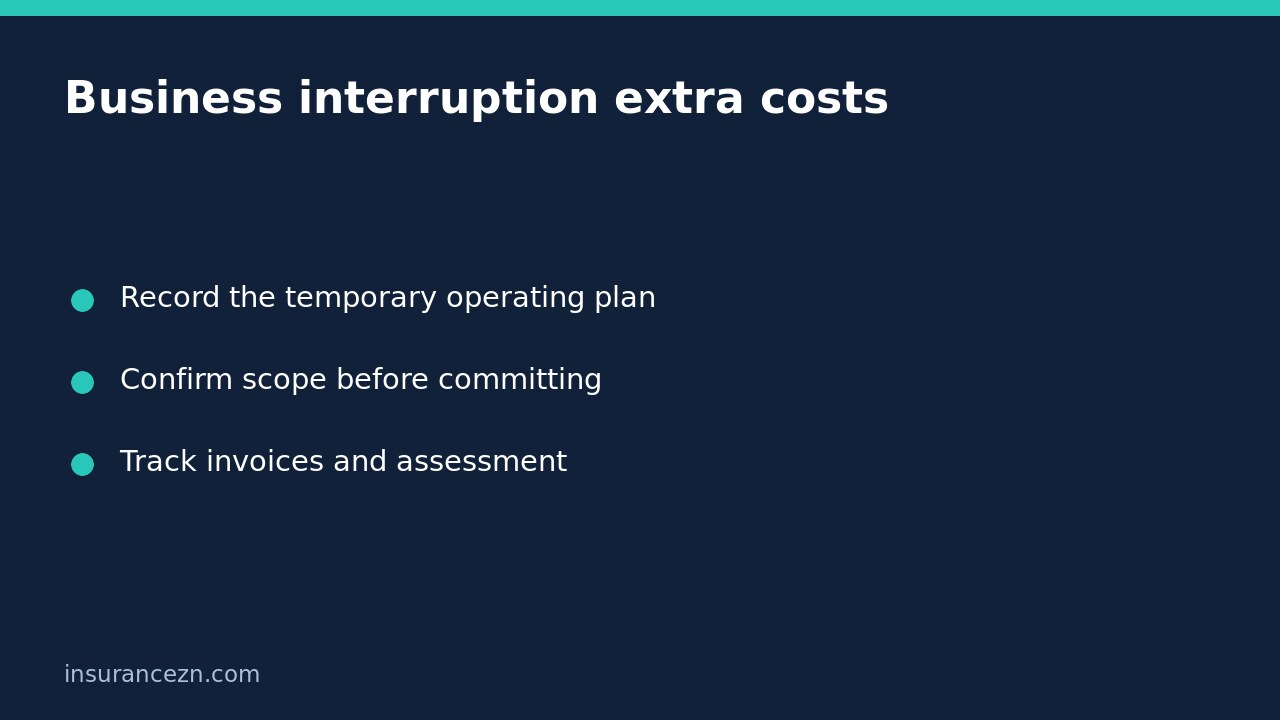
Describe the temporary plan before committing
Give the insurer or broker a short proposal linked to the existing claim reference. Explain what cannot currently operate, what temporary arrangement you propose, the intended dates and why it would help maintain trading. Attach supplier quotations with delivery, installation, hire, collection and cancellation charges separately shown.
For example, a fictional print shop considers hiring a substitute printer after insured premises damage. The owner should identify whether the proposed machine can fulfil existing orders, whether suitable space and power are available, and what happens if permanent repairs finish early. These are planning questions, not evidence that the hire is covered.
Ask whether the insurer needs alternative quotations or evidence of likely trading preserved. Do not invent a universal rule that an expense is payable whenever it costs less than the revenue it might save; obtain the particular policy’s calculation and approval requirements.
Build a ledger that follows each expense
Use one row per supplier charge rather than one combined total headed ‘business interruption’. Useful columns include:
- The expense description, supplier, quote version and proposed service dates.
- The operational reason and its connection to the claimed interruption.
- The quoted amount and tax treatment to confirm with your accountant and insurer.
- The insurer contact, approval reference, approved scope and any unresolved conditions.
- The actual invoice, service dates, payment evidence and variations.
- The amount submitted, assessment received and any difference still being queried.
Label each stage accurately. A received quotation is proposed spending. An acknowledgement that the quote was uploaded is evidence of receipt. Written approval may be limited to a specified item, duration or amount. The final assessment and actual payment are further steps, not interchangeable labels.
Control changes while the business recovers
If the temporary arrangement must run longer, ask about the extension before assuming the original approval continues. Preserve the first quotation and approval, then add the revised proposal and reason. A changed repair estimate does not itself authorise additional hire charges.
Where urgent safety action is necessary, do not delay essential protection while completing administration. Record why action was needed, keep available evidence and contact the insurer promptly. Ask how the policy treats that particular emergency expense rather than assuming urgency removes its conditions.
The duration of interruption cover is a separate issue. Our article on planning the business interruption indemnity period explains why recovery can extend beyond physical repairs. A sufficiently long period still does not make an otherwise excluded expense payable.
Review the assessment, not only the bank deposit
When an assessment arrives, match its line items to the ledger. Ask for an explanation of omitted charges, shortened periods or differences between approved and assessed amounts. Keep supplier credits and cancelled bookings visible so the same cost is not presented twice.
Does paying the supplier prove cover? No. It proves a payment, subject to matching the correct invoice; policy eligibility and the insurer’s assessment remain separate.
Does initial approval settle the entire interruption claim? Not necessarily. Confirm exactly which costs it addresses and what evidence remains outstanding. Retain the completed ledger with the claim correspondence so later questions can be answered without reconstructing the entire disruption.