
Two Australian hospital policies called Bronze Plus do not necessarily add the same treatments. The tier tells you the required minimum clinical categories, while Plus indicates additional coverage beyond that tier. To compare two quotes, identify exactly which categories each adds and how benefits apply before deciding that the cheaper policy offers equivalent protection.
This is general information for Australian readers, not personal financial advice. Read the policy rules, Private Health Information Statement and any applicable PDS; exclusions, restrictions, waiting periods and other terms can limit benefits. A comparison or estimate is not a guarantee of claim payment.
Start with the minimum tier, then identify the additions
The government’s PrivateHealth.gov.au product-tier explanation says hospital policies are classified as Basic, Bronze, Silver or Gold. Each tier has minimum requirements. A policy meeting its tier’s requirements with additional coverage can be described as Plus. That does not turn every Bronze Plus policy into the same package, or make it equivalent to every Silver policy.
Ask each insurer for the current statement and policy rules corresponding to the exact quoted product. Record the product name, version or document date and proposed commencement date. Similar marketing names, a previous year’s brochure or a comparison site’s short description may not describe the contract you are actually considering.
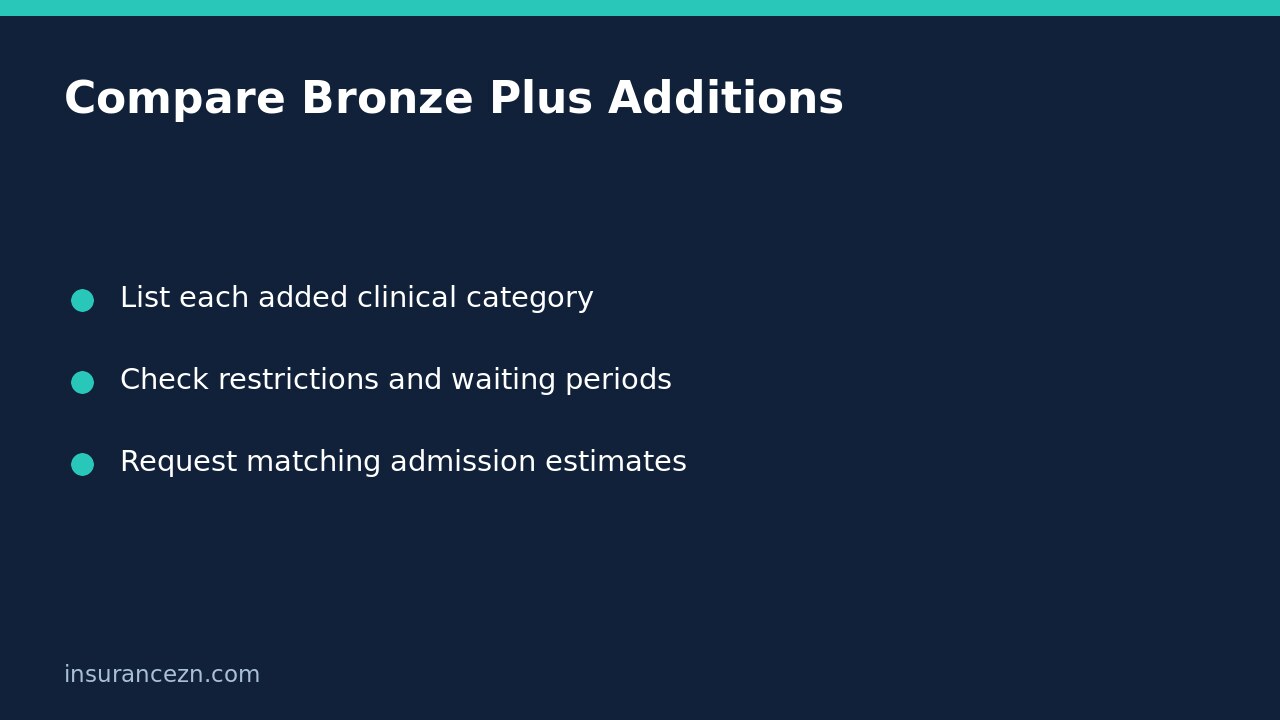
Use the government tier table to identify the baseline, then mark the additions offered by each product. Do not simply count the number of extra categories: a category you expect to need may matter more to your comparison than several unrelated additions.
Build a category-by-category comparison sheet
Create one row for each relevant clinical category, with separate columns for Policy A and Policy B. Record the insurer’s description of inclusion, exclusion or restriction, and the document page supporting the entry. Write unknown where the information is unclear rather than translating a sales phrase into a benefit promise.
As a hypothetical example, suppose one quote’s documents add one category outside Bronze’s minimum, while another adds a different category. Both products might legitimately use Plus, but switching between them could remove the first addition. The task is to compare the actual category lists, not assume one label preserves the other product’s treatment scope.
PrivateHealth.gov.au explains that clinical categories group hospital treatments. Its tier table concerns treatment as part of a hospital admission. Do not extend a hospital-category inclusion to outpatient consultations, extras services or every procedure associated with a body part. Obtain the proposed treatment description and item numbers from the treating provider before asking the insurer to match a planned admission to its rules.
Separate category inclusion from the amount you may pay
An included category does not mean every account will be paid in full. Compare excesses, co-payments, hospital arrangements and likely doctors’ charges separately. Where restricted cover is allowed, the government explains that the benefit can leave significant expenses in a private hospital or private room. Ask the insurer and hospital for details rather than treating restricted as another word for fully included.
For a planned admission, request written estimates using the same hospital, doctors, procedure and proposed date for both policies. Keep hospital charges and medical accounts separate so an estimate for one is not mistaken for an all-inclusive figure. Our guide to checking surgical implant benefits before admission explains another component that may need a specific enquiry.
Waiting periods are another independent check. The government’s basics page says first-time cover or an upgrade can require waiting periods before benefits are available. Ask which parts of the proposed change are treated as an upgrade and obtain the relevant dates in writing; do not assume an unchanged Bronze Plus label proves continuity for every added category.
Ask for a matched written answer before switching
Send each insurer the same short request: “For this exact product and commencement date, please identify the clinical categories above the Bronze minimum, any restrictions, applicable waiting periods, and the excess or co-payment for the proposed admission. Please explain which treatment details you still need for a personal estimate.”
Keep the reply with the quote and policy documents. If the answer conflicts with the statement, ask the insurer to reconcile it before proceeding. A request to switch or a payment instruction is not proof that the intended cover has commenced. After an accepted change, check the processed membership record, commencement date, actual premium and retained categories.
Quick questions before choosing
- Is Plus a separate standard tier? No. The government describes four tiers; Plus indicates additional coverage beyond a tier’s minimum.
- Does more categories mean lower personal costs? Not necessarily. Treatment scope and the amount payable are different comparisons.
- Can I compare without a planned procedure? Yes. Compare documented categories and costs now, while recognising that a later treatment-specific estimate will require more details.
Checked sources: PrivateHealth.gov.au’s product tiers and clinical-category table and private health insurance basics. These support the comparison framework, not an endorsement or a benefit decision for a particular policy.