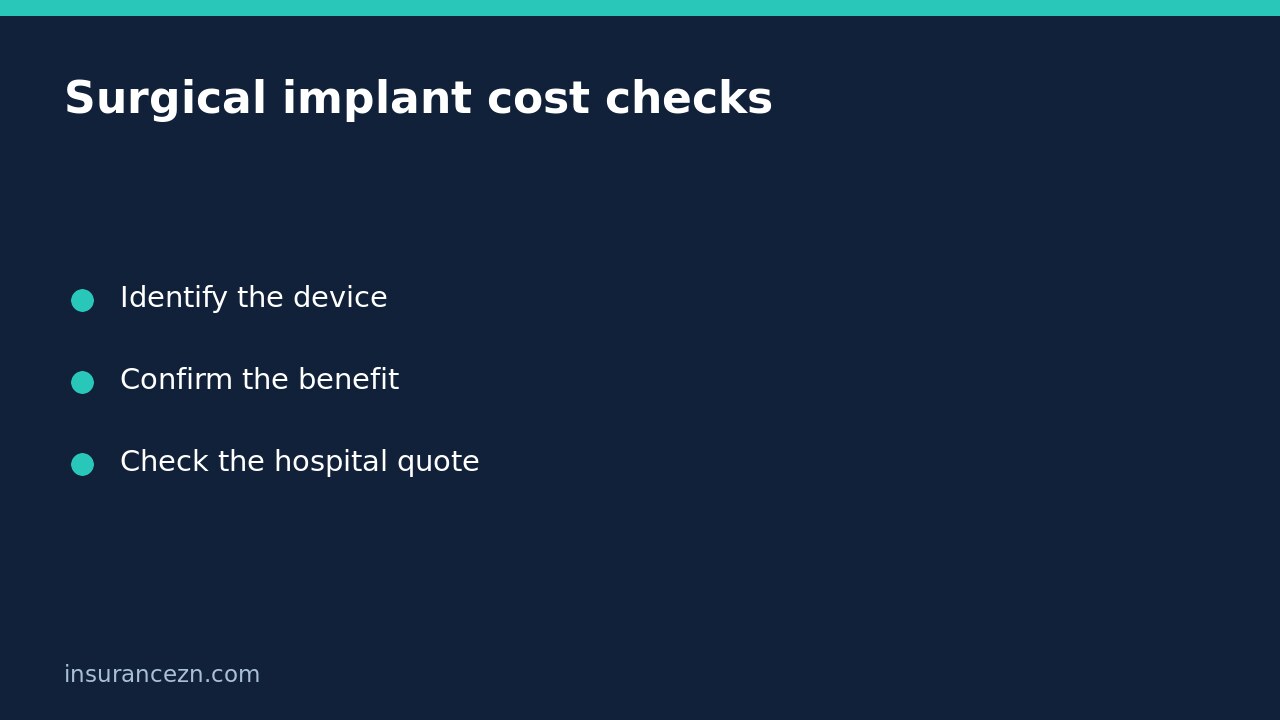

If planned surgery involves an implant, ask about the device itself as well as the operation. Having hospital cover for the treatment does not, by itself, tell you whether an implant will leave a separate amount to pay. Obtain the proposed device details, ask the insurer about the applicable benefit, and ask the hospital whether its quoted charge leaves a gap.
This is general information for Australian readers, not personal financial advice. Benefits depend on the policy, relevant product disclosure statement (PDS) or fund rules, clinical eligibility and the actual treatment. This is not medical advice; your treating team should guide clinical decisions.
Understand which cost you are checking
A surgical prosthesis is an artificial replacement for a body part. The government consumer guide gives examples including hip replacement devices, pacemakers and replacement heart valves. The device cost is a different question from the surgeon’s fee, the anaesthetist’s fee or the hospital excess.
According to PrivateHealth.gov.au’s out-of-pocket costs guide, an insurer must pay a benefit for an eligible product on the Medical Devices and Human Tissue Product List when the patient has the correct hospital cover. The guide also explains that a gap may arise if the minimum benefit does not cover the device cost. Do not interpret a listed product as a promise that every associated bill disappears.
Get an identifiable device description
Start with the specialist’s rooms. Explain that you are checking financial arrangements, not selecting equipment yourself. Ask which implant or device is proposed and whether the practice or hospital can supply the exact product description and relevant list reference. A broad description such as ‘hip implant’ may not be enough for a reliable benefit enquiry.
- Record the planned procedure, hospital and admission date.
- Request the proposed product name and identifying details that the insurer needs.
- Ask whether the product is on the relevant list.
- Ask whether the device may change during surgery, and how cost information would be updated if that happens.
If the clinician has not yet chosen a specific device, record that uncertainty. Do not turn an approximate description into an assumed benefit approval.
Ask the insurer and hospital different questions
The insurer should confirm whether your policy covers the proposed treatment and what benefit applies to the identified device. Ask what information remains outstanding, whether waiting periods or other policy conditions affect eligibility, and whether the answer applies to your intended admission date. Save the written reply with its reference number.
The hospital should explain what it expects to charge for the device and whether any amount remains payable by you. Ask whether that amount is already included in its estimate or is additional. Confirm who will bill you and when payment would be due. An insurer benefit figure and a hospital charge are not interchangeable numbers.
If you are still assembling the treatment details, the related article on checking cover when an MBS item number is missing explains why the procedure information also needs clarification. A procedure item number is not a substitute for identifying the implant.
Reconcile the answers before accepting a quote
Use a simple worksheet with separate lines for the proposed device, hospital charge, insurer-confirmed benefit and patient amount. Add a column stating whether each figure is confirmed, estimated or still unknown. Keep the hospital excess and medical practitioner gaps on other lines so the same expense is not counted twice.
For example, a fictional patient receives an estimate saying ‘implant included’ but an insurer reply referring only to a minimum listed benefit. The next step is not to assume either document is wrong. Send both to the hospital billing office and ask whether ‘included’ means included in its overall quoted price or fully covered with no patient device charge. Request a revised written estimate if the answer changes the budget.
What if the proposed device is not listed?
The government guide recommends asking the doctor whether an alternative on the list could be used. That is a clinical conversation, not a reason to choose a device solely on price. Ask the treating team about appropriate options and ask the insurer and hospital to confirm the financial consequences of each proposed option. Do not assume a non-listed device will receive a benefit, and do not delay necessary treatment simply to complete an insurance enquiry.
Quick questions before admission
- Does a covered operation guarantee a free implant? No. Confirm the actual product, benefit and hospital charge separately.
- Can the hospital excess be my only payment? Possibly, but an excess alone does not describe device or medical gaps.
- What should I keep? The device description, estimates, insurer response and any written explanation of changes.
If answers conflict, identify the specific mismatch and request clarification rather than treating a general assurance as a final cost guarantee.