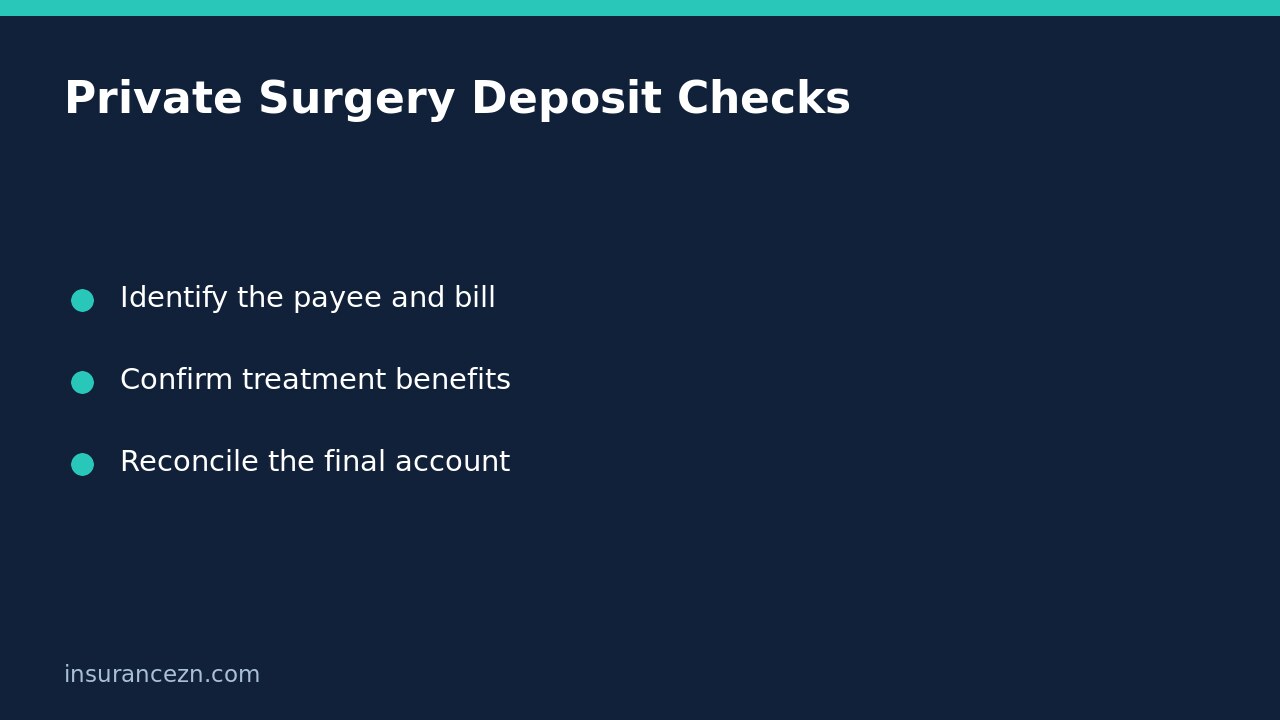

Paying a deposit for private surgery does not, by itself, establish that your health insurer has approved benefits or that every treatment cost is included. Before transferring money, identify exactly who is collecting it, which services it relates to and how it will appear on the final account. Then check the insurance position separately.
This is general information for Australian readers, not personal financial advice. Benefits depend on your policy, applicable PDS or fund rules, waiting periods and the treatment actually provided. Do not delay urgent medical care to complete insurance administration.
Identify what the deposit actually pays for
A private admission can involve several accounts. Your surgeon’s fee is separate from the hospital’s accommodation and theatre charges, and other clinicians may bill independently. A payment requested by one office should not be treated as payment to everyone involved.
Ask the collecting office for a written document showing the patient’s name, intended procedure, provider, proposed admission date, amount due and payment purpose. Is this an advance against a particular doctor’s fee, a hospital charge or something else? Ask whether the amount is an estimate, a deposit credited against a later bill or a stated final charge for a defined service.
Also ask when payment is due, how the balance will be calculated and what written cancellation, rescheduling or refund terms apply. Do not assume those terms are identical across providers. Keep the quotation and terms supplied before payment alongside the receipt.
Check the treatment benefit before relying on reimbursement
The government website PrivateHealth.gov.au explains out-of-pocket costs and recommends obtaining service item numbers and written fee estimates, then checking benefits with the insurer. It distinguishes doctors’ medical fees from hospital charges and notes that a hospital agreement does not remove an applicable policy excess or co-payment.
Give your fund the proposed hospital, procedure and available MBS item numbers. Ask whether the treatment is included under your current membership, what waiting-period or restriction checks remain and what benefit estimate applies. If information is missing, record what is still needed rather than interpreting a partial answer as full approval.
Ask each relevant doctor’s office whether a gap arrangement will actually be used for your case. A hospital booking, a payment receipt and a doctor’s participation in a scheme are different pieces of information. For treatment without an MBS item, read our explanation of checking hospital cover when there is no MBS item number.
Build a payment-and-benefit worksheet
Consider an illustrative situation: a surgeon’s office requests a deposit, the hospital sends a separate admission estimate and the anaesthetist’s fee is not yet available. The useful next step is not to combine the first two documents and call that the total. Mark the anaesthetist estimate as outstanding and ask how to obtain it.
- Provider and service: identify whose account is being estimated.
- Quoted charge: record the amount and whether it is provisional.
- Expected benefits: note who supplied the estimate and its assumptions.
- Deposit paid: record the payee, date, receipt and account reference.
- Outstanding questions: list missing fees, conditions and payment deadlines.
Do not subtract the same deposit twice or subtract an estimated insurance benefit from an amount that already represents the provider’s estimated patient gap. Ask the office to explain the arithmetic and the expected billing pathway in writing.
Reconcile the deposit after treatment
When the final account arrives, compare the services and provider details with the estimate. Check that the deposit has been allocated to the correct patient and invoice. Separately compare any actual Medicare or fund benefit statements with the assumptions used before admission.
If the deposit is missing from the account, send the receipt and transaction reference to the collecting office and request a corrected account. A bank debit establishes that money left your account; it does not alone establish that the provider allocated it correctly. Likewise, an insurer enquiry acknowledgement is not a completed benefit assessment.
Quick questions before you pay
Does the receipt prove I am covered? No. It records a payment, not the fund’s treatment eligibility decision.
Will a deposit cover every doctor? Do not assume so. Obtain the scope of that payment and ask which other clinicians may bill you.
What if the plan changes? Ask for revised fee and benefit estimates, and clarify how the existing deposit will be treated. Keep confirmation of any refund or credit actually processed, rather than relying only on a submitted request.