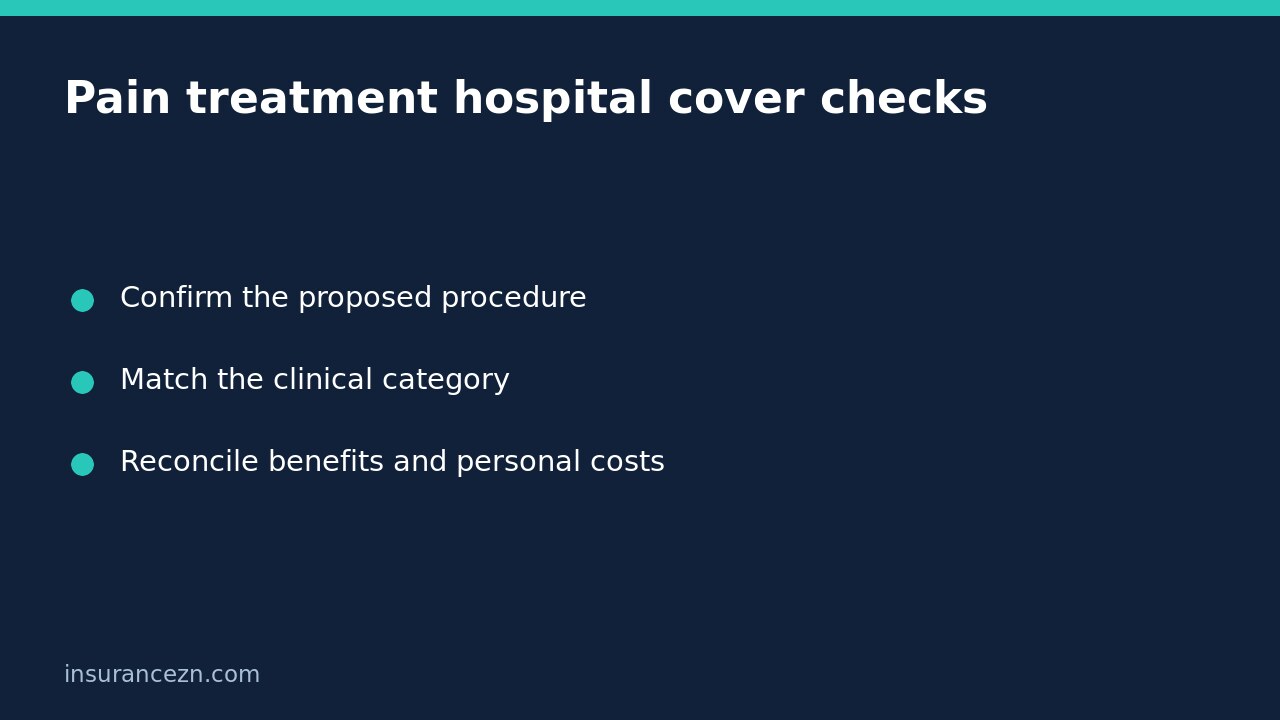

Having hospital cover for pain management does not, by itself, establish cover for a procedure involving an implanted pain device. Australia’s standard hospital clinical categories separate Pain management from Pain management with device. Before accepting a planned private admission, match the exact proposed procedure to your policy rather than relying on the everyday phrase ‘pain treatment’.
This is general information for Australian readers, not personal financial advice. Benefits depend on your policy, applicable product disclosure statement (PDS), fund rules, exclusions, restrictions, waiting periods and the actual treatment. This is an insurance-administration checklist, not medical advice; do not delay urgent care while checking costs.
Understand the two category descriptions
The government’s clinical categories overview describes Pain management as hospital treatment that does not require insertion or surgical management of a device. Examples include treatment of nerve pain and certain pain treated by injection of a nerve block.
Pain management with device concerns implantation, replacement or other surgical management of a device required to treat pain. The overview gives an infusion pump or neurostimulator as examples. These are descriptions of standard categories, not a determination that a particular patient’s procedure is covered.
The distinction is about the actual treatment, not simply the body part that hurts. Do not decide that any back-pain procedure must be covered because another back-related category appears on your policy. Ask the treating specialist for the proposed procedure description and ask the insurer which category applies.
Collect the procedure details before asking about benefits
Ask the specialist’s office for the planned treatment in writing, including relevant Medicare Benefits Schedule (MBS) item numbers where applicable. If a device is involved, request its details and clarify whether the plan concerns implantation, replacement or another procedure. Also identify the hospital, treating practitioners and expected admission arrangements.
If the treatment plan is still provisional, label it provisional. A preliminary discussion about an injection is not a reliable basis for pricing a later device procedure. Save dated versions so that you can tell which plan the insurer assessed.
A useful enquiry is: ‘For the attached procedure and item numbers, at this hospital on this proposed date, which hospital category applies under my exact product? Is that category included, restricted or excluded, and what remaining requirements affect my benefits?’ Ask for a written response identifying the procedure and policy, rather than relying on an unqualified statement that you have pain cover.
Separate category inclusion from the total bill
Even a positive category answer does not settle every cost. The government’s out-of-pocket costs guidance distinguishes doctors’ fees from hospital charges and explains that patients can face gaps. Ask the hospital, specialist, other treating doctors and insurer for their respective estimates.
- Confirm any hospital agreement and the expected hospital benefit for this admission.
- Identify your excess or co-payment without assuming it is the only personal cost.
- Ask each doctor whether their proposed bill uses your insurer’s gap arrangement for this particular episode.
- For a proposed device, ask what benefit applies to the actual product and whether a separate gap remains.
- Ask what changes if the procedure, device or treating team changes before admission.
Keep these answers in separate columns: quoted charge, expected Medicare or insurer contribution where applicable, and your estimated personal payment. Do not add a bundled hospital estimate to separately listed components until the hospital confirms whether those components are already included.
Work through a changed-plan example
Consider a hypothetical patient who first receives a quote for an admitted nerve-block procedure and later discusses an implanted neurostimulator with their specialist. The original quote and insurer response should not simply be reused. The second proposal may involve a different clinical category, different providers and a device-specific cost assessment.
The patient’s task is not to choose a clinical treatment based on an insurance label. It is to obtain the updated plan, have the insurer assess that exact plan under the current policy, and request revised provider estimates. A received document, enquiry reference or payment receipt is not the same as a confirmed benefit assessment.
For the device-cost part of the enquiry, the related checklist on checking a surgical implant’s benefit before admission can help organise questions. It does not replace the pain-management category check.
Final questions before a planned admission
Does a specialist referral guarantee insurance payment? No. Clinical referral and the insurer’s policy assessment answer different questions. Obtain both the treatment plan and the benefit response.
Can I assume an injection is outpatient treatment? No. Confirm the actual admission and billing arrangements. A procedure name alone does not establish hospital-patient status or payable benefits.
What if the insurer and hospital descriptions differ? Ask them to reconcile the same written procedure details and item numbers before relying on the estimate. Keep the names, dates and reference numbers for those discussions, and request an updated written answer if the plan changes. General category definitions are a starting point, not a promise that every charge will be paid.