
If your friend can no longer join an overseas holiday, do not assume your travel insurer will pay for your decision to cancel as well. Before buying cover, check whether the policy’s definitions and cancellation conditions address your actual travel arrangement. Sharing an itinerary, booking accommodation together and being an insured person are not interchangeable facts.
This is general information for Australian readers, not personal financial advice. Cover depends on the applicable policy wording, PDS, certificate, exclusions and the insurer’s assessment. The checks below help you ask precise questions; they do not establish that a particular friend’s circumstances are insured.
Begin with the policy’s words, not your description of the friendship
Smartraveller’s travel insurance guidance says the PDS explains inclusions, exclusions, word definitions and claims procedures. It also advises checking cancellation cover rather than assuming all changed plans are covered. That general guidance does not supply a universal Australian definition of a travelling companion.
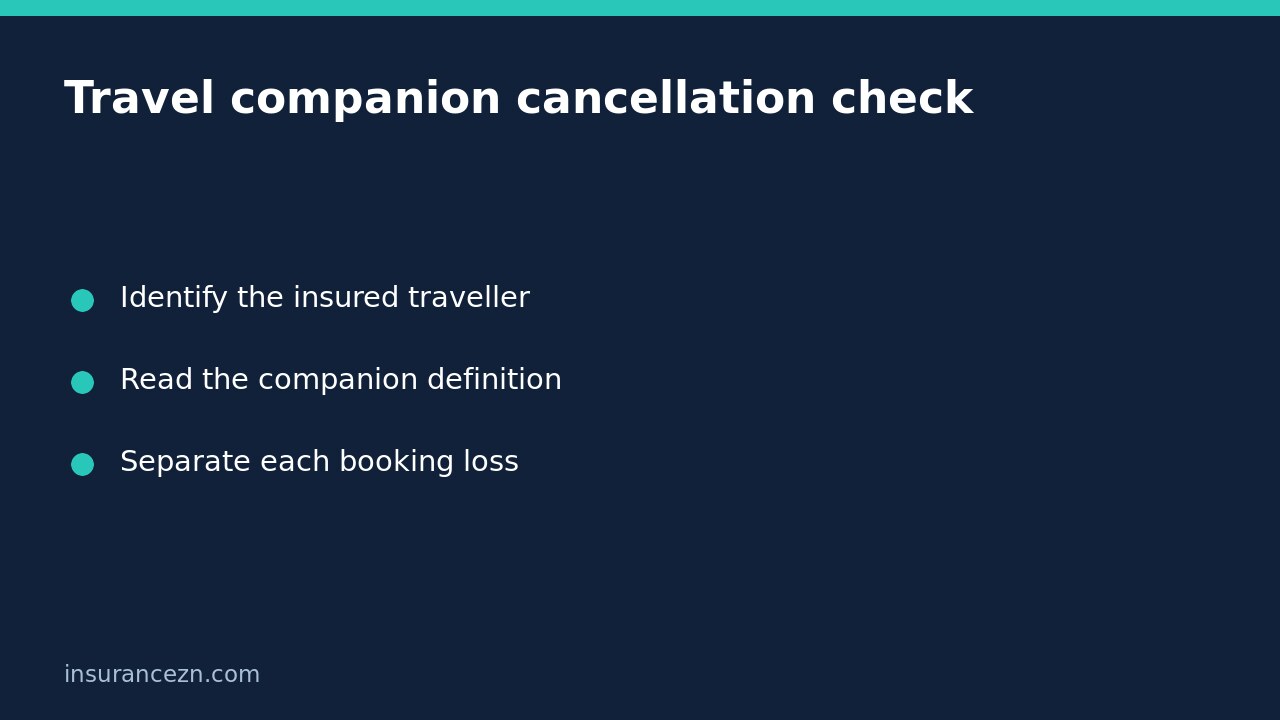
Search the proposed PDS for ‘travelling companion’, ‘travel companion’, ‘insured person’ and the cancellation section. Then read those provisions together. If the policy uses a different term, follow its exact definition. Ask whether the friend must satisfy conditions beyond travelling on the same dates, and whether the particular cancellation event is addressed. Do not invent a qualifying rule simply because another insurer uses one.
Describe the real arrangement in a written enquiry
Tell the insurer who would be insured under the proposed policy, who is travelling separately and which bookings are shared. Describe whether you will travel together throughout or only meet for part of the holiday. If you have separate insurance, do not assume either policy extends its insured-person status to the other traveller.
A useful question is: ‘I plan to travel with a friend on these dates, with these shared and separate bookings. If they cannot travel for this described reason and I cancel my own trip, which definition, cancellation provision and exclusion would you apply? What evidence would you require?’
Keep the answer with the quote and the PDS version it addresses. If the response merely repeats a benefit heading, ask for the relevant clause. A general statement that cancellation is included does not answer whether this relationship and event qualify. If the facts or final product change, ask again rather than treating an earlier explanation as blanket approval.
Separate your loss from your friend’s loss
Make a short booking ledger with the supplier, traveller names, amount paid by each person, cancellation conditions and available refunds or credits. Check the supplier’s actual terms instead of assuming everything described as a shared booking is equally non-refundable for both travellers.
For a hypothetical example, two friends share a room but buy separate flights. One cannot travel. The other needs to establish whether the room can still be used, whether a name change is allowed, whether the supplier will refund anything and whether continuing alone changes the accommodation charge. Those questions identify the possible loss; they do not prove an insured cancellation event or entitlement to a single-occupancy supplement.
Ask the insurer how it would assess your own financial exposure and any shared payments. Do not present the entire group’s booking total as your personal loss without explaining who paid and who can obtain a refund. Preserve supplier responses and payment records. A supplier’s refusal to refund does not, on its own, make the loss covered by insurance.
Check the reason and timing before cancelling voluntarily
The relevant question is not only who the companion is, but why they cannot travel and when the circumstances arose. Give accurate facts and dates when seeking guidance. Ask about applicable exclusions and evidence rather than assuming a medical certificate, changed preference or work commitment has the same treatment under every product.
Follow the policy’s contact and claims instructions, and clarify whether the insurer needs to be contacted before discretionary changes. Keep supplier cancellation deadlines visible: an unanswered insurance enquiry does not extend a booking deadline. If the situation concerns an emergency, obtain necessary help promptly rather than delaying care for an insurance decision.
Distinguish an enquiry reference, an uploaded document and an actual lodged claim. None is automatically acceptance or payment approval. If a submission outcome is unclear, reconcile the existing reference before starting another claim.
Final pre-purchase checklist
- Does the exact companion definition fit the actual itinerary and relationship?
- Is the described event addressed by the cancellation wording, subject to its conditions?
- Which payments and unrecovered costs belong to you?
- What refunds, credits or booking changes are available from suppliers?
- What limits, excesses, exclusions and evidence requirements apply?
- Have you kept the current PDS, certificate and written explanation together?
Does a friend’s accepted claim mean mine will be paid? No automatic conclusion follows. Your policy, insured loss and circumstances need their own assessment. For practical preparation once cover is arranged, use our offline travel insurance emergency card checklist to keep the correct assistance contact and policy details accessible. An accessible phone number is useful preparation, not advance approval of a cancellation expense.