
Do not compare travel insurance alcohol exclusions by asking how many drinks are allowed. Start with each policy’s actual wording and ask the insurer to explain any uncertainty. A legal right to buy alcohol, a tour operator’s permission or a local driving threshold does not establish that an insurance claim would be covered.
This is general information for Australian readers, not personal financial advice. Cover depends on the specific Product Disclosure Statement (PDS), policy schedule, exclusions and circumstances. This article does not establish a safe alcohol intake, give medical advice or promise how an insurer will decide a claim.
Why there is no useful universal drink allowance
Smartraveller’s travel insurance guidance warns that travellers usually will not be covered if something goes wrong while they are under the influence of alcohol or drugs. It also warns that even a low blood alcohol level can lead to a claim being denied. That is a warning to investigate the contract, not a published numerical allowance that applies to every Australian policy.
Neither a friend’s successful claim nor a statement that a destination is relaxed about drinking answers your policy question. Do not translate a phrase in the PDS into a personal drink count. The guide does not establish a number of drinks below which all insurance benefits remain available.
Separate travel safety from insurance comparison. An insurer’s explanation is not medical clearance to drink, and an apparent absence of a particular exclusion does not make an activity safe or lawful.
Compare the clauses before the premium
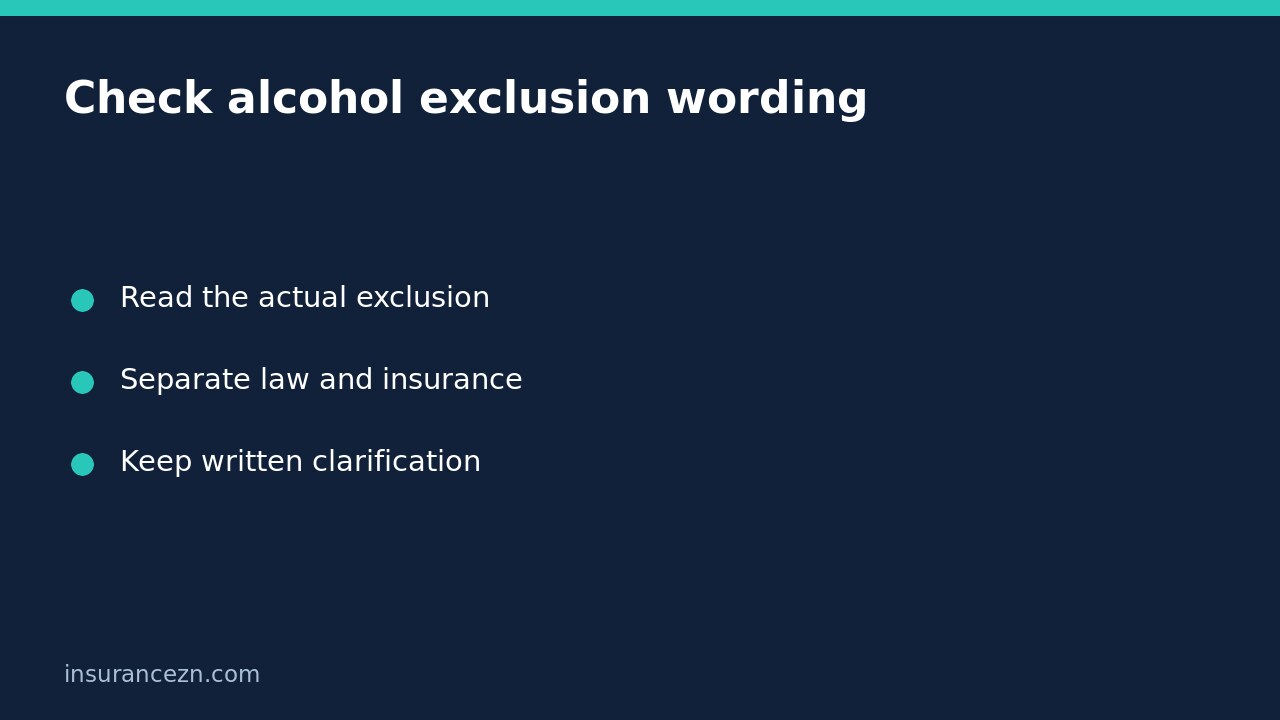
Download the documents for the exact product and level you are considering. Search for alcohol, intoxication and related exclusion wording, then read the surrounding provisions and definitions. Record the document version so that a quotation or answer can be matched to the right contract.
- Copy the relevant clause into a private comparison worksheet with its page or section reference.
- Check whether it appears among general exclusions, benefit-specific conditions or both.
- Identify any defined terms or other clauses the exclusion refers to.
- Ask which benefits the insurer says the clause may affect.
- Keep any unresolved ambiguity visible rather than treating it as permission.
This worksheet is not a substitute for reading the rest of the PDS. Smartraveller advises checking inclusions, exclusions, definitions, claims processes and emergency support. A policy can fail to fit your trip for reasons unrelated to alcohol, including the destination, planned activity or medical history.
Ask a factual question, not for a hypothetical guarantee
A useful enquiry might say: I am comparing this named policy for this itinerary; please identify and explain its alcohol-related exclusions, including the benefits to which they apply. If you have a specific concern, describe it accurately without asking the insurer to endorse an unsafe plan.
Consider a hypothetical traveller booking a resort stay with evening meals and drinks. An all-inclusive package explains what the resort sells; it says nothing about the travel policy’s exclusions. The traveller should compare the insurance documents separately rather than treating the booking confirmation as acceptance by the insurer.
Save the written reply with the PDS. If the reply seems inconsistent with the contract, request clarification. A customer-service acknowledgement is not an amendment, and a general explanation is not advance approval of an incident that has not happened. Do not assume paying a higher premium removes an exclusion unless the issued documents actually establish the relevant arrangement.
Keep legal permission and activity eligibility separate
Smartraveller lists breaking the law and undertaking excluded activities as separate situations that can leave a traveller without cover. Passing one check does not settle the others. Being old enough to enter a venue does not establish insurance eligibility for every incident there.
The same separation matters when transport or adventure activities are involved. Permission from a rental operator, a ticket seller or a guide is not an insurer’s decision. Do not use a destination’s driving rules as an insurance threshold or interpret a tour’s inclusion of drinks as evidence of covered medical costs.
If your itinerary includes an activity requiring an extra policy option, verify that option independently. Our rental-scooter activity confirmation checklist illustrates why operator access and insurance acceptance are different questions. Alcohol wording remains a separate check even when an activity is otherwise accepted.
If an incident happens, prioritise care and accurate records
Do not delay urgent medical help while trying to interpret an exclusion. Use the local emergency pathway when needed and contact the insurer’s assistance service as soon as reasonably possible. Assistance access does not itself establish approval of every treatment cost.
Give accurate information about what happened and retain the documents you actually receive, including medical accounts and relevant incident records. Do not change a factual account to fit an assumed threshold or omit alcohol use because you fear an exclusion. Ask the insurer what evidence it needs and keep the claim reference.
Does any alcohol automatically defeat every claim? This article cannot determine that. The exact contract and circumstances must be assessed; a broad government warning is not an individual claim decision.
What completes the pre-purchase check? A comparison of the actual clauses, a suitable policy for the whole trip and clarification of unresolved wording. A guessed drink count is not a coverage plan.