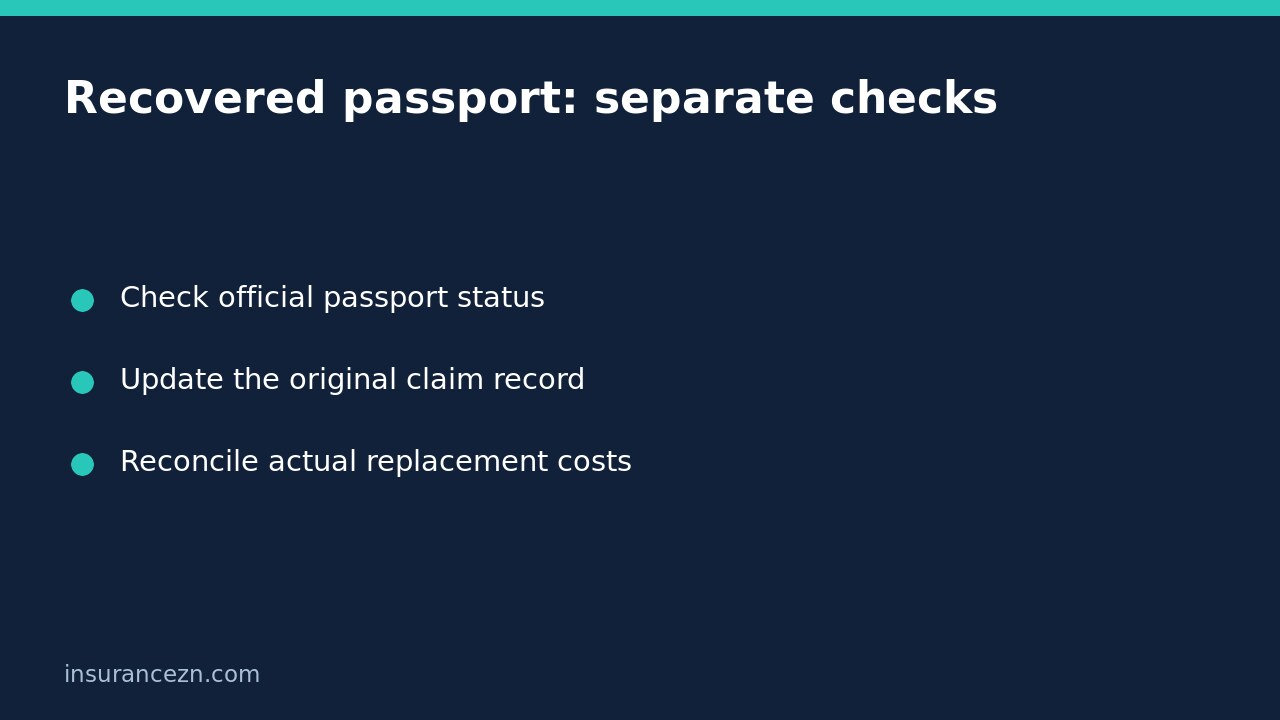

Finding your Australian passport after reporting it lost does not make it valid again. The Australian Passport Office says a passport reported lost or stolen is cancelled and cannot be used again, even if recovered. Deal separately with your travel document, transport bookings and any travel-insurance claim: resolving one does not resolve the others.
This is general information for Australian readers, not personal financial advice. Insurance benefits depend on your applicable policy, Product Disclosure Statement (PDS), limits, exclusions, evidence and insurer assessment. No replacement cost or travel disruption described here is a guaranteed benefit.
First establish whether a formal loss report was made
The Australian Passport Office’s lost and stolen passport guidance explains that reporting triggers cancellation and notification to border authorities. It also says to make sure the passport really is lost or stolen before reporting it. That is not a reason to conceal a genuine loss or delay a required report.
If you cannot tell whether a conversation was merely an enquiry or a completed loss report, contact the Passport Office, or an Australian embassy or consulate overseas, through official channels. Ask about the document’s status and the next application step. Do not try the passport at a border as a way of testing whether cancellation has taken effect.
The Passport Office says a new passport application is needed after loss or theft; ordinary renewal is not available in that situation. Follow the official instructions for your location rather than assuming a replacement can be issued immediately.
Record the discovery without rewriting what happened
Keep a short factual timeline: when you last knew the passport’s location, when you noticed it missing, when and to whom you reported it, and when and where it was found. Preserve original reports and acknowledgements. Add the recovery as new information instead of silently altering the earlier version.
For example, a hypothetical traveller reports a missing passport overseas and later finds it inside a luggage lining. The later discovery changes what is now known; it does not make a truthful earlier account fraudulent or restore the cancelled document. Describe facts you know, and distinguish uncertain recollections from evidence.
Keep passport numbers and copies secure. Use the recipient’s authorised document channel rather than posting identification in public messages or sending it to an unverified address.
Update the existing insurance file, not a duplicate claim
If you already contacted your travel insurer, supply the discovery update against the original reference. Ask what further information is required and whether any pending instructions or expense requests need reassessment. A recovery update being uploaded is not the same as it being read, correctly recorded or accepted for assessment.
Smartraveller’s travel-insurance guidance stresses reading the PDS for inclusions, exclusions and the claims process. Its general overview does not establish that every product pays for a replacement passport or resulting accommodation, transport and booking changes. Check the specific benefit and its conditions.
- Identify each expense already incurred and retain receipts.
- Separate unpaid estimates from amounts actually paid.
- Record any supplier refunds, credits or cancelled charges.
- Ask whether further non-urgent spending needs prior authorisation.
- If payment has already been received, disclose the recovery and ask whether the assessment or amount needs review.
Do not assume that finding the physical passport erases legitimate replacement expenses, or that incurring an expense guarantees reimbursement. Those are assessment questions under the actual policy.
Check bookings against the usable replacement document
Once you have official instructions, contact relevant carriers or booking providers about document details and any itinerary changes. A carrier accepting an updated passport number is not immigration permission, and an insurer acknowledging a message is not authorisation of additional travel costs. Confirm each decision with the organisation responsible for it.
Keep a single expense and correspondence record so a changed flight, a replacement-document application and an insurance update are not confused. If travel cannot proceed as booked, ask the provider about available changes or refunds and tell the insurer accurately what remains payable.
Prepare for the next conversation
Have the original loss-report reference, insurer reference, recovery timeline, application correspondence and relevant invoices ready. For storing verified assistance details before another trip, see building an offline travel-insurance emergency card. That is a contact-access tool, not proof that a particular expense is insured.
Brief FAQ
Can I travel with the recovered passport? Not if it was cancelled after a formal loss or theft report. Follow Passport Office instructions.
Does finding it automatically end my claim? Do not assume either closure or payment. Provide the update and request a written assessment of the actual costs.
Should I start another claim? Reconcile the existing reference first so the same event and expenses are not submitted twice.