
If an employee reports a work-related injury and you do not know where to direct an insurance question, start by identifying the relevant workers compensation scheme and its authority. Safe Work Australia provides national information, but it does not administer schemes or manage individual claims. Sending a claim question to a national policy body is not the same as notifying the appropriate insurer or authority.
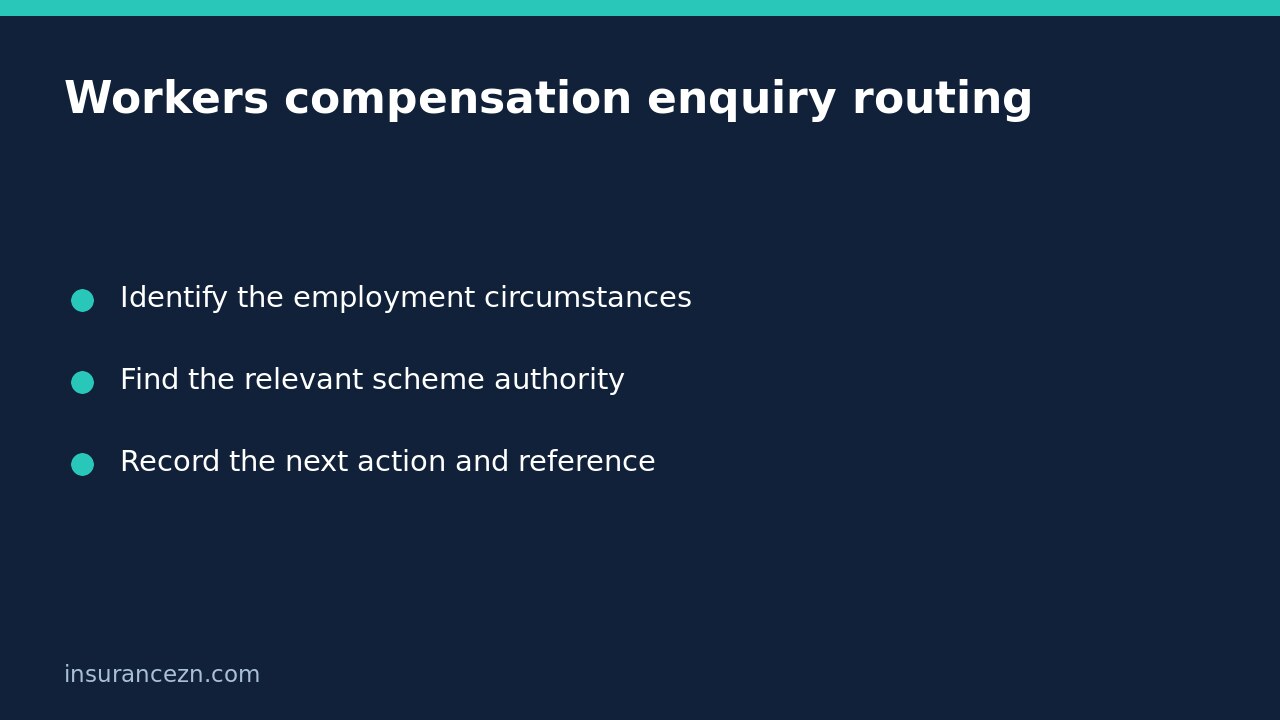
For a small Australian business, the useful first task is a routing check: who handles this matter, what notification is required, and what must happen next? Do not let an administrative search delay urgent medical assistance or necessary workplace safety action.
Separate national guidance from the claim pathway
Safe Work Australia’s workers compensation overview explains that Australian schemes operate under different laws and may work differently. It directs people with specific claim questions to their workers compensation authority. The page also supplies jurisdictional contacts, which are a better starting point than guessing from a general search result.
The overview describes possible support such as wage replacement, medical costs and rehabilitation. Those descriptions are not an individual eligibility assessment. Do not promise an employee a particular payment, duration or treatment approval based on the overview alone. Obtain the applicable scheme’s instructions for the actual circumstances.
Prepare the facts needed to identify the scheme
Before contacting an authority or existing insurer, assemble a short factual record. Keep uncertain information clearly marked rather than filling gaps with assumptions:
- The employer’s legal name and available insurance details.
- Where the employee normally works and where the incident or exposure occurred.
- The reported incident date, or the period involved if the concern developed over time.
- The person’s employment arrangements as actually documented, without treating a contract label as a final legal classification.
- Any existing notification, claim reference or correspondence, including who received it.
If interstate work, Commonwealth employment or an unusual arrangement makes the scheme unclear, explain that uncertainty explicitly. Do not assume the incident location alone resolves every jurisdiction question. Ask the relevant authority which pathway applies and whether another body needs to be contacted.
Ask a focused routing question
A hypothetical small employer might write: ‘An employee has reported an injury involving work in more than one state. Our business details and existing policy information are attached through your nominated secure channel. Can you confirm whether your scheme is the appropriate starting point, which insurer or administrator should receive notification, and what immediate steps or time requirements we need to check?’
This requests directions, not a ruling that cover exists. If the authority redirects you, record the organisation and reason, then confirm the next recipient actually received the enquiry. Avoid circulating medical reports widely merely to find the right contact. Ask what information is necessary and how sensitive documents should be supplied.
Track notification separately from acceptance
Maintain a simple action log with the date, recipient, reference, documents supplied and next task. Record a website enquiry, formal notification and claim lodgement as separate events if that reflects what actually happened. An automated response does not establish that a claim has been lodged correctly, accepted or paid.
When a response arrives, check whether it answers the routing question or asks for more information. Ask which steps remain outstanding, who is responsible for them, and how to obtain confirmation of completion. Do not assume a general enquiry pauses a statutory or scheme deadline; obtain timely scheme-specific instructions instead.
Keep your other business insurance documents available, but do not treat them as substitutes for this check. Our guide to checking a business insurance certificate of currency explains why a certificate should be read for its actual purpose rather than treated as proof of every benefit.
Quick questions before closing the enquiry
Can Safe Work Australia decide the claim? Its overview expressly distinguishes its national policy role from scheme administration and claim management. Use the relevant authority’s directions for individual matters.
Does finding the insurer mean benefits are approved? No. Identifying a recipient, lodging documents and receiving a claim decision are different stages.
What should the business retain? Keep the original report, referral instructions, submission records and subsequent decisions together, with access limited appropriately. Preserve corrections as dated updates rather than silently replacing the earlier account.
This is general information for Australian readers, not personal financial advice. Workers compensation obligations and entitlements depend on the applicable legislation, scheme rules and circumstances. Other business insurance depends on the policy, Product Disclosure Statement (PDS), purchased sections and assessment; national guidance is not a coverage or payment guarantee.