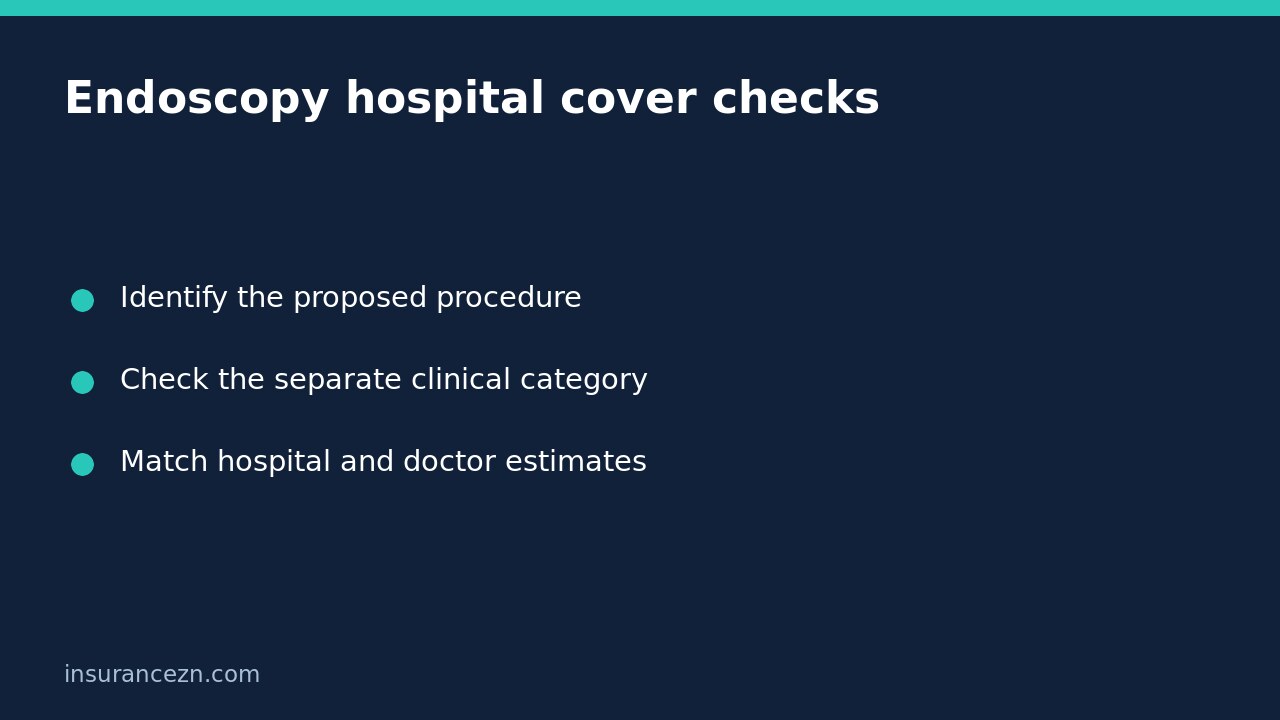

Seeing Digestive system on your Australian hospital insurance documents is not enough to establish cover for a colonoscopy or gastroscopy. Gastrointestinal endoscopy is a separate clinical category. Before agreeing to a planned private admission, ask your doctor for the proposed procedure and item numbers, then ask your insurer which category applies and what your exact policy will pay.
This is general information for Australian readers, not personal financial advice. Benefits depend on your policy terms, applicable PDS or fund rules, exclusions, restrictions, waiting periods and individual circumstances. A category description is not a personal benefit approval.
Why the two category names matter
The government’s PrivateHealth.gov.au clinical categories page describes Digestive system as hospital investigation and treatment of the digestive system. It expressly lists endoscopy separately under Gastrointestinal endoscopy. That separate category includes diagnosis, investigation and treatment using an endoscope, with examples including colonoscopy, gastroscopy and endoscopic retrograde cholangiopancreatography.
The same page says non-endoscopic digestive procedures are listed under Digestive system. Therefore, a body-system label should not be used as a shortcut for every procedure affecting that part of the body. The clinician identifies the proposed treatment; the insurer checks how that treatment fits your actual cover.
This is an insurance-administration distinction, not advice to choose one medical procedure over another. Discuss clinical decisions and timing with your treating practitioner. Do not delay urgent care while trying to complete a cover checklist.
Build a procedure-specific enquiry
Ask the doctor’s rooms for the planned procedure name, expected MBS item numbers where available, proposed hospital or day facility, likely admission date and treating providers. Clarify whether you will be an admitted patient. A short visit or a day procedure should not be classified from its duration alone.
Then send the details to your insurer using a secure channel. A useful request is: My documents show Digestive system. Please confirm whether the proposed procedure falls under Gastrointestinal endoscopy, whether that category is included, restricted or excluded on my current product, and the benefits and conditions applying to this admission.
- Confirm the exact product and membership component being checked.
- Ask about waiting periods and any other eligibility assessment relevant to you.
- Check whether the proposed facility has an agreement with the insurer.
- Ask for applicable excesses, co-payments and any hospital benefit restrictions.
- Keep the insurer’s written answer, reference number and the details on which it was based.
A staff member acknowledging your enquiry is not the same as a completed benefit check. If the answer simply says digestive treatment is covered, ask for clarification against the actual procedure and separate category rather than treating the broad wording as sufficient.
Separate category eligibility from the full bill
Even confirmation that a category is included does not establish that every account will be paid in full. PrivateHealth.gov.au explains that hospital charges and medical fees are separate. A treating specialist and an anaesthetist may issue their own accounts, while the facility may charge for hospital services.
Request written estimates from the relevant providers and ask whether any proposed medical gap arrangement will actually be used for this episode. A doctor’s participation in a scheme generally is not confirmation that your particular account will be billed through it. Match each estimate with the insurer’s benefit information rather than combining unrelated figures.
For example, imagine a patient whose insurer confirms endoscopy-category eligibility but whose written doctor’s estimate still shows a personal gap. Those statements can both be correct: the category check concerns eligibility, while the estimate concerns the actual fee and expected benefit. This is a hypothetical illustration, not a quote or a promise about anyone’s costs.
Refresh the check when the plan changes
If the doctor changes the proposed procedure, item numbers, facility or date, keep the original estimate and request a revised check. An answer for a previous plan should not silently become confirmation for a different one. Ask what remains provisional and how unexpected additional services would be assessed, without assuming that every possible extra procedure is pre-approved.
If you cannot obtain an item number, use the separate guide on checking hospital cover when there is no MBS item number. Do not invent a number or infer entitlement from an informal procedure label.
Before the planned admission: a final checklist
- Is Digestive system enough? Not by itself for endoscopy: check the separate category against the actual procedure.
- Does an appointment booking prove insurance approval? No. Keep the booking and the insurer’s benefit response as separate records.
- Is an included category a no-gap guarantee? No. Reconcile hospital estimates, doctors’ accounts, excesses and benefit conditions.
- What should I save? The proposed treatment details, dated insurer response, provider estimates and any later amendments.
Sources: PrivateHealth.gov.au clinical category definitions and its explanation of out-of-pocket hospital and medical costs.