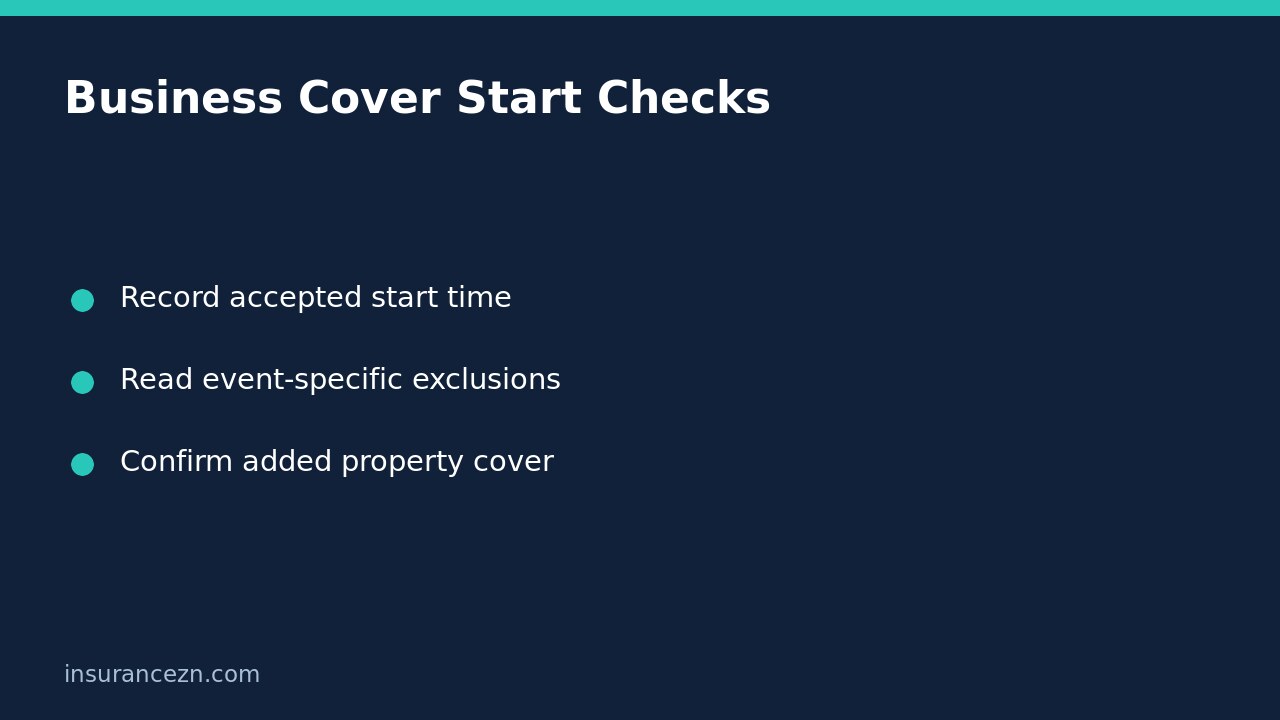

Starting a business insurance policy does not necessarily mean every insured event is covered from the first moment. Before relying on newly purchased property protection, check the accepted commencement time, the sections actually purchased and any event-specific exclusion applying at the start. A receipt proves payment; it does not replace the policy wording.
This is general information for Australian readers, not personal financial advice. Cover depends on the applicable Product Disclosure Statement (PDS), policy wording, schedule, endorsements, limits, conditions and exclusions. The insurer example below is not a recommendation or a rule for every Australian policy.
Read the commencement restriction separately from the cover list
On its Small Business Insurance overview, AAMI lists contents and stock protection for fixed premises against insured events. However, a qualification on the same page says it does not insure flood, bushfire or grass fire in the first 72 hours of commencing a new policy or adding property damage cover. It separately says cyclone damage within 72 hours of commencing a new policy is not covered, and directs readers to its PDS and policy wording.
Those are provider-specific summary statements. Do not assume that another insurer uses the same period, that every weather event is treated identically, or that a rule about commencing a policy necessarily describes every later amendment. Read the applicable contract for qualifications and ask about the precise transaction being processed.
Build a start-time record before relying on the change
Keep the quote, accepted application, policy schedule and payment confirmation together, but label their different purposes. Record the following information in a simple commencement register:
- The insured business, exact premises and property categories.
- The original policy commencement date, time and stated time zone.
- The requested amendment and when the insurer accepted it.
- The effective date and time shown on the updated documents.
- The relevant event exclusion and any written clarification.
A quote saved on Monday, payment made on Tuesday and cover accepted for Wednesday are different records. Do not use the earliest timestamp simply because it produces a more favourable result. If documents conflict, ask the insurer or broker to reconcile them in writing.
Distinguish an existing policy from newly added property protection
For example, imagine a business that already holds liability cover and now asks to add contents and stock insurance. The business has been a customer for months, but that fact alone does not establish when the newly requested property protection starts or how a commencement restriction applies. Ask specifically whether adding that section triggers an exclusion, which events it affects and what accepted time controls it.
This is different from merely checking the stock value. A suitable sum insured does not establish immediate event eligibility. If a delivery is also increasing the amount of stock held, use the separate seasonal stock review checklist alongside the commencement check, rather than treating one as a substitute for the other.
Ask a precise question rather than requesting general reassurance
A useful written enquiry is: “Please confirm the effective date and time of the accepted property damage section for these premises, identify any commencement restrictions for flood, bushfire, grass fire or cyclone, and explain whether the restriction applies to this amendment.” Attach the actual schedule and amendment reference through an official channel.
Ask the insurer to identify the relevant clause and any applicable qualifications. A message saying the request was received is not confirmation that cover was accepted. Likewise, a certificate or premium debit does not by itself resolve an event-specific exclusion. Keep the response with the processed schedule, not only in a sales conversation.
If damage happens during an uncertain commencement period
Prioritise safety and follow emergency instructions. Record the event and damage accurately, preserve photographs and relevant timestamps, and notify the insurer through its official claims channel. Do not change the incident date or delay reporting to place the loss outside a restriction. Ask for an assessment under the policy actually in force and a written explanation of any exclusion relied upon.
Arranging later cover does not retrospectively insure an existing loss. Equally, an unclear commencement record should be investigated rather than turned into a guessed claim outcome.
Quick questions before you file the documents
Does paying mean every event is covered immediately? No. Check accepted commencement and contractual restrictions separately.
Is 72 hours a universal business insurance rule? No. It is the period in the cited AAMI summary for the described circumstances; your contract must be checked.
What closes the administration task? A reconciled accepted start time, the processed schedule and a clear answer about the relevant event restriction—not simply a submitted amendment.