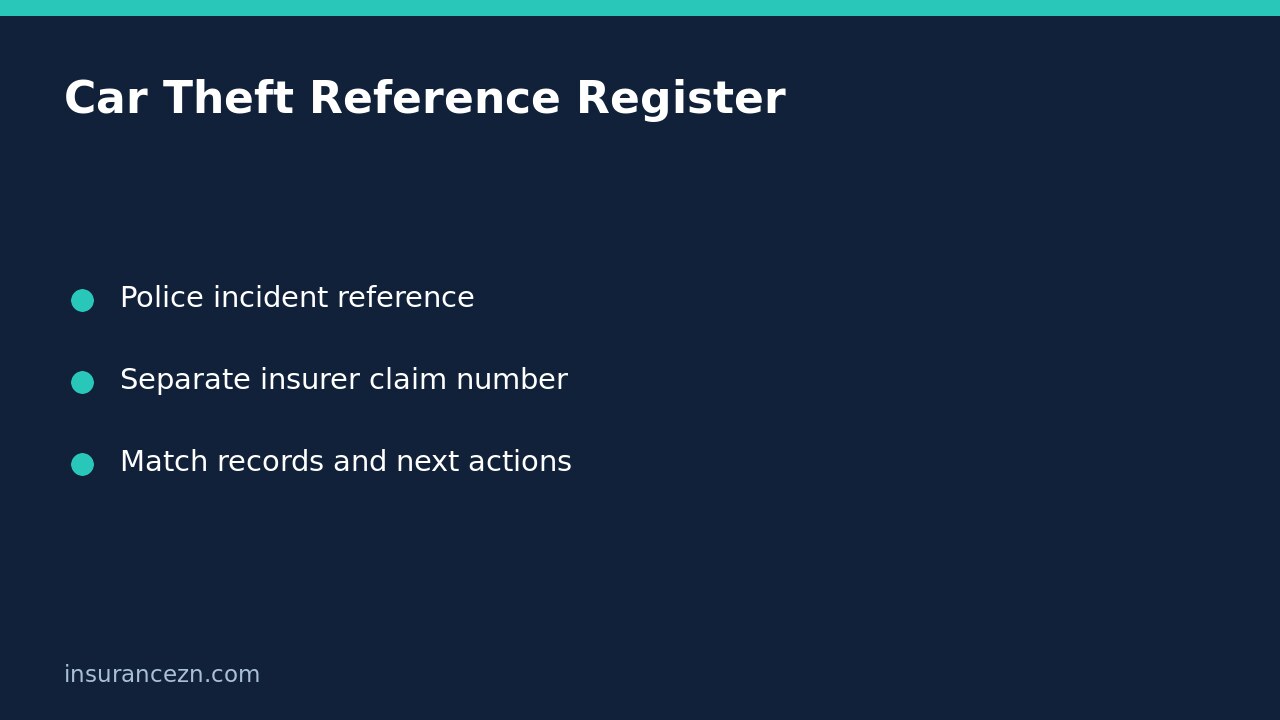

A police report about a stolen car and an insurance claim serve different purposes. Keep the police incident reference and insurer claim number in separately labelled fields, then confirm that both relate to the same vehicle and event. Reporting the theft to police is not proof that an insurance claim has been lodged, and an insurer reference is not evidence that a police report exists.
This is general information for Australian readers, not personal financial advice. Your policy/PDS, schedule, conditions, exclusions and the insurer’s assessment determine insurance benefits. This checklist organises records; it does not establish theft cover, claim acceptance or a promised payment.
Check the insurer’s actual reporting instructions
The Suncorp comprehensive car claims instructions say that if loss is caused by theft, the customer needs to notify police and obtain a report. The same instructions separately describe lodging an insurance claim and receiving a claim number and email confirmation afterwards.
That is a specific provider’s published process, not a guarantee that every insurer or police service issues identical documents. Follow the relevant police service’s reporting instructions and your insurer’s requirements. If there is immediate danger, seek emergency help first; do not wait to complete an insurance worksheet or try to retrieve the vehicle yourself.
Create two clearly labelled records
A small register prevents a common administrative error: placing whichever reference arrived first into every form. Use one row for the police report and another for the insurance claim. For each, record:
- The organisation that issued the reference and its exact label.
- The date reported or submitted and the confirmation received.
- The vehicle registration and other identifying details available.
- The reported incident period and location, distinguishing known facts from uncertainty.
- The next action, requested document and responsible contact.
Do not assume the two numbers share a format. A policy number identifies the insurance contract, while a towing job number may identify a supplier task. Neither should be silently substituted for an insurer claim number. Keep original confirmations so an unfamiliar label can be checked instead of guessed.
Match the event before supplying more documents
Suppose a car owner has a police acknowledgement for a theft reported overnight and an insurer email received the next morning. Before uploading the acknowledgement, match the vehicle, incident and existing insurance claim. Check that the number entered is the police incident reference, not a telephone enquiry receipt or an unrelated earlier report.
If a reporting time and an estimated theft time differ, preserve both and label them. Reporting at breakfast does not prove that the theft occurred at breakfast. Where the last-seen time is known but the actual theft time is not, give the accurate interval and explain its basis. Do not invent a precise time to make two systems look consistent.
Confirm each completed step independently
Suncorp’s page says customers can lodge without having every detail ready and add information later. For its process, that can help separate initial lodgement from later evidence collection. It does not remove policy obligations or establish another provider’s rules.
Check the status of each task directly: police report made, insurance claim lodged, document uploaded, document allocated to the correct claim, and any further information requested. These are separate milestones. An upload receipt is useful evidence of transmission, but it does not prove the insurer has reviewed the report or accepted the loss.
If you have lost the insurer reference, ask the insurer to locate the existing record through its official contact channel and required identity checks. Do not lodge another claim merely to obtain a convenient new reference. The related guide to recording unknown claim details without guessing explains the same evidence principle in an accident setting; it is not a theft-reporting procedure.
Handle later police information without overwriting history
If police provide a later report reference, correction or recovery notification, ask how it should be attached to the existing claim. Keep the original and revised records with their dates. Explain whether the new material replaces a factual entry or adds another stage to the same event; avoid silently editing earlier documents.
Use official insurer channels and disclose only information needed for the task. If the vehicle is located, seek appropriate police and insurer instructions about access, towing, inspection and next steps. Recovery alone does not establish roadworthiness, repair authority, ownership of any settlement proceeds or the end of the claim.
Frequently asked record checks
Does a police number mean my insurance claim is accepted? No. It documents a separate reporting process, not an insurer coverage decision.
Should I wait for a complete report before contacting the insurer? Follow the insurer’s notification instructions. Ask what can be lodged now and what evidence must follow rather than assuming a delay is permitted.
When is the reference-matching task complete? When you have identified the correct records for the same incident, confirmed outstanding documents and recorded the next action. Repair approval and settlement remain separate decisions.