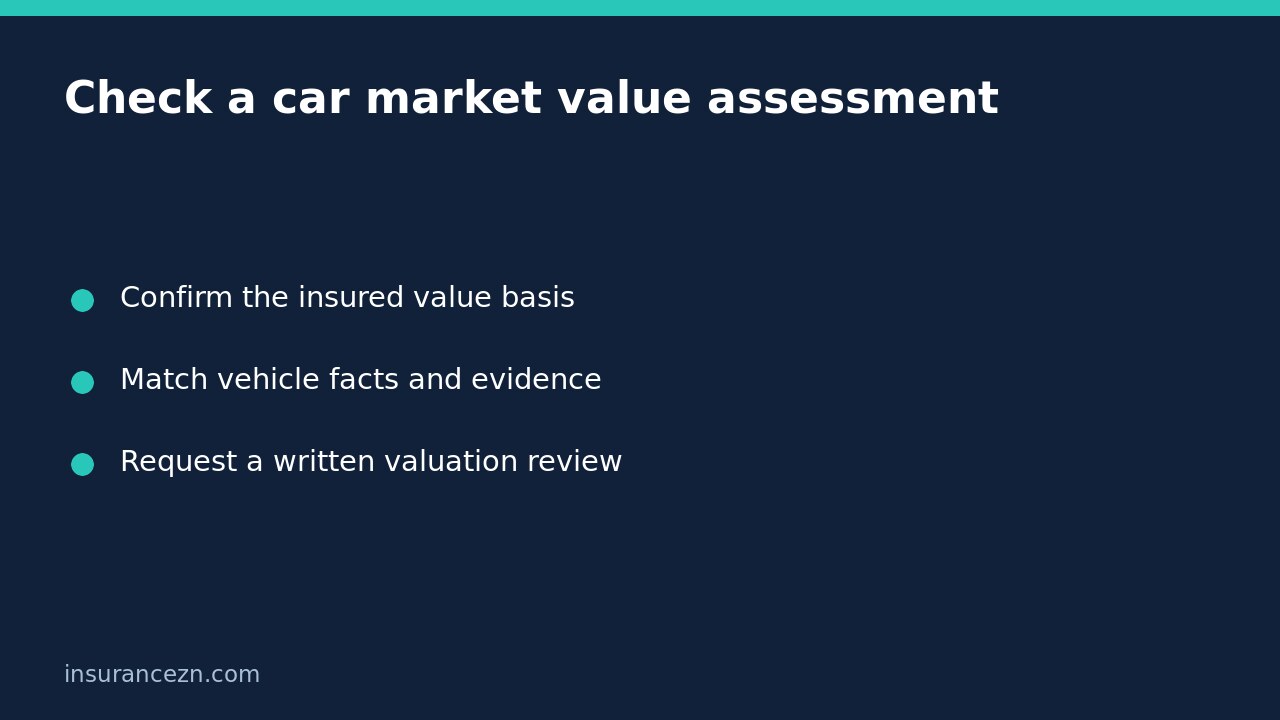

If your insurer’s car market value assessment appears too low, first check the vehicle facts and valuation basis rather than sending only the highest advertised price you can find. Build a short evidence file showing any incorrect model, kilometres, condition or comparison details, then request a written explanation and review under your existing claim reference.
This is general information for Australian readers, not personal financial advice. Your policy wording, Product Disclosure Statement (PDS), schedule, endorsements and claim circumstances determine the outcome. A request for review does not guarantee a higher valuation or payment.
Confirm that market value is actually the relevant basis
Find the policy schedule applicable to the incident date. Identify whether it records market value, an agreed value or another defined amount, and read the corresponding contract definition. Do not use a renewal document from a later period as proof of the earlier arrangement.
AAMI’s explanation of amount covered and market value distinguishes a set maximum amount from a variable assessment of what the market would pay at the time of an insured incident. It says market value is not necessarily the highest sale price. This provider-specific explanation is useful context, but your own insurer’s wording controls your claim.
If the insurer is using market value despite a different basis on your applicable schedule, ask it to explain the discrepancy first. Also keep the assessed vehicle value separate from deductions and the net amount offered: a smaller proposed payment does not necessarily mean the underlying valuation is the disputed figure.
Check the vehicle description against dated evidence
Ask for the vehicle details used in the assessment and any explanation or report the insurer can provide. Compare them with reliable records rather than memory. Your checklist can include:
- The exact make, model, variant, year and relevant specification.
- Kilometres travelled close to the incident date, supported by a dated service record or photograph where available.
- The pre-incident condition, including existing damage and maintenance information.
- Permanently fitted accessories or modifications, with evidence of what was actually installed.
AAMI lists age, make, model, kilometres, general condition and permanently fitted accessories or modifications among its market-value factors. That does not mean every receipt adds its purchase price to a claim. Provide the facts and ask how the applicable policy treats them.
Do not confuse the odometer reading with the annual kilometres estimate used for policy administration. A correction should say which field is wrong and what the evidence establishes, without creating a new estimate to make the valuation look better.
Use comparable vehicles, not simply expensive listings
Assemble a small set of genuinely comparable examples if you have them. Note the date captured, location, model and variant, kilometres, condition and advertised price. Save the listing itself as well as its URL because online adverts can disappear or change.
For a hypothetical review, suppose the assessment describes a base variant but the purchase and service records identify a higher-specification variant. The useful request is to correct the variant and explain its effect on the assessment, not to demand the price of a different, newer car. Flag differences in every example you provide.
Advertising shows an asking price, not necessarily the price achieved in a completed sale. AAMI says it may use recognised industry guides and publications tracking actual selling prices. Ask your insurer how it selected and adjusted its evidence rather than claiming that one advertisement proves a particular entitlement.
Keep acquisition costs distinct too. AAMI’s explanation says its market value excludes stamp duty, transfer fees, dealer warranty and delivery costs. Do not add these automatically to your own valuation request; check your contract’s treatment.
Send a focused review request
Use a simple structure: claim reference; assessed value and date; the fact you dispute; the replacement fact; supporting evidence; and the explanation or correction requested. Number attachments so the reviewer can connect each document to a specific point.
Ask for confirmation that the material has reached the valuation reviewer and for a written response explaining whether the assessment changes. An upload receipt confirms transmission, not that the vehicle record or valuation has been corrected. Keep the original offer and each later version rather than overwriting them.
If the explanation remains unclear, ask about the insurer’s internal complaints process and any current applicable response dates. Do not assume a valuation enquiry pauses an existing deadline or that you must accept an offer before asking questions.
Before agreeing to an outcome
Check that the final response addresses the disputed facts, identifies any revised value and separately explains deductions and the proposed payment. Confirm whether other claim issues remain unresolved. Our written claim-decision checklist can help organise an explanation if a separate coverage refusal is also involved; valuation and coverage are different questions.
The aim is a traceable, evidence-based review. Correct facts do not guarantee your preferred price, but they make it easier to understand what was assessed, what changed and what still needs a clear answer.