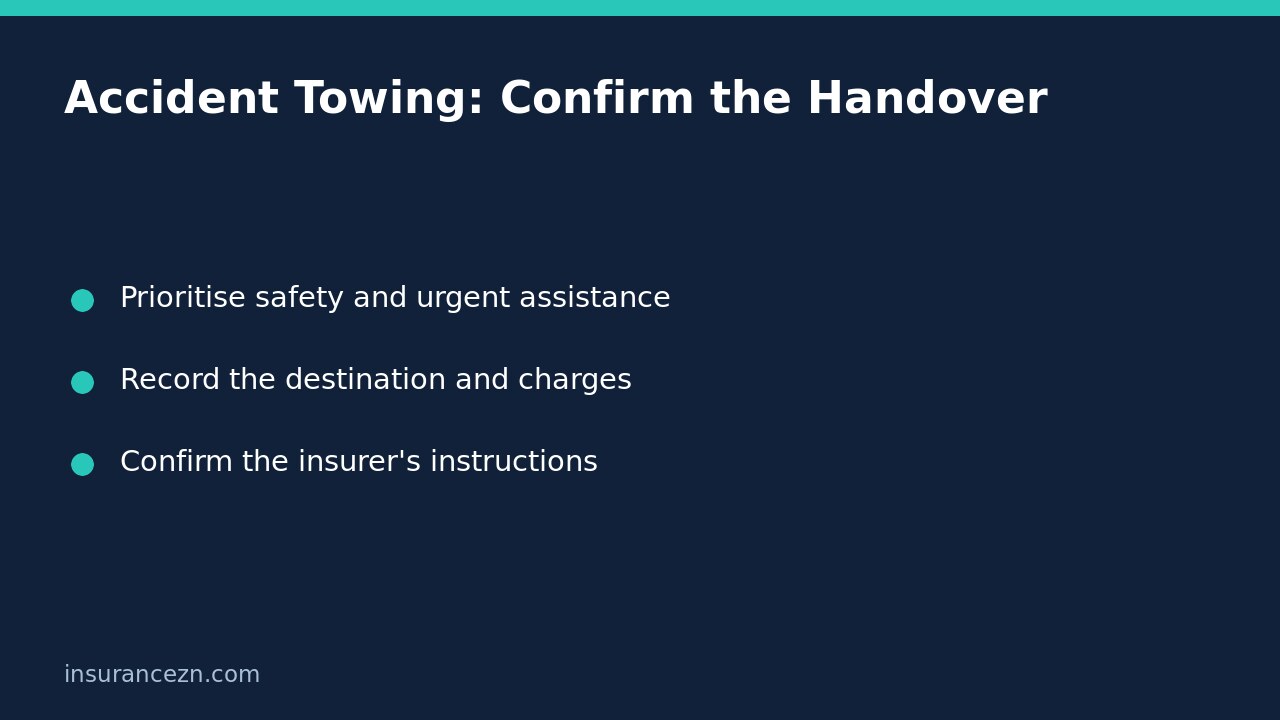

When your car needs an urgent tow after an accident, put immediate safety first. When safe and practical, contact your insurer using a verified claims channel to confirm arrangements, the destination and the scope of any authorisation. A truck arriving, a booking confirmation or a claim number does not by itself establish that every towing or storage charge will be paid.
This is general information for Australian readers, not personal financial advice. Your policy, Product Disclosure Statement (PDS), schedule and applicable conditions determine cover. Emergency directions and local towing requirements may affect what happens at the scene; this article does not replace them.
Deal with the urgent situation before paperwork
Follow emergency-service directions and do not remain in a dangerous location to collect insurance documents. If urgent medical or emergency assistance is needed, seek it without waiting for an insurance decision. Do not drive a damaged vehicle merely to avoid a possible towing bill when its safety is uncertain.
For its comprehensive car customers, Suncorp’s claims instructions direct people needing immediate help to secure property or arrange an urgent tow to its claims phone service. That is a provider-specific pathway. Other insurers may have different channels, so use your own policy documents, official website or app rather than assuming one provider’s arrangements apply to you.
Ask where the vehicle will go
Once safe, ask for the tow operator’s name, collection location and proposed destination. Establish whether the vehicle is going to a holding yard, an assessment location or a repairer. Those are not interchangeable steps. A first destination may not be the eventual repair location.
Ask what you are authorising when signing a document. In particular, clarify whether the agreement concerns transport only or includes storage, another transfer or other work. If anything is unclear, ask for an explanation and contact the insurer where practical. Do not assume a business described as a preferred repairer has authority for every service offered at the scene.
Record the destination’s address and a contact method. Knowing only that the car was taken ‘to the yard’ can make the next insurer conversation much harder.
Separate agreed instructions from reimbursement
Tell the insurer whether a tow has already been arranged, who arranged it, and what documents you have signed. Ask which part of the proposed transport it has authorised, whether it needs to arrange a further move, and how invoices should be provided. Request confirmation of any payment instructions or unresolved charges.
If a police or emergency direction means movement cannot wait, follow that direction and preserve the details when safe. Explain the circumstances to the insurer afterward. Do not assume urgent movement guarantees reimbursement, but do not delay essential safety action while trying to obtain it.
Towing, storage, vehicle assessment, repairs and replacement transport should be treated as separate decisions. Suncorp’s instructions describe several post-lodgement actions, including document uploads, repair bookings and a hire car if eligible. The availability of those actions does not mean every claim or expense has already been accepted.
Build a short handover record
Keep one note attached to your existing claim reference, if you have one. Include:
- Accident date, vehicle registration and collection location.
- The tow company’s identity and the vehicle’s actual destination.
- Who requested or directed the tow and when.
- The agreed services, quoted charges and any storage terms supplied.
- Copies of agreements, itemised invoices and payment receipts.
- The insurer’s instructions and any questions awaiting a response.
A receipt proves a payment was made; it does not prove insurer reimbursement approval. Similarly, an upload acknowledgement establishes neither that the invoice has been assessed nor that an account has been settled. Ask what remains outstanding and keep the response with the original documents.
If the car is at a different yard than expected
Confirm the actual location with the operator and notify the insurer promptly. Ask who should organise the next move, what authority is required and how any existing charges will be handled. Avoid independently arranging repeated transfers without clarifying the position when circumstances allow. Keep a record of conflicting instructions rather than silently replacing your original note.
For the related cost decision, see comparing a small repair claim with the actual benefit. That comparison is separate from making the vehicle safe and locating it after a tow.
Does a claim number mean towing is approved?
No. Suncorp describes issuing a claim number and confirmation after lodgement, followed by further claim steps. Ask specifically about the tow, destination and payment responsibility. Do not lodge another claim merely because the first tow invoice has not appeared in the claim record; reconcile the existing reference and outstanding evidence first.