
An annual travel insurance quote is not automatically good value because you might take several holidays. Start with journeys you actually expect to make, compare suitable cover on equivalent terms, and keep speculative travel in a separate scenario. This helps Australian travellers avoid counting imaginary savings while overlooking an unsuitable policy.
This is a price-and-planning exercise, not a claim forecast. An annual policy can be convenient, but its value depends on your itinerary and accepted cover, not simply the word annual.
Divide your travel list into confirmed and possible journeys
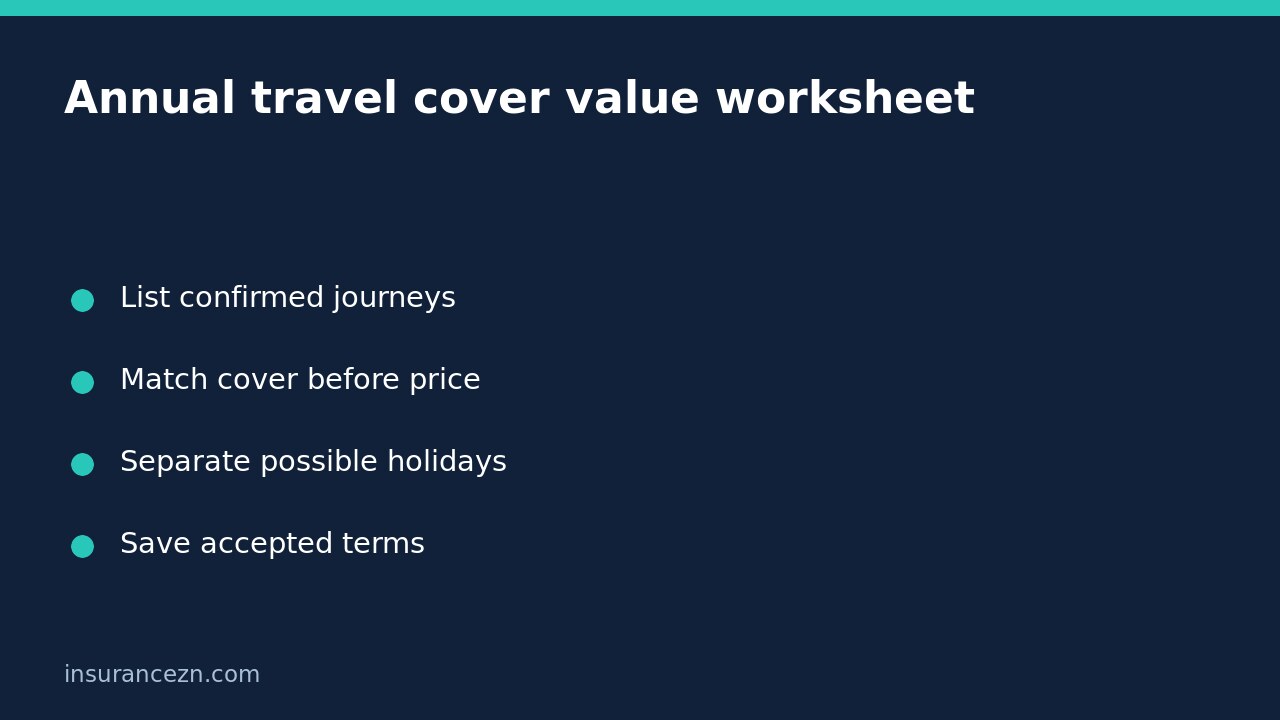
Create a worksheet with one row for each journey. Record destination, transit countries, departure and return dates, travellers, planned activities and any relevant medical declarations. Mark each row confirmed, likely or only an idea. Save the itinerary version used to obtain each quote.
Use confirmed journeys for the first comparison. Then create a separate scenario that adds a likely later holiday. Do not treat an unbooked ski trip, family visit or work conference as certain merely because including it makes an annual premium look attractive.
The government’s Smartraveller travel insurance guidance says an annual multi-trip policy may offer convenience and better value for frequent travellers. It also warns that multi-trip policies can restrict individual trip lengths. That is a reason to compare, not a promise that annual cover is cheaper.
Make the cover comparable before comparing premiums
Request single-trip quotes for the confirmed journeys and an annual quote covering those same journeys. Check that the countries, travellers, declared conditions and activities match. Record the excess, cancellation provisions, medical benefits and relevant item limits alongside the premium. A cheaper quote that omits an important exposure is not the same purchase.
- Include accepted options needed for the actual itinerary, rather than comparing a basic headline price with comprehensive cover.
- Check when cancellation protection begins and which bookings or events it can apply to.
- Check each trip’s duration and the annual policy’s start and end dates.
- Record any unresolved eligibility question as unconfirmed, not covered.
For the duration check, use our annual travel insurance trip-limit worksheet. That check establishes whether the itinerary fits; this worksheet addresses whether paying for the annual arrangement makes sense for travel you will actually take.
Build separate totals for separate scenarios
In the confirmed-travel scenario, add the actual payable single-trip premiums and necessary accepted options. Compare that total with the actual payable annual premium and its required options. Keep quote dates and expiry information: future single-trip prices are not guaranteed simply because you obtained an indicative quote today.
In the additional-holiday scenario, add a separate quote for that proposed trip. Ask whether the annual product would accept the exact destination, duration and activity, and whether extra premium would be required. Keep an unknown adjustment marked unknown rather than assuming it is free.
For example, imagine two booked family visits and a possible later skiing holiday. First compare suitable cover for the two visits alone. Then compare a second scenario including the ski trip and any accepted winter-sports option. If the annual quote only looks cheaper in the second scenario, write that dependency explicitly. You are buying flexibility for a possible trip, not banking a saving already achieved.
Check what changes before a later departure
Annual insurance should not be treated as an unlimited pass for future changes. Before adding a journey, recheck destination advice, medical disclosure requirements and activity conditions against the applicable PDS and schedule. Ask the insurer how changes during the policy year are handled.
If an amendment is needed, distinguish asking for it from receiving accepted terms. Save the written response, any additional premium, effective dates and revised documents before relying on the change. Do not assume a later purchase or amendment covers an event that has already happened.
Questions before paying
Should I divide the annual price by every holiday I hope to take? You can model that scenario, but label the assumptions. Keep the confirmed-travel comparison visible so the decision does not depend on trips that may never occur.
Does the lower total guarantee better insurance? No. Revisit exclusions, excesses, assistance and benefit limits. Smartraveller recommends reading the PDS and choosing cover suited to the trip rather than defaulting to the cheapest option.
What should I save? Keep the completed worksheet, dated quotes, PDS versions, schedules and written answers. Review the comparison if the travel plan changes.
This is general information for Australian readers, not personal financial advice. Eligibility, benefits, exclusions, limits and amendments depend on the policy/PDS and insurer acceptance. No comparison guarantees claim acceptance or payment.