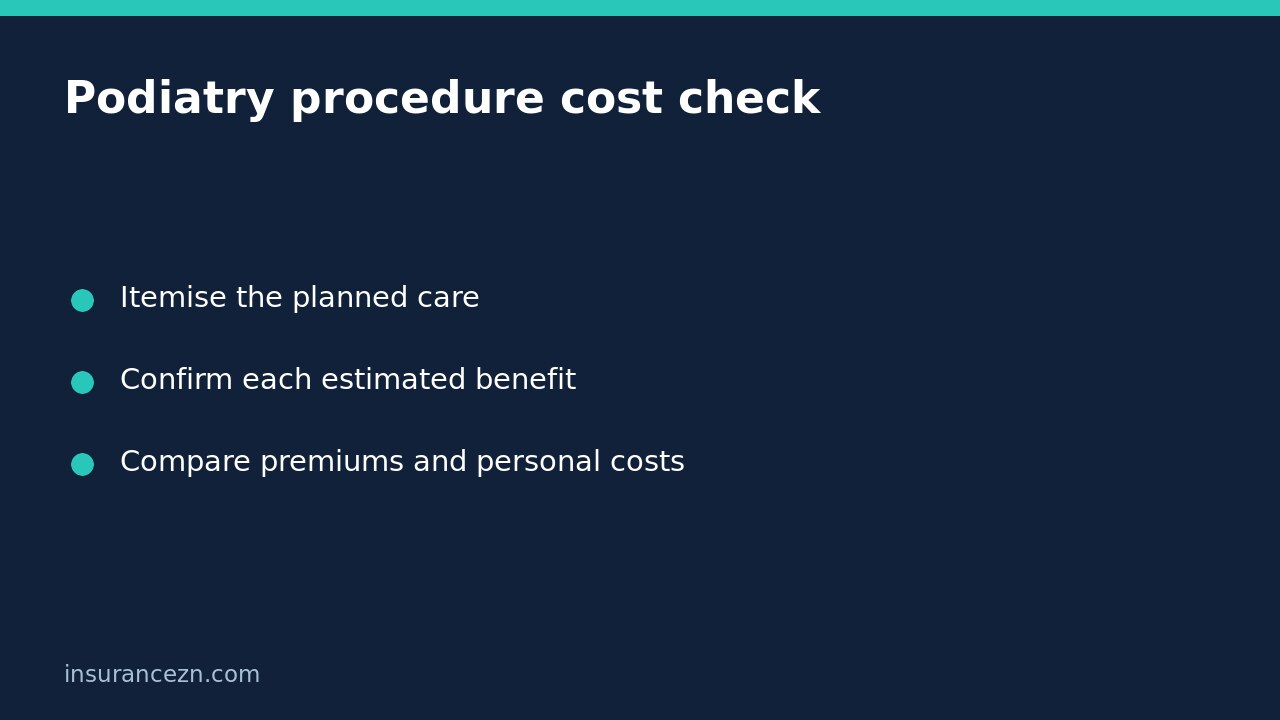

If you are comparing extras cover because a podiatrist has proposed a nail procedure, ask for an itemised treatment quote before comparing policies. A policy mentioning podiatry does not establish that every component of the planned visit is eligible, or that a procedure attracts the same benefit as a consultation. Compare estimated personal costs for the actual care, not the largest advertised annual allowance.
This is general information for Australian readers, not personal financial advice. Benefits depend on the applicable policy, fund rules, waiting periods and service eligibility. Read the policy documents and any relevant PDS; seek a personal estimate rather than relying on this article as confirmation of cover.
Start with the treatment plan, not the extras headline
Ask the treating practice to identify the planned service in its own billing terms. Request the practitioner name, practice location, expected service date, item descriptions or codes where used, and charges. A clinical description helps the insurer distinguish the intended procedure from an ordinary appointment. Do not choose a different code yourself to make a benefit appear available.
Ask which costs are included in the quote and which might be additional. Depending on the proposed care, questions could include whether the initial consultation, procedure, dressings and later review appointments are charged separately. These are questions to investigate, not a statement that every procedure involves these charges or that any insurer covers them.
Get a separate answer for each quoted component
The government’s private health insurance overview lists podiatry among possible general-treatment services. It also explains that policies differ, that services can have per-service, annual or lifetime limits, and that some services may not be covered. That overview does not establish a particular nail procedure’s eligibility.
Send the quote to each fund you are considering. Ask whether the exact practitioner at that location is recognised for the intended service, whether each quoted component is eligible, and what estimated benefit applies to you. Ask whether an overall podiatry balance, a narrower sublimit or another shared allowance constrains the estimate. Recognition of a provider is not approval of every service they offer.
- Is this estimate for my current product or the proposed new product?
- Are waiting periods complete for the exact service date?
- What balance has already been used or committed by other claims?
- Which documents would be required when claiming?
- Could a change to the treatment plan change the estimate?
Compare the same episode of care across policies
Create one worksheet covering the same consultation, procedure and planned follow-ups for every option. Record each charge, estimated benefit and remaining personal cost. Keep uncertain items marked as unconfirmed rather than treating them as fully covered. Do not count a headline annual maximum as money you will necessarily receive.
Include the actual payable premiums over an equivalent comparison period. If you already hold extras, compare the additional premium for upgrading against the additional estimated benefits, while considering other cover you genuinely need. If you are buying a combined package, separate any hospital-policy change from the podiatry calculation so the comparison does not quietly assume equivalent hospital protection.
A higher allowance may provide no practical improvement if the exact procedure is excluded, a waiting period applies, or the per-service benefit remains unchanged. Conversely, a lower advertised limit may still be sufficient for the planned eligible services. Only product-specific answers can establish which comparison applies.
Keep devices and later appointments separate
Do not add an orthotic allowance to a nail-procedure estimate simply because both involve a podiatrist. If an appliance is also proposed, request its own description, charge and benefit assessment. Our orthotics benefit checklist explains why the unit being quoted matters. Avoid counting the same shared balance twice across appointments and devices.
Ask the clinician which follow-up visits are expected and which are only possible. Keep confirmed care separate from hypothetical extra treatment, and do not delay necessary care solely to improve an insurance comparison. Clinical suitability and insurance benefits are different decisions.
Before paying more: a final checklist
Does an estimate guarantee payment? No. Keep the written estimate and its assumptions, but the final assessment depends on the service actually performed, claim evidence and applicable rules.
Will switching preserve every entitlement? Do not assume so. Ask about waiting-period recognition, product limits and any effect of previous claims before changing cover.
What should I retain? Keep the dated quote, fund response, product details and final itemised invoice. After treatment, compare the processed claim with the actual services. A receipt or successful submission confirms neither the estimated benefit nor a completed correction if something was recorded incorrectly.