

A small car repair does not automatically mean an insurance claim is worthwhile, but comparing the repair quote with the basic excess alone can miss important costs. First identify what your policy could actually pay, which excesses apply, and whether the accident also involves someone else’s property. Then ask the insurer which answers are confirmed and which depend on assessment.
This is general information for Australian readers, not personal financial advice or legal advice. Coverage, excesses and claim treatment depend on your policy, Product Disclosure Statement (PDS), schedule and circumstances. The worksheet below is a decision aid, not a recommendation to claim or pay privately.
Separate your repair bill from the whole accident
Write down your own vehicle damage, any other damaged property, and any demand already received. A scratched bumper may look inexpensive while the other vehicle needs additional assessment. Do not treat your own repair quote as the total accident cost or assume that a private payment settles every possible claim.
If another party has sent a demand, gather it before deciding how to handle the matter. Our article on what to send your insurer after receiving a car accident demand letter explains a related document-preparation task. Responsibility, policy coverage and repair price are separate questions.
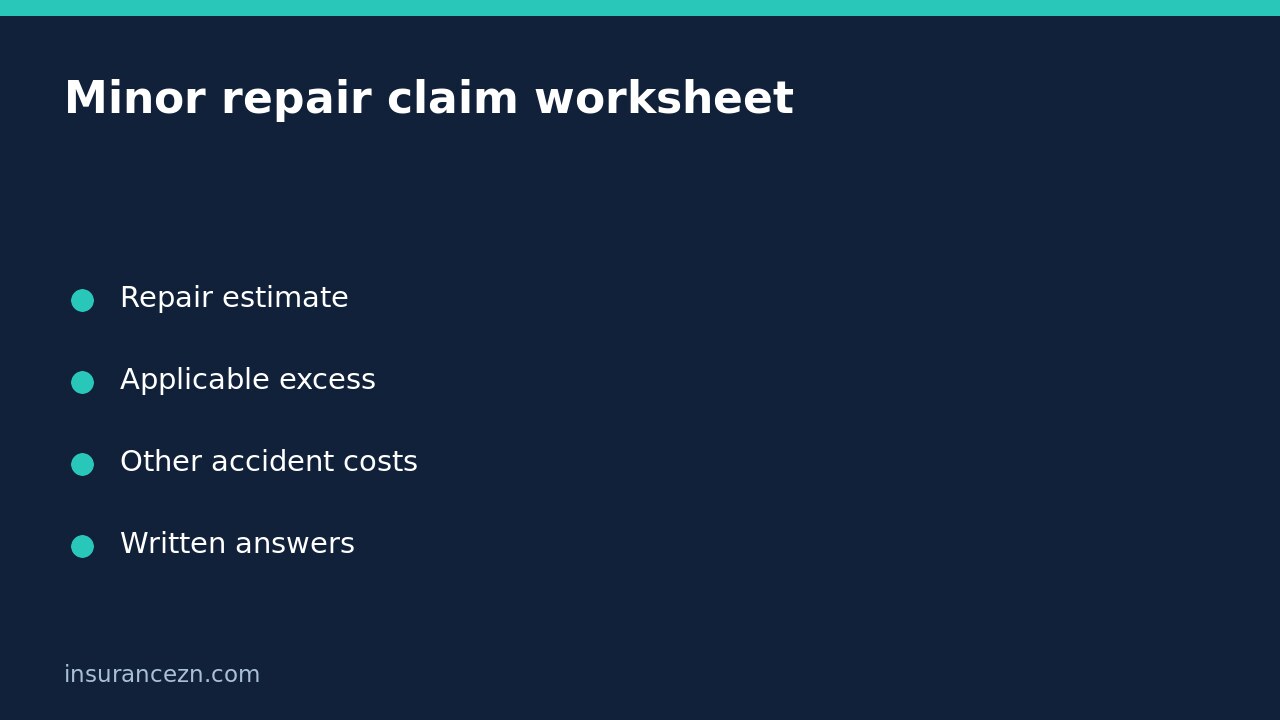
Build a repair-versus-excess worksheet
Use a written repair estimate rather than a guess from a photograph. Ask whether inspection could reveal hidden damage and whether the estimate includes relevant parts, labour and tax. A repairer’s quote is not necessarily the amount an insurer will approve.
- Repair amount: record the estimate and whether the insurer has assessed it.
- Excess: ask for each applicable excess and whether amounts combine for this event.
- Other costs: list towing, storage or transport separately, and check whether your contract covers them.
- Other-party exposure: record demands without assuming they are accepted or correctly valued.
- Unresolved matters: note disputed responsibility, hidden damage and unanswered policy questions.
Do not subtract an excess from each item automatically. Ask how the contract applies it across the particular claim. Similarly, do not assume an excess will be waived or recovered simply because you believe someone else caused the accident.
A fictional example of the immediate benefit
Suppose an insurer confirms an approved repair amount of $1,400 and a single applicable excess of $900. If the settlement is calculated simply as approved repairs less that excess, the immediate repair benefit would be $500. Those figures are invented for illustration; they are not a quote, a typical excess or an insurer’s offer.
That calculation is useful only within its assumptions. It does not price possible damage to another vehicle, establish responsibility, or tell you what happens to a future renewal. If the insurer manages the repair, also ask who receives payment and when you must pay the excess. A theoretical cash difference is not necessarily money deposited into your account.
Ask about future effects without inventing a premium forecast
Legal Aid NSW’s insurance guidance recommends considering the excess, possible effects on a no-claim bonus, premiums and future access to insurance before claiming. Its legal procedures are NSW-specific; this article uses its practical decision guidance, not state court rules.
Ask your insurer how this incident and a possible claim are recorded, and what any bonus protection actually protects. Request the relevant wording. A protected discount is not a promise that the entire renewal price stays unchanged. If the insurer cannot predict the next premium, mark that cost as unknown rather than assigning it an invented dollar value.
Keep notification and claim decisions distinct
Choosing not to seek payment does not itself resolve your policy’s notification requirements. Check the PDS and ask what you must report, by when, and what information is needed. Preserve photographs, estimates and correspondence. Before authorising repairs or agreeing to a private settlement, ask whether doing so could affect the insurer’s assessment or handling of another party’s demand.
For your final checklist, confirm the approved amount, all excesses, outstanding third-party issues and the next action in writing. Keep an enquiry reference and clarify whether you have merely requested information or actually lodged a claim. Do not let a worksheet delay a response to legal papers or another stated deadline; obtain appropriate advice promptly.
Does a small benefit mean I should never claim?
No. The immediate repair benefit is only one part of the decision. Uncertain damage, liability issues, repair arrangements and your ability to meet costs matter too. Conversely, a quote above the excess does not automatically make claiming the right choice. The useful result is a documented comparison of confirmed figures and genuine uncertainties, not a universal rule.


